Hold On Tight with These Heavy Duty 8 Inch Concrete Screw Anchors
Why the Right 8 Concrete Screw Makes or Breaks Your Masonry Connection
An 8 concrete screw is a threaded fastener — typically 8mm or 8-inch in length — designed to anchor directly into concrete, brick, or block without needing a separate anchor insert.
Quick answer: Here’s what you need to know at a glance:
| Feature | Specification |
|---|---|
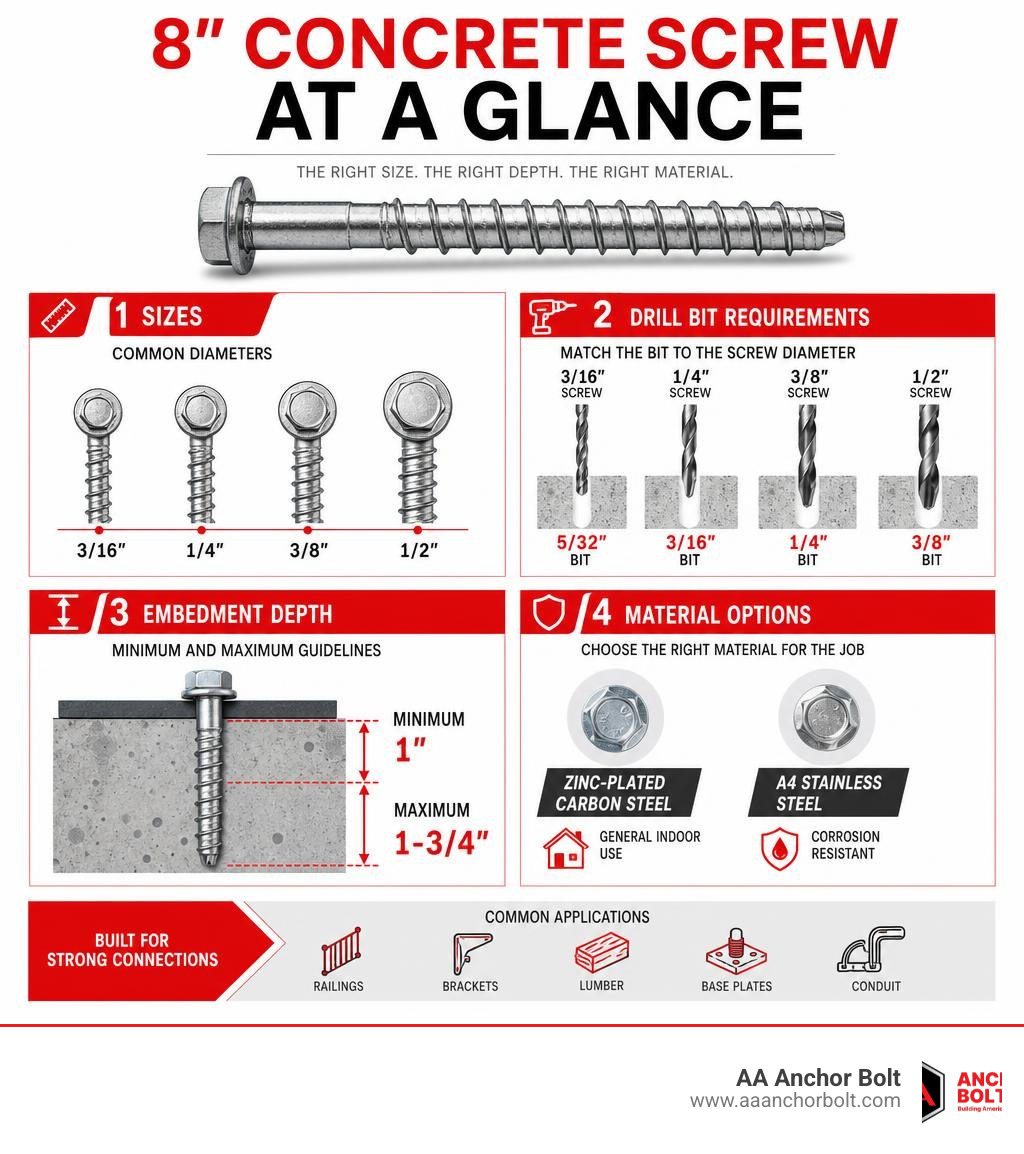
| Common diameters | 3/16″, 1/4″, 3/8″, 1/2″ |
| 8mm screw drill bit size | 8mm carbide-tipped bit |
| 3/16″ screw drill bit size | 5/32″ bit |
| 1/4″ screw drill bit size | 3/16″ bit |
| Minimum embedment depth | 1 inch |
| Maximum embedment depth | 1-3/4 inches |
| Common materials | Zinc-plated carbon steel, A4 stainless steel |
| Typical applications | Railings, brackets, lumber, base plates, conduit |
Concrete screws work by cutting their own threads directly into a pre-drilled hole. No expansion sleeve. No adhesive. The screw’s hardened threads mechanically lock into the base material as you drive it in.
That’s what makes them fast to install — and why getting the wrong size or material causes real problems on a job site. Stripped threads, failed connections, or corroded fasteners mid-project are costly mistakes that tight schedules can’t absorb.
Whether you’re securing base plates, attaching ledger boards, or mounting safety rails into a concrete substrate, understanding the specs upfront saves time and rework.
What is an 8 Concrete Screw and How Does It Work?
When professionals in the construction industry talk about an 8 concrete screw, they are generally referring to one of two things: an 8mm diameter concrete screw (highly popular in metric-specified commercial projects) or a heavy-duty 8-inch structural concrete screw anchor designed to secure thick wood ledgers or steel plates to foundation walls.
At AA Anchor Bolt, we understand that anchoring to masonry requires absolute precision. Whether you are using standard off-the-shelf fasteners or leveraging our custom Manufacturing Capabilities to build custom structural solutions for massive infrastructure projects in Michigan and across the USA, the fundamental physics of thread-cutting screws remain the same.
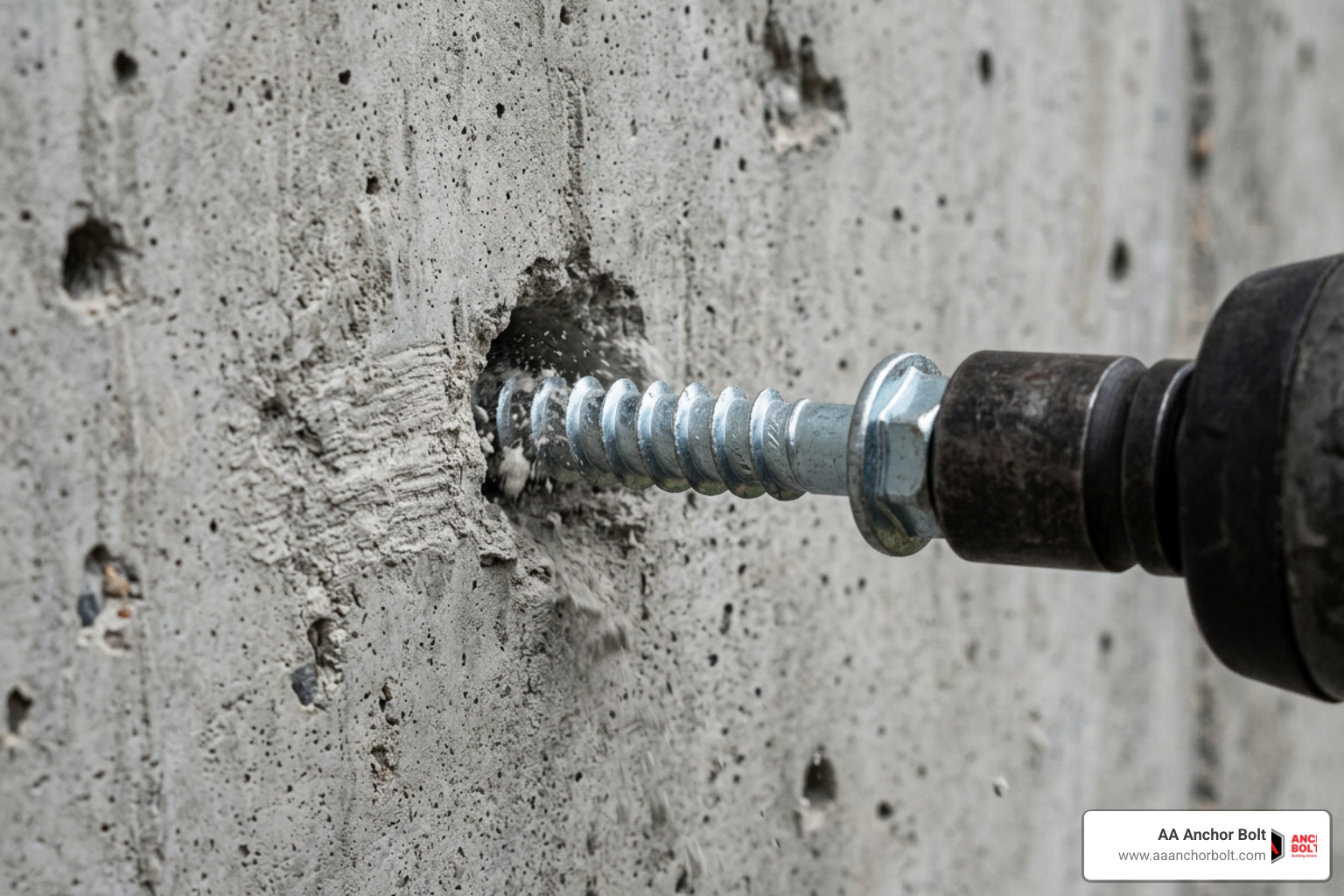
Unlike traditional expansion anchors that rely on outward radial pressure to friction-grip the sides of a pre-drilled hole, a concrete screw functions via direct mechanical interlock. The screw features hard, sharp, and often serrated threads that physically cut into the masonry substrate.
When driven into concrete, solid brick, or hollow block, the screw carves a neat, matching channel into the walls of the hole. This thread-cutting action distributes the load along the entire embedded length of the fastener, providing exceptional holding power without the high localized stress caused by expansion anchors.
How Thread-Cutting Screws Grip Masonry Substrates
The secret to the concrete screw’s success lies in its undercutting action. As the screw is driven in, the hardened lead threads shave away a small amount of the masonry, creating an expansion-free anchorage. Because there is no outward expansion force pushing against the surrounding material, you can install concrete screws much closer to the edge of a slab or closer to adjacent anchors without risking cracking or blowout.
This low edge-distance and narrow-spacing capability makes them an indispensable choice for mounting railing posts, structural steel base plates, and facade brackets.
Standard Masonry Screws vs. Heavy-Duty Structural Anchors
It is crucial to distinguish between standard, light-duty masonry screws and heavy-duty structural anchors.
- Standard Masonry Screws: Typically available in 3/16″ and 1/4″ diameters, these light-duty fasteners are perfect for attaching electrical junction boxes, conduit clips, furring strips, or light fixtures to brick or block walls. You will often see these sold as classic blue-coated screws.
- Heavy-Duty Structural Anchors: When you step up to larger diameters — such as 3/8″, 1/2″, or even metric 8mm, 10mm, and 12mm options — you are dealing with structural-grade concrete screw anchors. These are designed to carry substantial tension and shear loads.
High-performance options provide the heavy-duty structural performance required for safety-critical applications. For standard light-duty projects, you can browse retail options or check out specialized suppliers to find the right length and diameter for your everyday needs.
Choosing the Right Size, Head Style, and Material
Selecting the perfect concrete screw requires balancing the load demands of your project, the environmental conditions of the job site, and the physical constraints of the fixture itself.
| Screw Type / Material | Common Head Styles | Best For | Corrosion Resistance |
|---|---|---|---|
| Zinc-Plated Carbon Steel | Hex Washer, Flat Countersunk | Dry indoor applications, temporary bracing | Low (indoor only) |
| A4 / 316 Stainless Steel | Hex Washer, Torx / Star Flat | Outdoor, damp, marine, or highly corrosive areas | High (C5 corrosion category) |
| Special Coated Carbon Steel | Hex Washer, Pan Head | Outdoor construction, light structural framing | Medium-High (special coatings) |
Corrosion Resistance in Outdoor and Damp Environments
If your project is located outdoors, in a damp basement, or in an industrial environment, corrosion resistance must be your top priority. Standard zinc-plated steel screws will rust quickly when exposed to moisture, leading to structural degradation and eventual failure.
For highly corrosive environments, look for A4 stainless steel anchors. A4 stainless steel offers outstanding protection against rain, salt spray, and industrial pollutants. In fact, high-end zinc-coated and stainless options are tested to DIN EN ISO 9227, achieving resistance ratings for corrosion category C5 (withstanding up to 4800 hours of salt spray testing).
If you are working in a dry, covered indoor space, a standard zinc-plated option will provide excellent, cost-effective performance.
Head Styles and Drive Types for Specific Applications
The head style you choose determines how flush the fastener sits against your fixture and what tools you will need to drive it:
- Hex Washer Head: This is the workhorse of concrete screws. The built-in washer distributes clamping force evenly across the fixture. It is driven using a standard socket or nut driver (such as an SW13 socket for 8mm screws), making it incredibly easy to drive with a high-torque impact wrench without slipping.
- Flat Countersunk Head: When you need a completely flush finish — such as when fastening wood sills, thresholds, or door frames to concrete — countersunk heads are the way to go. These flat heads typically utilize a Torx or star drive to prevent cam-out during high-torque installation. For light-duty flush-mount projects, star flat-head concrete anchors offer clean, reliable installation.
Installation Guide and Hole Size Specifications
Installing concrete screws is straightforward, but it leaves very little room for error. Because these fasteners cut their own threads, drilling the exact hole diameter and depth is critical. If the hole is too small, the screw will bind, snap, or strip. If the hole is too large, the threads won’t have enough material to bite into, severely compromising the anchor’s holding capacity.

Installation Best Practices for an 8 Concrete Screw
Follow these step-by-step best practices to ensure a flawless installation every time:
- Mark and Drill: Use a rotary hammer drill equipped with a high-quality, carbide-tipped masonry drill bit. Keep the drill straight and steady. Do not use a standard non-hammer drill, as it will overheat and glaze the concrete rather than pulverize it.
- Drill Past the Embedment Depth: Always drill the hole at least 1/2″ deeper than the intended embedment depth of the screw. This extra space acts as a dust reservoir. When the screw cuts threads, concrete dust is pushed forward; if there is no extra space at the bottom, the screw will bottom out and snap before sitting flush.
- Clean the Hole (When Required): For standard screws, blow out the concrete dust using a hand pump, compressed air, or a vacuum. However, some advanced fasteners featuring specialized saw tooth geometry are approved for installation without hole cleaning in vertical ceilings or floors (as gravity naturally clears the hole or the screw is designed to handle the dust displacement).
- Drive the Screw: Use an impact wrench or a hand wrench to drive the screw through the fixture and into the hole. Finish the last few turns carefully. Do not over-torque, as you can strip the newly cut masonry threads.
Hole Size and Drill Bit Requirements
Always match your drill bit to the manufacturer’s exact specifications.
- 3/16″ Concrete Screws: Require a 5/32″ diameter drill bit.
- 1/4″ Concrete Screws: Require a 3/16″ diameter drill bit.
- 8mm Concrete Screws: Require an 8mm drill bit. High-performance 8mm concrete screws explicitly require an 8mm drill bit to match their outer thread geometry.
For high-performance metric installations where corrosion resistance and ease of installation are paramount, specialized concrete screws feature advanced coatings and precise dimensional tolerances to ensure maximum thread engagement with minimal driving torque.
Holding Values, Load Capacities, and Structural Ratings
When engineering a connection, you must look at both tension (pull-out) and shear (side-to-side) load capacities. The load capacity of a concrete screw is not a static number; it is heavily dependent on several critical variables.
Understanding the Load Capacity of an 8 Concrete Screw
The structural capacity of a concrete screw relies on:
- Embedment Depth: The deeper the screw is embedded, the more concrete it engages. Standard light-duty concrete screws require a minimum embedment of 1″ and a maximum of 1-3/4″ to prevent stripping the concrete during installation. Heavy-duty structural screw anchors can go much deeper, with nominal embedment depths ranging from 50mm to over 110mm.
- Compressive Strength of the Concrete: Harder concrete (measured in PSI or concrete classes like C20/25 up to C50/60) provides stronger material for the threads to grip, directly increasing pull-out resistance.
- Cracked vs. Non-Cracked Concrete: Structural concrete naturally develops micro-cracks under load. High-performance concrete screws are specifically tested and ETA-approved for use in cracked concrete and under seismic load conditions (categories C1 and C2).
- Fire Resistance: In commercial and infrastructure projects, safety compliance is non-negotiable. Leading concrete screw anchors are rated for fire resistance class R 120, ensuring they can maintain their structural integrity for up to 120 minutes in the event of a fire.
When to Use Large-Diameter and Heavy-Duty Anchors
While 3/16″ and 1/4″ masonry screws are fantastic for light-duty utility work, they are not designed to support structural steel columns, heavy machinery, ledger boards, or highway guardrails.
For heavy-duty structural applications, large-diameter concrete screw anchors (such as 1/2″ or 3/4″ diameters) are required. These heavy-duty anchors provide massive shear and tension capacities, often replacing traditional wedge anchors or sleeve anchors due to their rapid, dust-free installation and easy removal.
When your project demands robust, custom structural fasteners engineered to exact North American standards, explore our comprehensive range of structural Products, or order our high-strength F1554 Anchor Bolt configurations to secure heavy steel columns and industrial framing to concrete foundations.
Frequently Asked Questions About Concrete Screws
What is the minimum and maximum embedment depth for concrete screws?
For standard light-duty concrete screws (like 3/16″ and 1/4″ sizes), the recommended minimum embedment depth is 1″, and the maximum is 1-3/4″. If you embed them shallower than 1″, they will not have enough thread engagement to hold the load. If you try to drive them deeper than 1-3/4″, the torque friction becomes so high that the screw head will likely shear off, or the masonry threads will strip out entirely. For heavy-duty structural anchors, always consult the manufacturer’s spec sheet, as they allow for much deeper embedment depths.
Do you need to clean the drill hole before installing concrete screws?
For standard concrete screws, yes — cleaning the hole is absolutely vital. If concrete dust remains in the hole, the screw will compress it as it is driven in, causing the screw to bind and snap before it is fully seated. However, modern high-performance concrete screws designed with advanced saw tooth geometry are approved for installation without cleaning, specifically when drilling vertically into ceilings or floors, where dust either falls out naturally or is accommodated by the screw’s thread design.
Can concrete screws be reused or adjusted after installation?
Standard concrete screws should never be reused in the same hole once removed, as the thread-cutting action permanently deforms the masonry inside the hole. Reinserting a screw into a used hole results in significantly reduced holding power. However, high-quality structural concrete screws with specific approvals are allowed to be backed out up to two times to adjust the thickness of the fixture or base plate, provided the total embedment depth is maintained and the screw is not completely removed.
Conclusion
Finding the right concrete screw is all about matching your load requirements, environmental exposure, and installation constraints to the correct fastener. From light-duty utility projects using standard 3/16″ masonry screws to massive structural designs requiring heavy-duty 8-inch screw anchors, selecting high-quality, code-compliant fasteners ensures your work stands the test of time.
At AA Anchor Bolt, we pride ourselves on being a Michigan-based, family-owned manufacturer of custom anchor bolts and specialty fasteners. With nearly a million pounds of in-house steel and complete domestic production control at our Northville, MI facility, we deliver lightning-fast turnarounds for all your heavy-duty construction and infrastructure needs across the USA.
Need custom fasteners or expert anchoring advice? Learn more about our specialized Services, or contact us today to Order F1554 Anchor Bolts for Heavy-Duty Construction. We are here to help you hold on tight!