Navigating Airport Bolt Pickups Like a Pro
Why the Right U-bolt for Airport Infrastructure Can Make or Break Your Project
A U-bolt for airport applications isn’t just a generic fastener you grab off a shelf. In aviation environments, the wrong bolt — or a poorly installed one — can compromise lighting systems, signage, and perimeter structures that directly affect safety and FAA compliance.
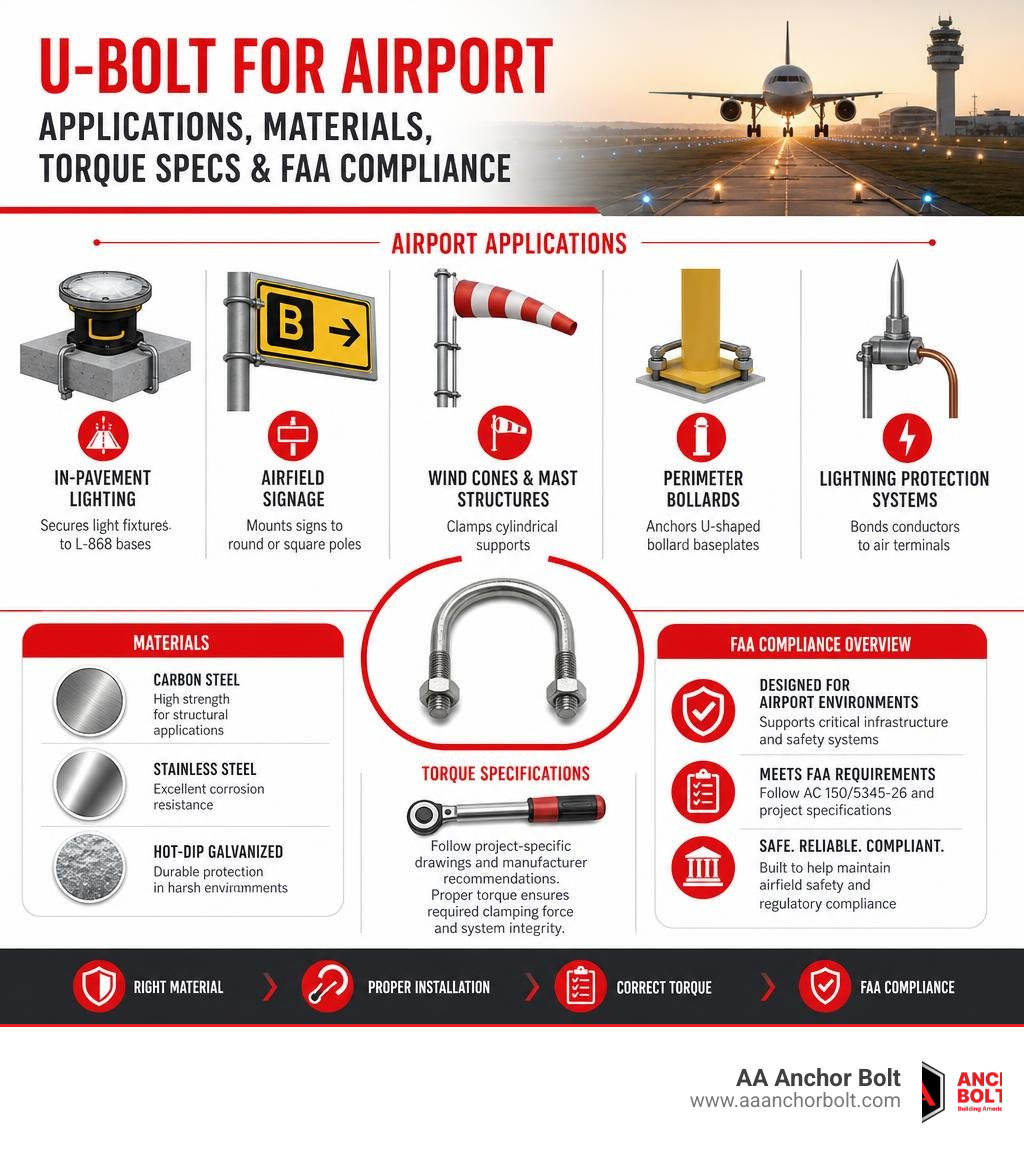
Here’s a quick overview of the most common U-bolt uses at airports:
| Airport Application | U-bolt Role | Key Requirement |
|---|---|---|
| In-pavement lighting | Secures light fixtures to L-868 bases | Min. 4,900 lb clamping force per bolt |
| Airfield signage | Mounts signs to round or square poles | Corrosion-resistant material |
| Wind cones and mast structures | Clamps cylindrical supports | High-strength, weather-rated fasteners |
| Perimeter bollards | Anchors U-shaped bollard baseplates | 5/8″ anchor bolts, Schedule 40 steel |
| Lightning protection systems | Bonds conductors to air terminals | UL Listed, UL 96A / NFPA 780 compliant |
For Midwest infrastructure contractors, the pressure is real. Tight deadlines, strict FAA standards, and limited local supply of custom fasteners all stack up fast. Getting the right U-bolt spec — correct material, coating, thread, and size — before you’re on-site is the difference between a smooth install and a costly delay.
This guide walks you through every step: selecting the right U-bolt, understanding torque and clamping requirements, choosing corrosion-resistant materials, and staying compliant with FAA standards.
Sourcing the Right U-bolt for Airport Infrastructure
When sourcing structural hardware for major transportation hubs, standard off-the-shelf components rarely cut it. Airport environments demand precise engineering, whether you are retrofitting existing security zones or constructing brand-new terminal expansions. Here in Michigan, we know that timing is everything. Just like arranging a ride to Detroit Metropolitan Airport (DTW) using the Northville Airport Car Service to DTW or booking an Uber via How to get from Northville, MI to Detroit Airport (DTW) – Uber, coordinating your heavy construction hardware deliveries requires absolute punctuality.
At AA Anchor Bolt, we manufacture our specialty fasteners right here in Northville, Michigan, ensuring that your structural components arrive exactly when your crew needs them. Our extensive catalog of custom-manufactured Products is designed to meet the rigorous demands of municipal and aviation engineering specs.
Sourcing a high-quality U-bolt for airport use requires looking beyond basic dimensions. You must evaluate the exact structural role the bolt will play, the wind loads it will endure, and the physical stress from passing aircraft and service vehicles.
Key Applications of a U-bolt for Airport Lighting and Signage
Airfield lighting and directional signage are the guiding eyes of any runway. From taxiway edge lights to massive elevated runway signs, these systems must remain perfectly aligned under extreme conditions.
- Runway and Taxiway Lighting: Elevated airfield lights are often mounted on support poles or bases secured by heavy-duty U-bolts. These fasteners must withstand high vibration from jet blasts without backing off.
- Wind Cones and Meteorological Equipment: Wind cones (windsocks) and weather monitoring stations rely on cylindrical mast structures. A heavy-duty U-bolt for airport weather stations securely clamps these masts to their concrete-anchored base plates.
- Airfield Signage: Directional signs must be anchored firmly to round or square metal posts. Standard U-bolts provide a wrap-around grip that prevents the signs from rotating or shifting when blasted by turbine exhaust.
For in-pavement lighting fixtures, engineers rely on strict guidelines. The standard reference, FAA Engineering Brief 83A, details the precise physics required to keep light bases flat and secured under the crushing wheel loads of modern commercial aircraft. While in-pavement lights use flange-mounting bolts rather than traditional U-shaped fasteners, the engineering principles of clamping force, vibration resistance, and thread integrity remain identical across all airfield fastening systems.
Selecting a Heavy-Duty U-bolt for Airport Security and Bollards
Airport perimeters, terminal entrances, and cargo bays require robust physical security barriers to protect pedestrians and sensitive infrastructure from vehicle impacts.
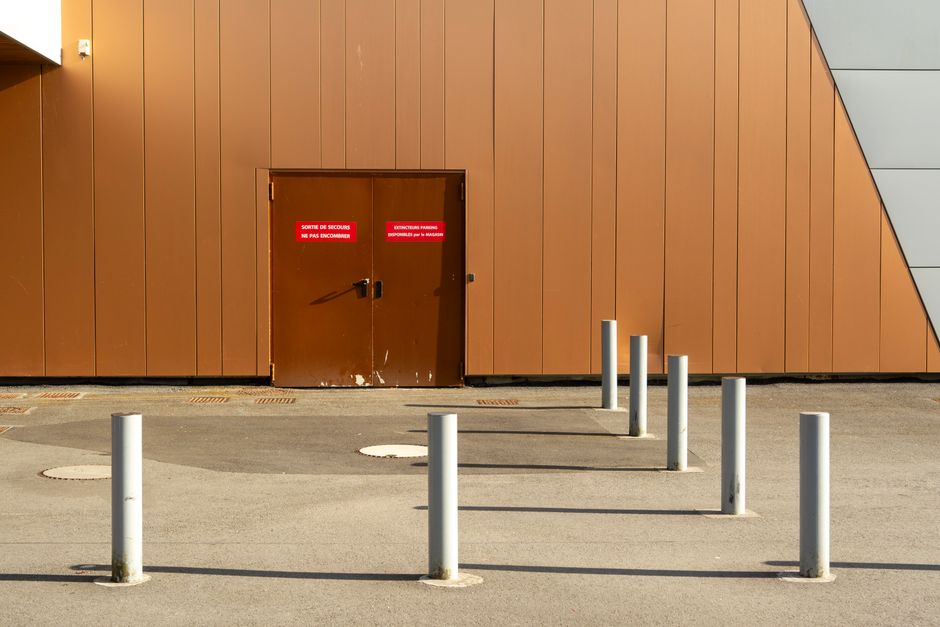
- U-Shaped Bollards: Many modern airport parking garages, storefronts, and fuel storage zones utilize U-Shaped Bolt-Down Bollards – Affordable Alternative to Horseshoe Style. These heavy-duty barriers are constructed from Schedule 40 carbon steel pipes with welded baseplates. They are anchored to concrete surfaces using robust 5/8-inch anchor bolts through predrilled holes, providing wide-span protection that is highly cost-effective compared to traditional bent-pipe horseshoe bollards.
- Security Gates and Fencing: Perimeter chain-link fences and automated security gates use industrial-grade U-bolts to secure hinges, latch mechanisms, and post connectors.
- Traffic Control Barriers: During runway maintenance or terminal construction, temporary traffic control is vital. Low-profile, high-visibility barriers like the Low Profile Airport Barrier – U.S. Barricades® are deployed to guide airfield traffic safely. While these water- or sand-ballasted polyethylene barriers are designed for rapid deployment without heavy machinery, permanent perimeter gates and signposts adjacent to them rely on deeply anchored U-bolts to maintain structural integrity.
Materials, Coatings, and Corrosion Resistance in Aviation Environments
Aviation environments are notoriously harsh. Fasteners are constantly exposed to deicing chemicals (such as potassium acetate and sodium formate), runway salts, jet fuel exhaust, dramatic temperature swings, and heavy moisture. Without the proper material selection and protective coatings, galvanic corrosion can rapidly degrade a fastener, leading to catastrophic structural failure.
When matching the right bolt to your project, it is helpful to look at the structural standards of the industry. For instance, our F1554 Anchor Bolt selections are widely utilized in heavy civil construction to anchor structural steel columns, light poles, and overhead sign bridge structures. The same structural integrity required by ASTM F1554 must be applied to custom U-bolts used in airport security and lighting installations.
To combat corrosion, engineers generally specify two primary material paths:
1. Stainless Steel (Grade 304 and 316)
Stainless steel is highly favored for its inherent resistance to atmospheric corrosion. Grade 316, which contains molybdenum, is particularly effective in coastal airport environments where saltwater spray accelerates rust.
- Lightning Protection: For mission-critical lightning protection, systems often use UL Listed Stainless Steel U-Bolts – LBA One Source. These specialty fasteners are UL Listed (compliant with UL 96A and NFPA 780) and provide a 1-1/2 inch secure surface contact area to bond lightning conductors directly to structural pipes and air terminals.
- High-End Terminal Protection: Major aviation hubs prioritize stainless steel for its aesthetic longevity and clean appearance. For example, terminal renovations often utilize stainless steel protective products to maintain pristine interiors and high-durability loading zones, as seen in the Project Spotlight: JFK International Airport- New York, NY – Pawling Corporation.
2. Hot-Dip Galvanized Carbon Steel
For heavy-duty structural applications requiring maximum tensile strength, hot-dip galvanized (HDG) carbon steel is the industry standard. The hot-dip galvanizing process coats the steel in a thick, durable layer of protective zinc. This zinc acts as a sacrificial anode, corroding before the underlying steel is affected.
- Galvanizing Quality Control: When threading galvanized U-bolts, precision is key. At AA Anchor Bolt, our in-house hot-dip galvanizing line allows us to control the entire process. We chase the threads after galvanizing to ensure clean, easy assembly without excess zinc buildup, preventing on-site installation headaches.
Installation Best Practices and Torque Specifications
Even the highest-quality U-bolt for airport applications will fail if it is improperly installed. Achieving the correct clamping force (preload) is critical to preventing fasteners from loosening under the intense vibrations of taxiing aircraft.
According to FAA Engineering Brief 83A, securing in-pavement light fixtures requires a minimum target clamping force of 4,900 pounds per bolt. This specification is calculated to withstand the massive wheel loads generated by heavy commercial aircraft, such as the Airbus A380-800.
To achieve this exact clamping force without over-stretching the bolt, installers must follow precise torque calculations. For example, a coated SAE J429 Grade 5 3/8-inch bolt requires approximately 27.8 foot-pounds of torque to safely achieve a 4,941-pound clamping force.
Crucial Installation Steps:
- Use a Calibrated Torque Wrench: Never rely on impact wrenches or standard air-driven tools for final tightening. Use a calibrated dial-type torque wrench (accurate to within 2%) to ensure even tensioning.
- Apply the Star Pattern: When tightening multi-bolt baseplates or light fixtures, always tighten the bolts in a star pattern rather than a circular sequence. This prevents uneven flange loading and warping.
- Apply Anti-Seize Compounds: Stainless steel is highly prone to thread galling (cold welding). Applying a high-quality anti-seize lubricant to clean, dry threads prevents galling and ensures accurate torque-to-tension conversion.
- Avoid Helical Split Washers: Traditional split-ring lock washers can flatten out or split under high loads, compromising the clamping force. Instead, use specialized two-part wedge-locking washers, and always replace them with brand-new washers whenever a bolt is removed for maintenance.
Our advanced Manufacturing Capabilities at AA Anchor Bolt allow us to chamfer rod ends and cut clean, precise threads. This eases the assembly of tapped hardware and guarantees functional, hassle-free field installation.
Comparing Mounting Solutions for Airport Infrastructure
| Mounting Solution | Tensile Strength | Corrosion Resistance | Installation Complexity | Primary Airport Use Case |
|---|---|---|---|---|
| Custom HDG U-Bolts | High | Excellent (Sacrificial Zinc) | Low (Simple wrenching) | Signposts, conduit, masts, gates |
| Stainless Steel U-Bolts | Medium-High | Superior (Inherent) | Medium (Galling risk) | Lightning protection, coastal zones |
| Standard Anchor Bolts | Very High | Variable (Coated/HDG) | High (Requires concrete pour) | Structural columns, heavy bollards |
| Horseshoe Bollards | High | Moderate | High (Bulky, welded pipe) | Heavy storefront protection |
Maintenance, Inspection, and FAA Compliance Standards
Airport infrastructure is subject to constant wear and tear. High-traffic areas, snowplow operations during Michigan winters, and routine runway maintenance can all inflict physical damage on exposed fasteners.
- Routine Inspection Intervals: FAA guidelines recommend inspecting critical airfield fasteners and in-pavement lighting fixtures every three months. Inspectors should check for signs of rust, thread stripping, loose nuts, or physical deformation.
- Immediate Replacement Rules: If an inspection reveals that 50% or more of the bolts on a specific fixture are damaged or loose, the entire set of fasteners for that fixture must be replaced immediately to maintain structural balance.
- Local Travel Connections: Ensuring that airport runways remain safe and compliant is vital for smooth travel. Whether students are heading to the University of Michigan via local transit options outlined in To and From the Airport – Campus Information – University of Michigan, or business travelers are flying out of West Michigan’s HOME | Ford Airport – IMT, runway safety starts with the smallest structural details.
Just as travelers rely on the seamless efficiency of ride-hailing apps like Bolt to get them to their terminals on time (which you can easily download on the Bolt: Request a Ride – Apps on Google Play or the Bolt: Request a Ride – App Store – Apple), airport maintenance crews rely on domestic manufacturers who can deliver high-quality replacement parts without delay. Keeping a local inventory of critical fasteners ensures that runways can be serviced quickly, minimizing flight delays and keeping travelers moving safely.
Frequently Asked Questions about Airport Fasteners
What are the FAA torque requirements for airport light fixtures?
The FAA recommends a minimum target clamping force of 4,900 pounds per bolt for in-pavement light fixtures to withstand heavy aircraft wheel loads. Achieving this force typically requires torquing a coated Grade 5 3/8-inch bolt to approximately 27.8 foot-pounds using a calibrated torque wrench.
How do you prevent galvanic corrosion on airport U-bolts?
To prevent galvanic corrosion (which occurs when dissimilar metals contact each other in the presence of an electrolyte like runway deicer), engineers use non-conductive isolation washers, specify matching materials (such as stainless steel bolts with stainless steel fixtures), or apply high-durability hot-dip galvanized coatings to carbon steel fasteners.
What are the lead times for custom domestic airport U-bolts?
Because we are a domestic, family-owned manufacturer based in Northville, Michigan, AA Anchor Bolt bypasses the lengthy delays associated with overseas shipping. With nearly a million pounds of raw steel kept in-house, we can manufacture, thread, bend, and galvanize custom U-bolts in a fraction of the time of traditional suppliers, providing rapid turnaround times for critical airport infrastructure projects.
Conclusion
When safety, structural integrity, and FAA compliance are on the line, choosing the right U-bolt for airport infrastructure is a decision that shouldn’t be left to chance. From runway lighting and directional signs to high-security perimeter bollards, every fastener must be engineered to withstand extreme vibrations, heavy loads, and corrosive environmental conditions.
At AA Anchor Bolt, we are proud to support Michigan and national infrastructure projects with high-quality, American-made fasteners. Our full domestic production control, massive raw material inventory, and in-house manufacturing capabilities mean we can deliver custom-engineered fasteners to your job site faster than anyone else.
Ready to secure your next airport project? Explore our full line of structural Products and let our family-owned team manufacture the exact hardware you need to get the job done right.