Find the Right UNF Bolt Thread Pitch for High-Stress Assembly
Why a 7/16-20 UNF Bolt Fits High-Stress Assemblies
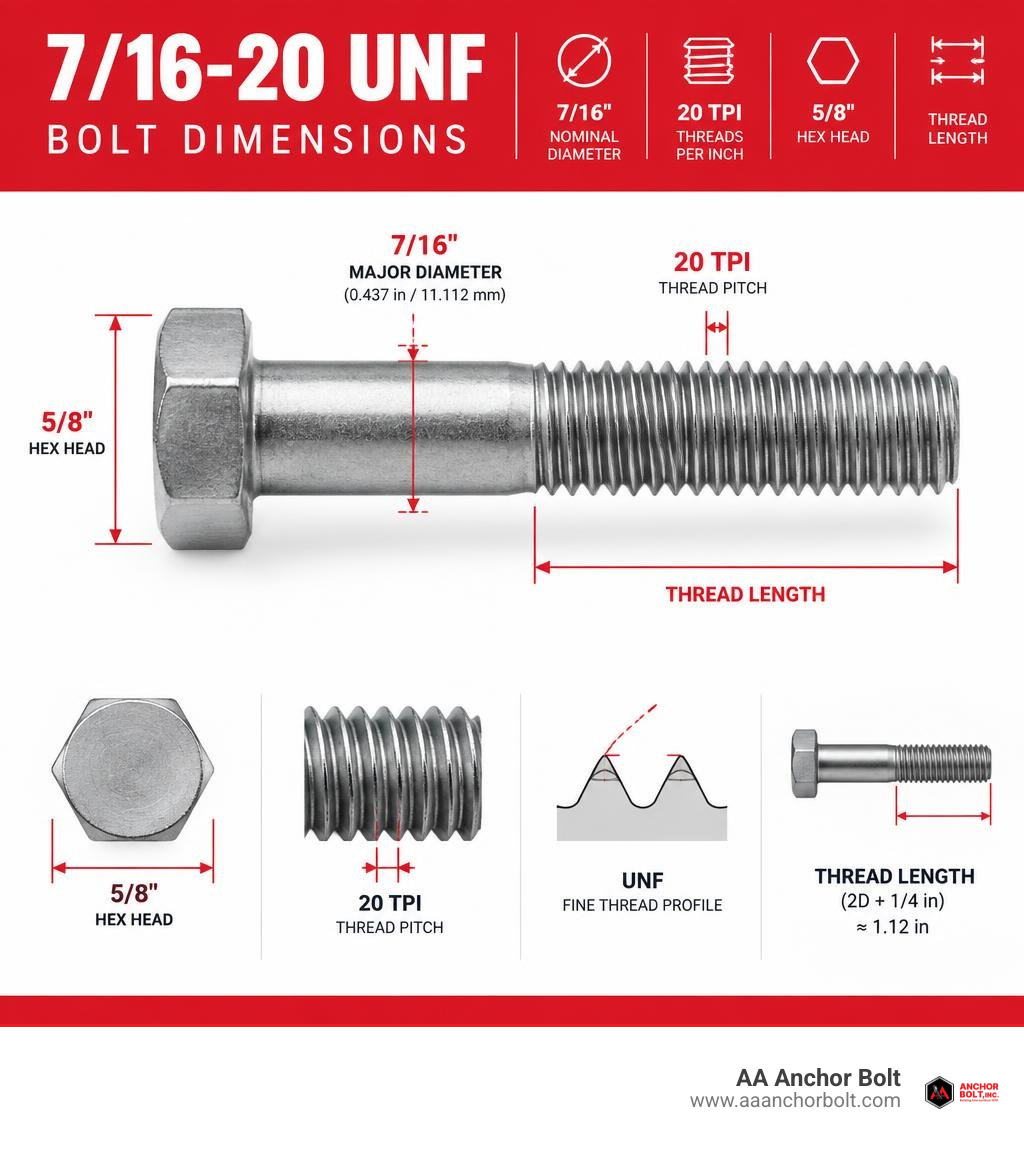
A 7/16-20 UNF bolt has a 7/16-inch nominal diameter and 20 threads per inch. Its major diameter is 0.437 in (11.112 mm), and a standard hex head takes a 5/8-inch wrench or socket. The fine UNF thread gives closer adjustment and strong thread engagement, making it a practical choice for machinery, vehicle, and vibration-prone steel assemblies.
For a standard partially threaded hex bolt, ASME B18.2.1 uses a thread-length formula of 2D + 1/4 in for bolts up to 6 inches long. At this diameter, that is about 1.12 inches of thread. The plain shank should span the shear plane when possible, rather than placing threads in the joint.
Choosing the right grade, coating, nut, washer, and installation torque matters as much as choosing the thread pitch. A Grade 5 bolt, for example, has a typical dry tightening value of 55 ft-lb, while Grade 8 is commonly tightened to 78 ft-lb under dry conditions.
I am Pauline Horton, and this guide breaks down the dimensions and selection details needed to specify this fine-thread fastener with confidence.
Engineering Specifications and Anatomy of the 7 16 20 UNF Bolt
When engineers specify threaded fasteners for critical industrial framing or heavy machinery, every fraction of an inch counts. Understanding the physical layout of a 7/16-20 fastener ensures that components seat flush, clamp loads remain predictable, and assembled joints survive dynamic fatigue.
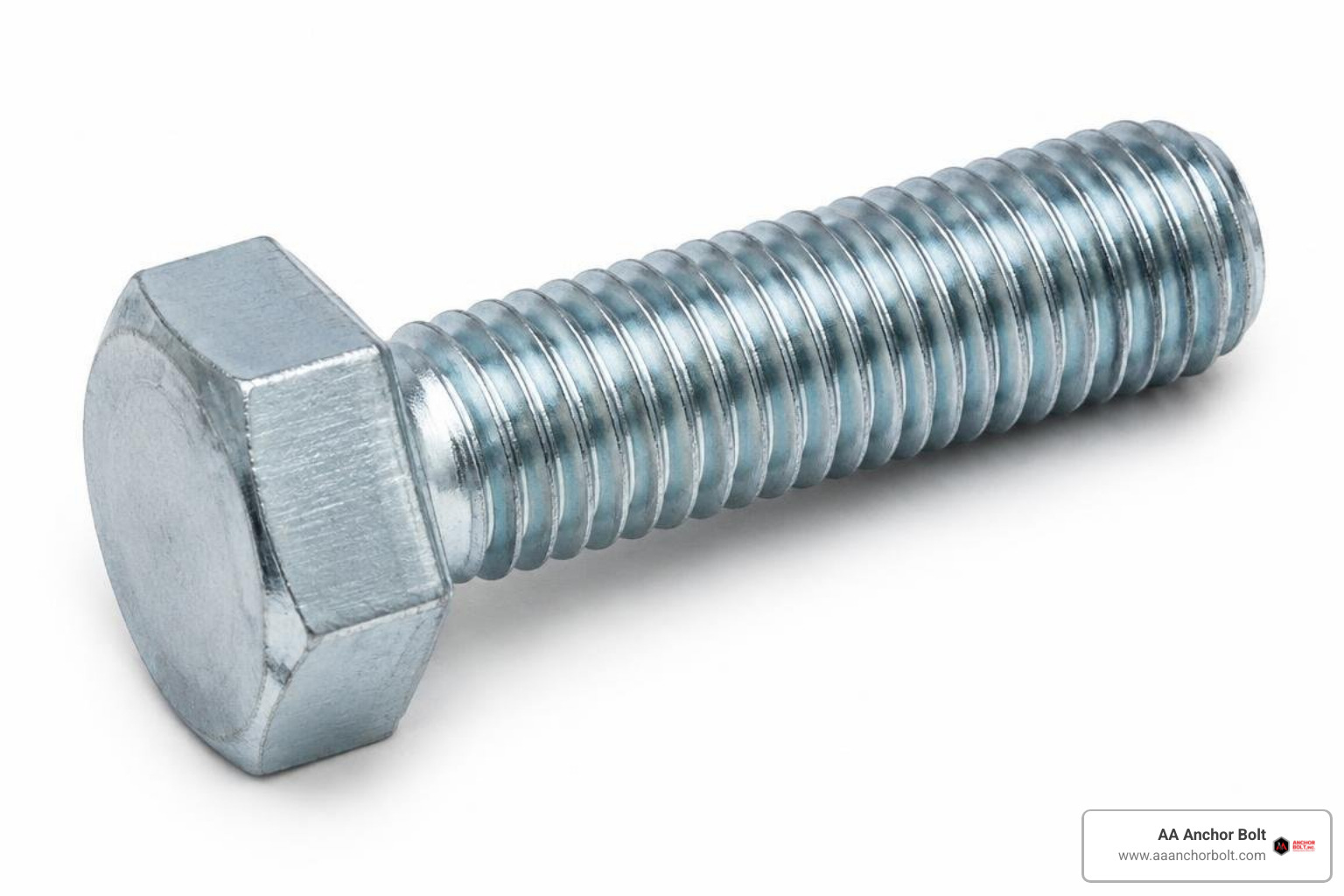
The basic architecture of a fine-pitch bolt relies on tightly controlled imperial machining tolerances. Under both American standards like ASME B18.2.1 and international references such as AS 2465, the nominal profile provides a high strength-to-diameter ratio. For projects needing precise hardware fitment, reviewing a dimensional breakdown of 7/16-20 fasteners offers a clear reference for production and field assembly.
Thread Profile, Major Diameter, and Pitch Dimensions
The primary dimensional values governing the thread geometry include:
- Nominal Major Diameter: 0.4375 in (11.112 mm), with practical manufacturing limits spanning 0.4300 to 0.4375 in (10.93 to 11.13 mm).
- Thread Pitch: 20 Threads Per Inch (TPI), corresponding to an axial thread pitch distance of 0.050 in (1.27 mm) per rotation.
- Pitch Diameter: Roughly 0.4050 in (10.287 mm), serving as the theoretical boundary where tooth thickness equals tooth space.
- Minor Diameter: 0.383 in (9.738 mm), forming the solid core diameter of the threaded segment.
- Thread Geometry: Standard 60-degree Unified National thread angle with radiused roots to minimize stress concentration points under tensile spikes.
Because fine threads have a shallower thread depth than coarse variations, the solid core of the fastener is thicker. This increased cross-sectional area gives the fastener greater tensile load capacity. When your application calls for non-standard lengths or unique materials beyond off-the-shelf catalog parts, specifying custom threaded rods and fasteners allows you to match exact clamp-length requirements without compromising load pathways.
Head Dimensions and Spanner Socket Size
The finished hex head on an imperial 7/16-20 bolt is engineered to withstand substantial driving torque without corner rounding:
- Width Across Flats (Wrench/Socket Size): Standard nominal 5/8 in (0.625 in / 15.875 mm), with typical tolerance bounds of 0.612 to 0.625 in (+0 / -0.022 in).
- Head Height: Nominal 0.297 in (7.541 mm), with standard production runs resting between 0.272 and 0.291 in (6.91 to 7.40 mm).
- Width Across Corners: 0.698 to 0.722 in (17.73 to 18.34 mm), defining the minimum rotational clearance needed inside recessed counterbores.
Using a correctly calibrated 5/8-inch six-point socket ensures maximum surface contact across the flats. An ill-fitting or worn tool risks rounding off the head corners, compromising your ability to reach target clamping preloads during installation.
Hex Bolt vs. Hex Set Screw: Choosing the Correct Configuration
In fastener terminology, the distinction between a hex bolt and a hex set screw (often referred to as a fully threaded tap bolt) comes down to thread coverage along the shank.
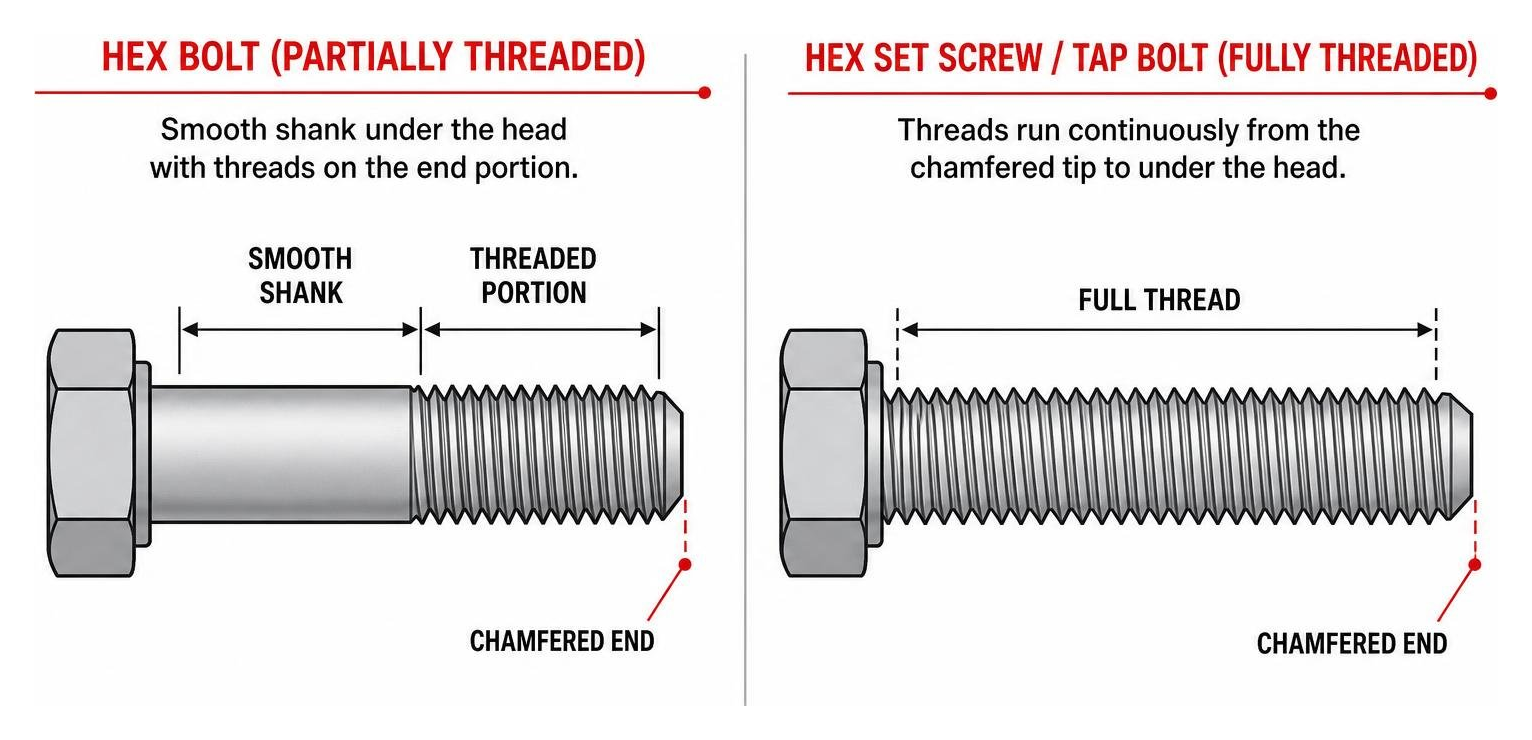
- Hex Bolt (Partially Threaded): Features a smooth, unthreaded cylindrical body beneath the head before transitioning into threads.
- Hex Set Screw / Tap Bolt (Fully Threaded): The thread runs continuously from the chamfered tip directly to the undercut below the hex head.
Why Shear Resistance Matters in a 7 16 20 UNF Bolt Shank
When bolted assemblies experience lateral force—such as wind shear on an exterior frame or cyclic side loads on an engine bracket—the bolt acts as a mechanical dowel pin.
A partially threaded shank provides a continuous, solid steel cross-section across the shear plane. In contrast, if the threaded section of a fully threaded screw aligns with the joint interface, the shear load bears against the reduced minor diameter (0.383 in). The root valleys also create localized notch effects that accelerate fatigue cracking under cyclic vibration. For heavy shear joints, always size the bolt length so that the unthreaded body spans the structural seam.
Standard Thread Length Calculation per ASME B18.2.1
Under ASME B18.2.1, standard thread lengths ($L_{th}$) for imperial hex bolts are established using direct dimensional formulas based on nominal bolt diameter ($D = 0.4375\text{ in}$):
- For Bolt Lengths $\le$ 6.00 inches: $$L_{th} = 2D + 0.25\text{ in} = 2(0.4375) + 0.25 = 1.125\text{ in (approx. 1.12 in / 28.58 mm)}$$
- For Bolt Lengths > 6.00 inches: $$L_{th} = 2D + 0.50\text{ in} = 2(0.4375) + 0.50 = 1.375\text{ in (34.93 mm)}$$
For example, a 7/16-20 x 3.5-inch partially threaded bolt features approximately 1.125 to 1.375 inches of usable thread, leaving a smooth grip shank of over 2 inches to bear clean shear loads across joined plates.
Materials, Grades, and Corrosion Protection Options
Material composition determines whether a bolt can survive corrosive weather, ocean spray, or extreme mechanical tension. When sourcing USA-made fasteners for infrastructure projects, matching the alloy chemistry and protective coating to the operating environment is critical for joint longevity.
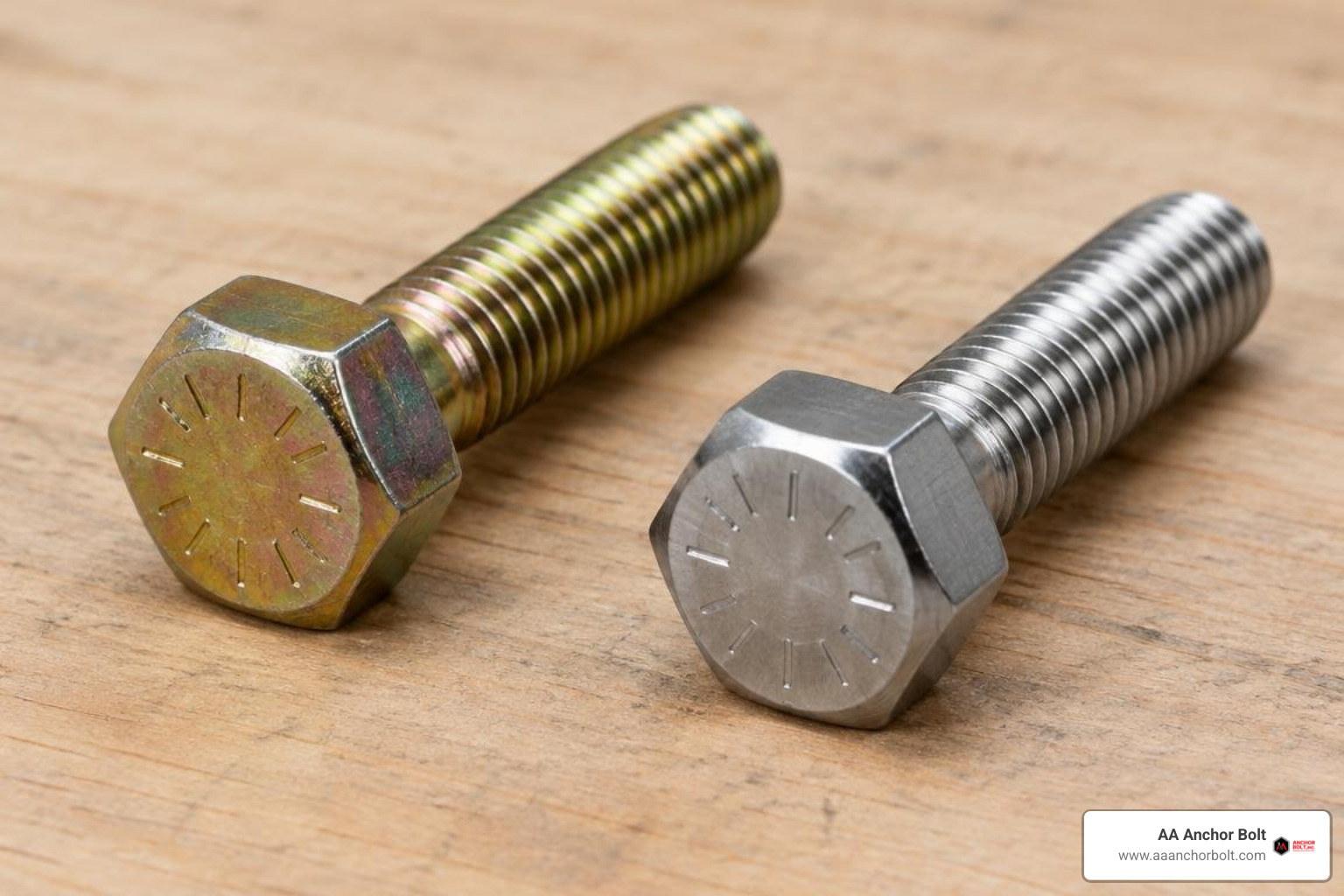
Carbon steel fasteners offer high mechanical strength and natural magnetic properties rooted in their iron core, whereas austenitic stainless steels provide chemical corrosion defense.
Comparing Carbon Steel Grade 5 and Grade 8 Strengths
Imperial carbon steel bolts rely on standardized SAE J429 property markings on the hex head:
- SAE Grade 2: Low or medium carbon steel. No radial head markings. Tensile strength: 74,000 PSI. Best for non-structural, light-duty utility mounting.
- SAE Grade 5: Medium carbon steel, quenched and tempered. Marked with 3 radial lines. Tensile strength: 120,000 PSI; Yield strength: 92,000 PSI; Proof load: 85,000 PSI. Ideal for general machinery and structural steel framing.
- SAE Grade 8: Medium carbon alloy steel, quenched and tempered. Marked with 6 radial lines. Tensile strength: 150,000 PSI; Yield strength: 130,000 PSI; Proof load: 120,000 PSI. The industry standard for heavy equipment, automotive drivetrains, and high-stress industrial joints.
Stainless Steel Alloys, A2/A4 Properties, and AccuBlack Coating
For wet, chemical, or outdoor conditions where electroplated zinc (which typically measures just 5 to 12 microns thick) would corrode prematurely, stainless steel alloys are the standard choice:
- A2-70 (AISI 304 / 18-8): Formulated with approximately 18% chromium and 8% nickel. Provides robust resistance against atmospheric moisture, freshwater, and general industrial environments with a tensile strength of 700 MPa (approx. 101.5 ksi). Bulk shipping weights hover around 4.02 kg per 100 units for a 1.75-inch bolt length.
- A4-70 (AISI 316 Marine Grade): Contains 16–18% chromium, 10–14% nickel, and 2–3% molybdenum. The molybdenum addition shields the metal lattice against chloride pitting, salt spray, coastal splash zones, and de-icing chemicals.
- AccuBlack Chemical Conversion: A specialized matte black chemical blackening applied directly to stainless steel. It retains the underlying base alloy’s corrosion resistance while eliminating surface glare and reflections for architectural fixtures, military gear, and optical assemblies.
Torque Specifications and Installation Best Practices for 7 16 20 UNF Bolt Assemblies
Achieving a durable joint depends on applying correct installation torque to stretch the bolt elastically, generating clamping force (preload) across the assembled parts.
Clamp Load Calculations for Dry and Lubricated Joints
Friction consumes roughly 85% to 90% of applied installation torque. Changing surface conditions from dry steel to a lubricated thread significantly alters the required torque to achieve the target clamp load.
Applying dry torque values to an anti-seize-coated bolt can overload the fastener past its yield point, causing permanent plastic elongation or premature tensile fracture. Always calibrate torque tools to match the joint lubrication state.
Preventing Thread Galling on Stainless Steel Hardware
Stainless steel alloys naturally develop a transparent, self-healing chromium oxide film that stops rust. However, during rapid mechanical tightening, friction can break down this oxide layer. The bare metal surfaces make direct microscopic contact, generating localized friction heat that causes the threads to cold-weld together—a failure known as thread galling or seizing.
To prevent galling on fine-pitch 7/16-20 stainless fasteners:
- Apply a quality anti-seize compound (nickel, copper, or PTFE base) to male threads before assembly.
- Use manual hand ratchets or throttle impact tools to low RPMs; high-speed friction immediately accelerates galling.
- Ensure mating threads are clean and free of metal shavings, grit, or sand.
- Never force a binding stainless nut; back it off immediately, clean the threads, reapply lubricant, and re-engage.
Comparing UNF Fine Thread and UNC Coarse Thread Performance
Fastener selection often comes down to choosing between 7/16-14 UNC (Coarse) and 7/16-20 UNF (Fine). While coarse threads are common in general construction for their fast assembly and tolerance for minor site grime, fine-pitch threads offer distinct mechanical advantages in high-stress installations.
Tensile Stress Area Advantages Under Vibration
The 7/16-20 fine thread profile features shallower thread cuts, leaving a minor diameter of 0.383 in compared to 0.360 in for coarse 7/16-14 threads. This gives the UNF fastener an effective tensile stress area of 0.1187 sq in—an 11.6% increase in usable solid steel over its UNC equivalent.
Additionally, the thread lead angle on a 20 TPI fastener is shallower ($1.27^\circ$) than on a 14 TPI bolt ($1.82^\circ$). Under dynamic vibration and cyclical transverse loads, the shallower ramp angle creates higher friction resistance against self-loosening, making fine-thread bolts a reliable choice for vehicle suspensions and vibrating machinery.
Matching Nuts, Washers, and Governing Standards
A high-tensile bolt is only as dependable as the mating components holding it together. For reliable field performance, follow these pairing rules when matching anchor bolt nuts and hardware:
- Nut Compatibility: Always match materials and property classes. A Grade 8 bolt requires an SAE Grade 8 finished hex nut to prevent thread stripping under proof load. For marine assemblies, choose matching 316 stainless nylon-insert locknuts.
- Washer Selection: Pair high-tensile Grade 8 bolts with ASTM F436 hardened steel flat washers. Soft, unhardened commercial washers can cup or deform under 78 ft-lb of torque, dissipating joint clamp load.
- Locking Mechanism Protocols: When using nylon-insert locknuts (Nyloc NE Series), treat them as single-use components. The internal nylon ring undergoes permanent deformation during initial thread cutting; reusing the nut reduces its prevailing breakaway torque. That nylon inserts are temperature-rated to 120°C (248°F) continuous use (150°C short-term).
- Cross-Standard Harmonization: While ASME B18.2.1 defines American imperial standards and AS 2465 governs Australian imperial equivalents, metric standards like DIN 931 apply to metric-shank fasteners (such as M11 equivalents). Always confirm thread pitch before mixing hardware on international equipment.
Frequently Asked Questions About 7/16-20 Fasteners
What wrench or socket size fits a 7/16-20 hex head?
A standard 7/16-20 hex head bolt per ASME B18.2.1 requires a 5/8-inch wrench or socket. The hex head measures 0.625 inches (15.875 mm) across the flats with a production tolerance of +0 / -0.022 inches. Always use a clean 5/8-inch six-point socket on high-torque assemblies to avoid rounding off the hex corners.
What is the tightening torque for a Grade 8 7/16-20 bolt?
For an SAE Grade 8 carbon alloy steel 7/16-20 bolt, standard tightening torque is:
- 78 ft-lb (106 Nm) under dry (unlubricated) joint conditions (friction factor $K \approx 0.20$).
- 58 ft-lb (79 Nm) under lubricated or anti-seize conditions ($K \approx 0.15$).
These settings achieve a reliable clamp preload of approximately 75% of the bolt’s minimum proof load yield point.
Can a Nyloc locking nut be reused on fine-thread bolts?
Reusing a Nyloc nut on fine-thread hardware is not recommended. The nylon collar deforms permanently as the bolt threads cut through it on first installation. While the nut will spin back onto the bolt, its prevailing torque drops significantly, increasing the risk of backing off under cyclical vibration.
Conclusion
The 7/16-20 UNF hex bolt provides an effective balance of tensile load capacity, fine-tuning capability, and vibration resistance for high-stress connections. By selecting the correct bolt length, positioning the smooth shank across the joint’s shear plane, and following proper torque procedures, you can build reliable joints that perform under demanding conditions.
From standard hex runs to specialized infrastructure hardware, our Michigan manufacturing facility maintains nearly a million pounds of prime domestic steel. We handle custom fabrication, bending, and threading in-house under tight quality control. To see our custom threading capabilities in action, explore our overview of industrial bolt threading machinery and fabrication capabilities or contact our team to quote your project.