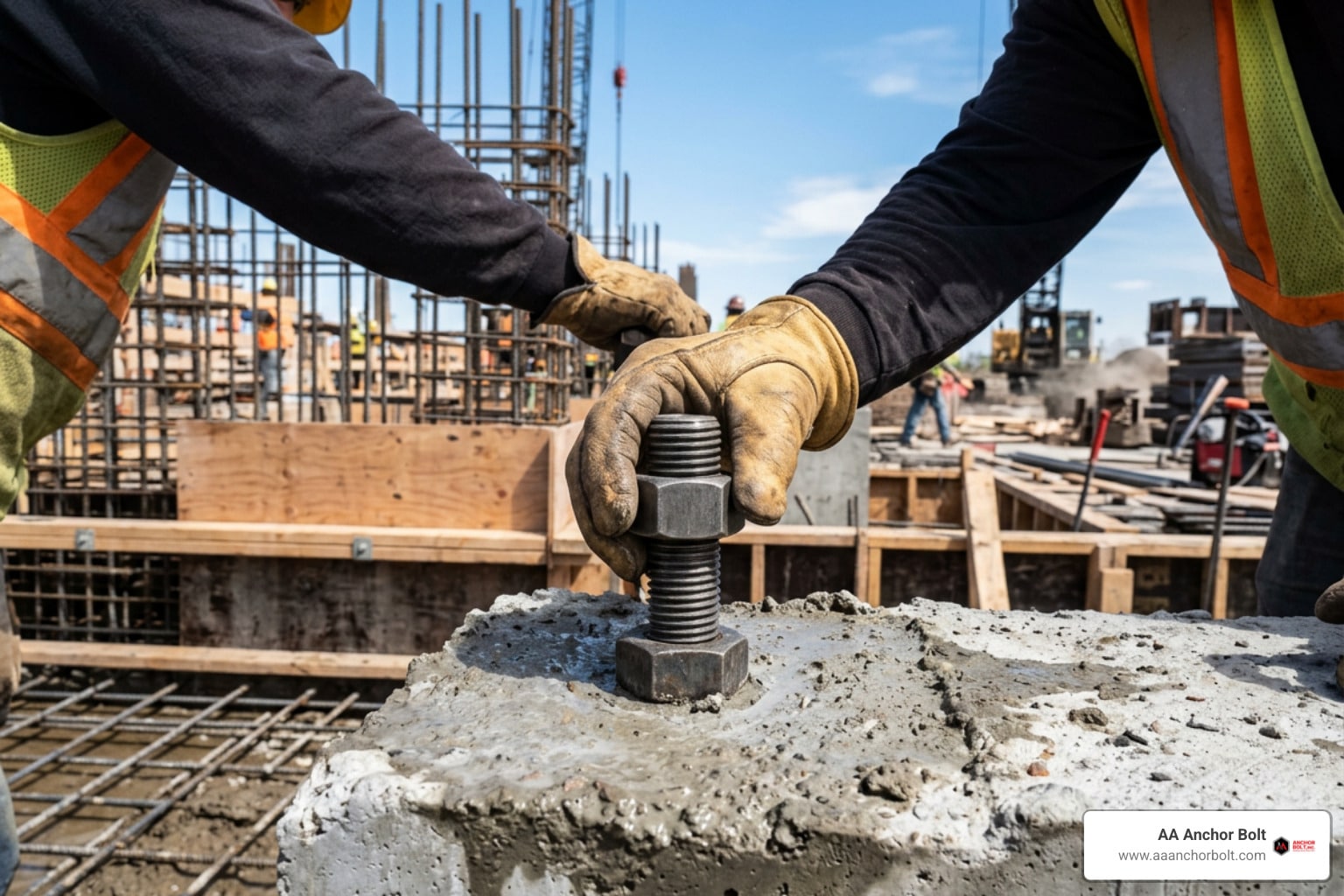
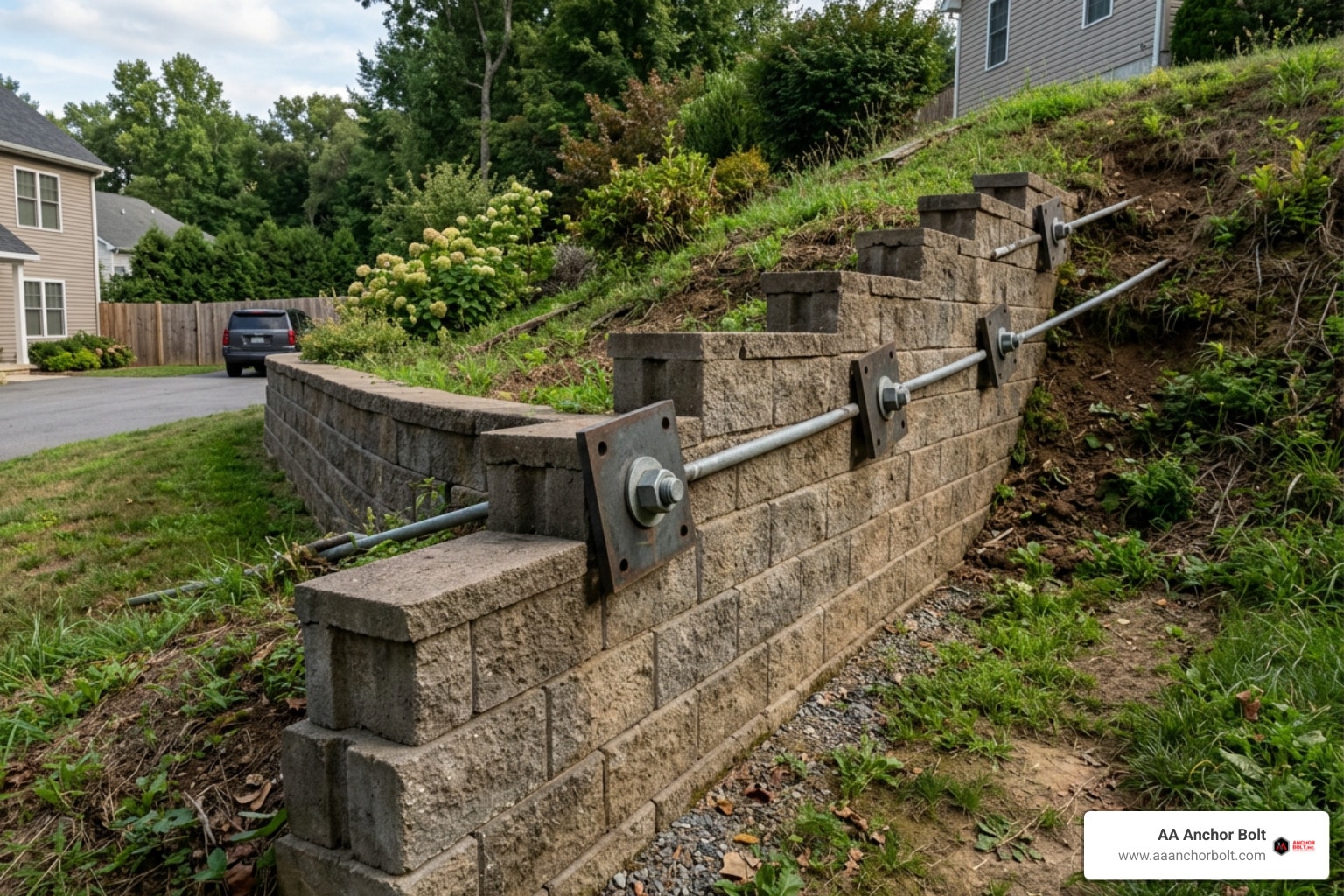
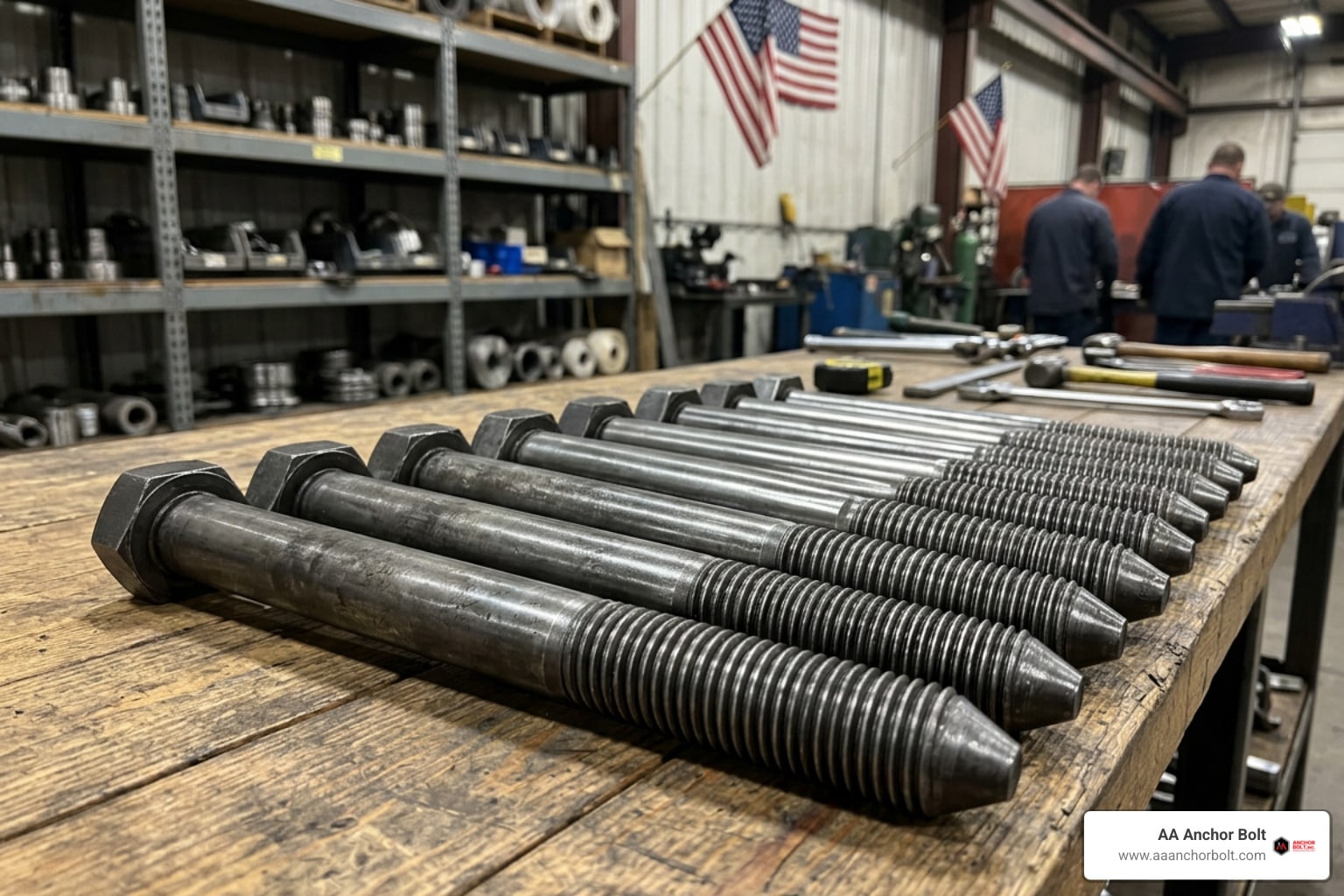
How Galvanized Expansion Anchors Keep Things Securely in Place
What You Need to Know About Galvanized Expansion Anchors
Galvanized expansion anchors are mechanical fasteners used to securely attach structural elements to concrete — and they’re coated with zinc to resist rust in outdoor, damp, or corrosive environments.
Here’s a quick summary if you’re in a hurry:
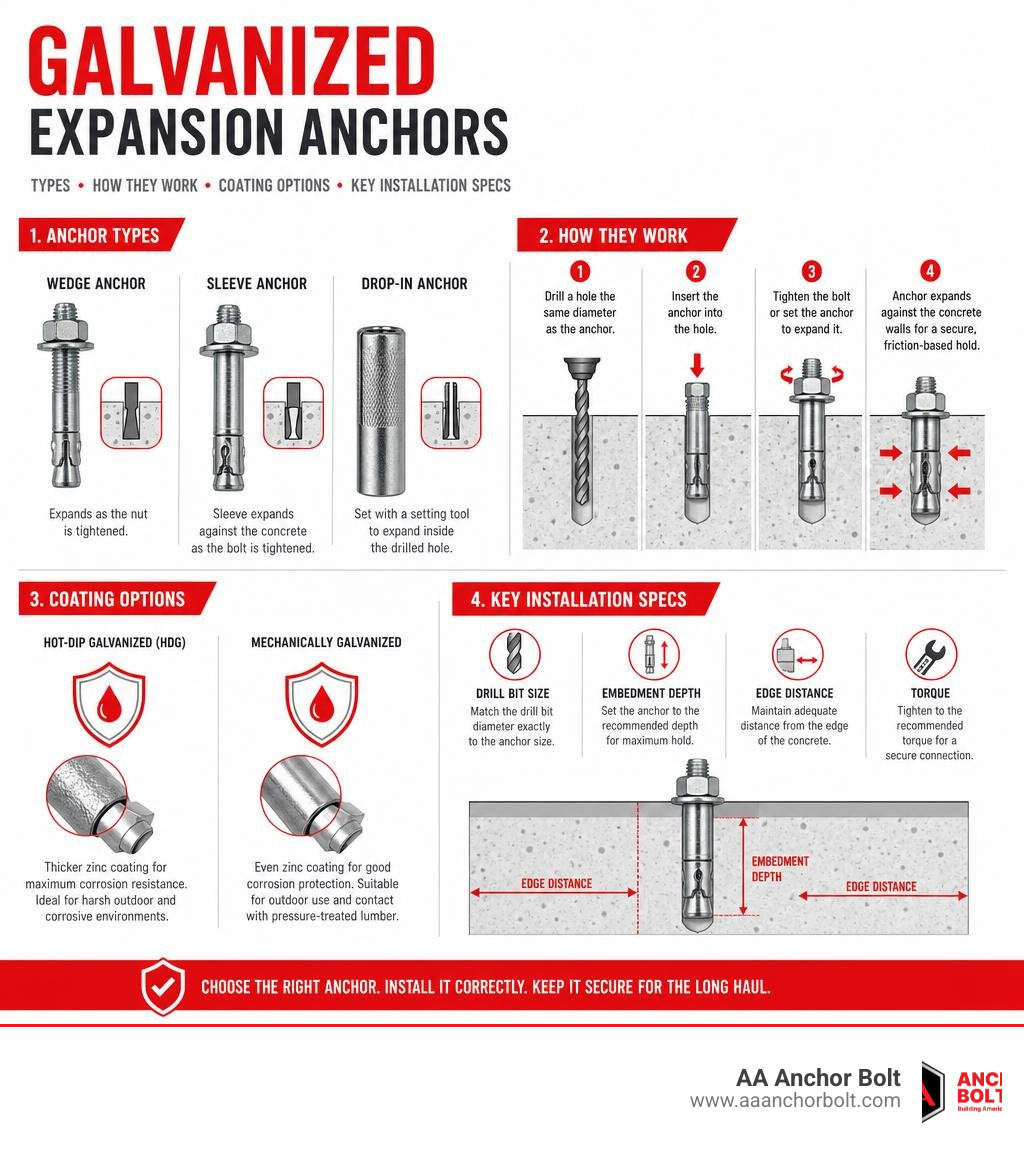
- What they are: Steel expansion anchors (wedge, sleeve, or drop-in style) with a zinc galvanized coating for corrosion protection
- How they work: They expand against the walls of a drilled concrete hole, creating a friction-based hold
- Where they’re used: Outdoor concrete fastening, structural steel connections, dock bumpers, handrails, equipment pads, and more
- Two main coating types: Hot-dip galvanized (HDG) for thicker protection, mechanically galvanized for outdoor and pressure-treated lumber contact
- Not for: Brick, hollow block, or cracked concrete (unless the anchor is specifically rated for it)
- Key specs to know: Drill bit size must match anchor diameter exactly; torque, embedment depth, and edge distance all matter for safe performance
Whether you’re anchoring structural steel columns to a concrete foundation or securing outdoor equipment to a slab, choosing the right galvanized anchor — and installing it correctly — is what keeps the connection safe and code-compliant for the long haul.
What are Galvanized Expansion Anchors and How Do They Work?
At its core, a galvanized expansion anchor is a heavy-duty mechanical fastener designed to create a permanent, high-strength hold in solid concrete. Unlike wood screws or drywall anchors that bite directly into the surrounding material, concrete is far too hard and brittle for direct threading. Instead, expansion anchors rely on a simple but incredibly powerful physical principle: friction.
When you install one of these anchors, you are placing a steel body into a pre-drilled hole and forcing a portion of that anchor to expand outward. This expansion creates immense lateral pressure against the interior walls of the hole, locking the anchor in place.
The “galvanized” part of the equation refers to the protective zinc coating applied to the steel. Carbon steel is incredibly strong, but when exposed to moisture and oxygen, it quickly oxidizes and rusts. By applying a layer of zinc, we create a sacrificial barrier that shields the underlying steel from corrosion, making galvanized expansion anchors the go-to choice for outdoor construction, coastal infrastructure, and damp environments.
How the Expansion Mechanism Operates
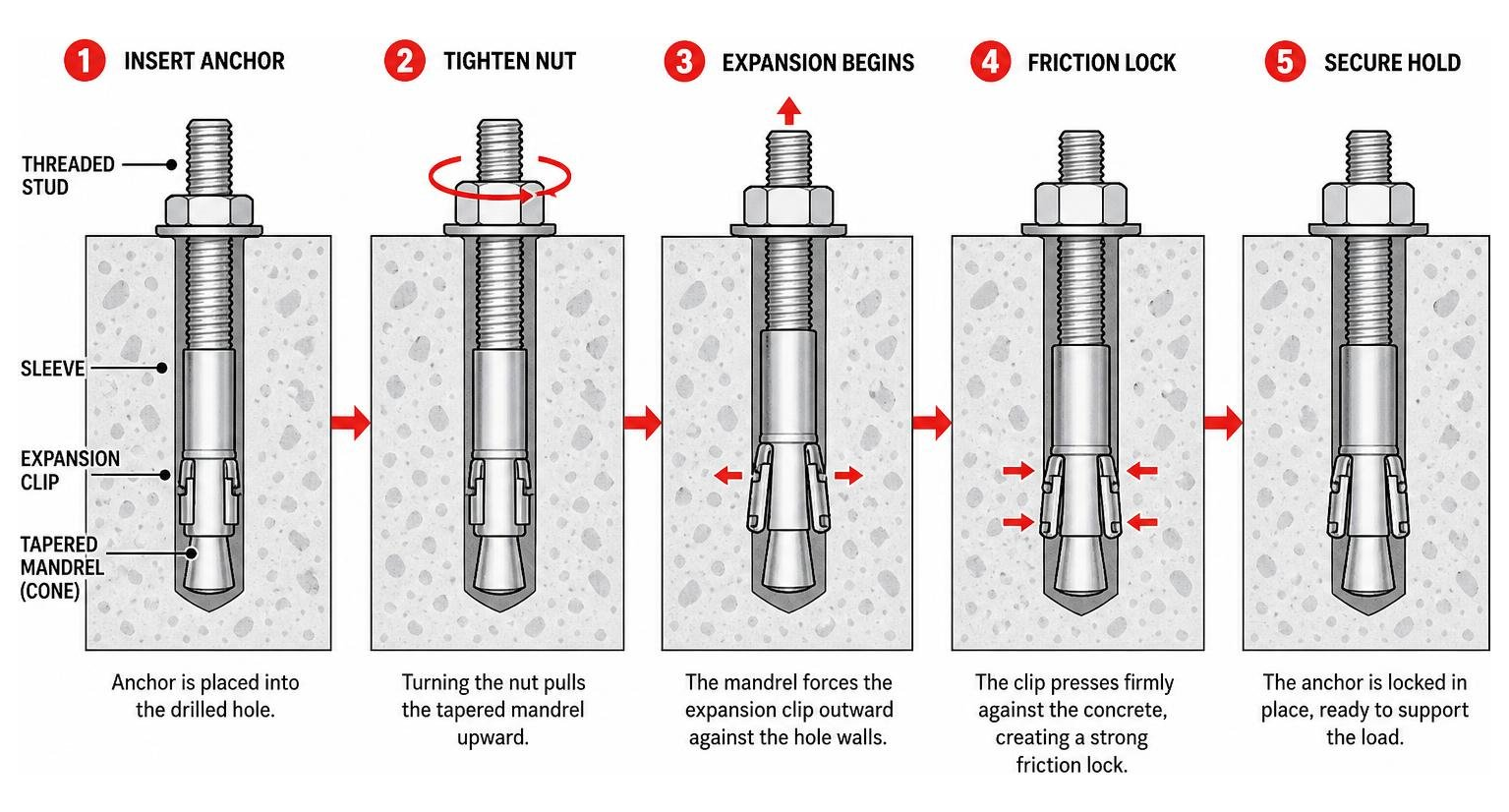
To understand how these fasteners achieve their massive holding power, let’s look at the mechanical components. A typical wedge-style expansion anchor consists of a threaded steel stud, a tapered mandrel (or cone) at the bottom end, and a small expansion clip wrapped around that mandrel.
Here is the step-by-step physics of how the friction lock is set:
- Insertion: The anchor is hammered into a pre-drilled hole. The expansion clip sits snugly against the walls of the hole.
- Tightening: As you turn the nut on the threaded end, the anchor body is drawn upward.
- Expansion: Because the expansion clip is held in place by friction against the concrete, the upward movement of the anchor forces the tapered mandrel directly through the clip.
- The Lock: The clip is forced outward, expanding to tightly wedge itself between the mandrel and the solid concrete wall.
This mechanical expansion converts tension (the upward pull-out force applied by tightening the nut or loading the fixture) into lateral expansion force. The harder you pull on the anchor, the tighter the clip wedges itself into the concrete. To ensure this mechanism functions without seizing or corroding, high-quality wedge anchors often combine a galvanized steel body with a highly corrosion-resistant 304 stainless steel expansion clip. This dual-material design prevents galvanic corrosion while ensuring the clip can slide smoothly over the mandrel during setting.
Suitable Base Materials for Installation
For an expansion anchor to work safely, the base material must be strong enough to withstand the intense lateral forces exerted by the expanding clip. If the substrate is too soft, brittle, or hollow, the expansion forces will simply crack or blow out the material, leading to catastrophic failure.
- Solid Concrete: This is the absolute gold standard for expansion anchors. Whether it is standard 2,000 PSI residential concrete or high-strength 4,000+ PSI structural concrete, solid concrete provides the rigid structure required for a secure friction lock.
- Uncracked Concrete: Standard mechanical anchors perform best in uncracked concrete zones, where the substrate remains completely solid and free of tension-induced micro-fractures.
- Lightweight Concrete: Many structural expansion anchors are rated for lightweight concrete slabs, though their ultimate load capacities will be lower than in standard-weight concrete.
- Grout-Filled CMU (Concrete Masonry Units): Some specialized expansion anchors can be safely installed in the grout-filled cells of concrete blocks, provided the cells are completely filled with structural grout rather than left hollow.
Substrate Limitations: It is critical to note that standard wedge-style expansion anchors should never be used in brick, hollow block, or clay tile. The concentrated expansion forces will easily shatter these materials. If you must fasten to hollow masonry, you should look toward alternative solutions, such as sleeve anchors or specialty zinc-alloy (Zamak) anchors designed for medium-duty loads in hollow elements.
Main Types and Applications of Galvanized Anchors
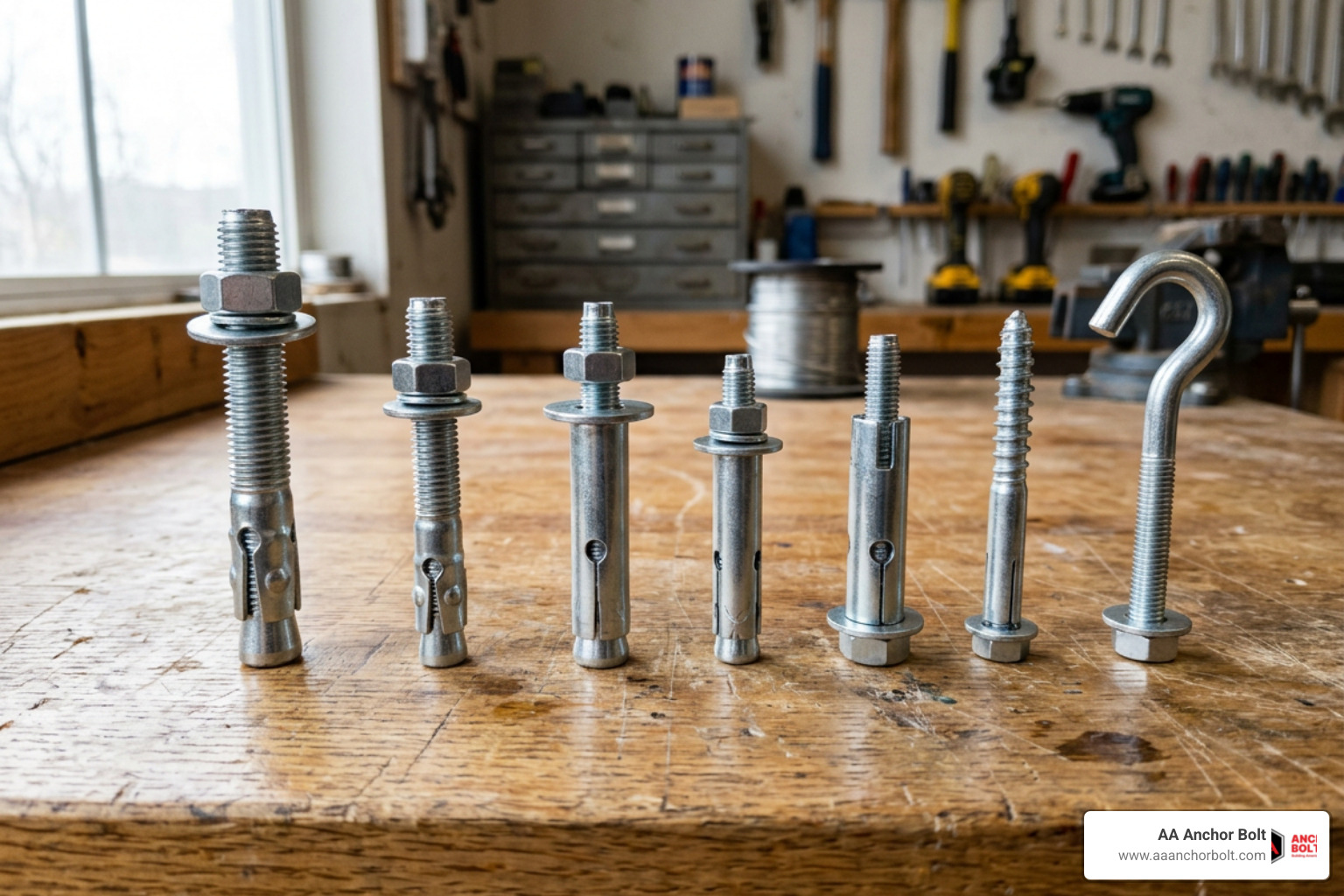
Not all concrete projects are created equal, which is why mechanical expansion anchors come in several distinct designs. Selecting the right style depends on your load requirements, the thickness of your fixture, and whether you need a permanent stud or a flush-mounted female socket.
Key Types of Galvanized Expansion Anchors
1. Wedge Anchors
Wedge anchors are the workhorses of the structural fastening world. They are male-threaded fasteners designed strictly for solid concrete. Because the drill bit size matches the anchor diameter exactly, they offer incredibly high pull-out and shear values. For example, a heavy-duty 5/8 x 6-inch galvanized expansion anchor is commonly used to secure structural columns and post bases, providing massive depth and holding power.
2. Sleeve Anchors
Sleeve anchors feature a full-length metal sleeve surrounding a threaded bolt. When tightened, the sleeve expands along its entire length. This distributes the expansion forces over a larger surface area, making sleeve anchors more forgiving in lower-strength concrete or solid brick than highly concentrated wedge anchors.
3. Drop-In Anchors
Also known as “hit anchors” or female expansion anchors, drop-in anchors sit flush with or just below the concrete surface. They feature an internal expansion plug (often called an anchor ball) that is driven down using a dedicated setting tool and a hammer. Once set, they provide a permanent female-threaded socket, allowing you to easily insert and remove bolts or threaded rods.
If you are looking for standard sizes for everyday commercial projects, options like a standard 3/8″ x 5″ hot-dipped galvanized wedge anchor provide excellent off-the-shelf reliability for standard concrete depths.
Typical Applications in Construction and Infrastructure
Where do you find these fasteners in the real world? Virtually anywhere structural steel or heavy equipment meets outdoor concrete.
- Highway Barriers and Signage: Securing heavy steel posts and guardrails to concrete road beds requires fasteners that can handle constant outdoor weather exposure and high shear loads.
- Structural Steel Columns: Connecting structural steel columns to concrete foundations is a primary use case for large-diameter wedge anchors, ensuring the building frame remains anchored against wind uplift.
- Dock Bumpers and Marine Environments: Heavy-duty galvanized wedge expansion anchors are highly valued for securing dock bumpers to concrete piers due to their high resistance to the constant vibratory loads of docking ships.
- Outdoor Framing and Decks: When attaching deck ledgers, porch framing, or mudsills to concrete foundations, building codes typically mandate galvanized fasteners to handle the moisture present at the wood-to-concrete interface.
Comparing Galvanization Methods and Corrosion Resistance
When choosing galvanized expansion anchors, the method used to apply the zinc coating is just as important as the anchor’s size. Different galvanization processes yield varying coating thicknesses, which directly impacts how long the fastener will last before rust takes over.
| Coating Type | Process | Average Thickness | Salt Spray Resistance | Best Use Case |
|---|---|---|---|---|
| Electro-Galvanized (Zinc Plated) | Electroplating (Cold) | 5 – 12 μm | 24 – 48 Hours | Dry indoor environments, temporary fixtures |
| Yellow Zinc / Black Zinc | Electroplating + Chromate | 8 – 15 μm | 72 – 96 Hours | Humid indoor areas, mild condensation |
| Mechanically Galvanized | Mechanical tumbling with zinc powder | 40 – 50 μm | 500+ Hours | Outdoor framing, pressure-treated lumber |
| Hot-Dipped Galvanized (HDG) | Molten zinc bath dipping | 50 – 85+ μm | 1000+ Hours | Heavy infrastructure, industrial, highly damp areas |
| 304 / 316 Stainless Steel | Solid alloy (Not a coating) | N/A | Excellent (Lifetime) | Marine, coastal, high-salinity, chemical exposure |
Hot-Dipped Galvanized (HDG) vs. Mechanically Galvanized
Hot-dip galvanizing involves dipping cleaned steel fasteners into a bath of molten zinc at temperatures around 840°F (450°C). This thermal process creates a metallurgical bond, forming several zinc-iron alloy layers topped with a pure zinc outer layer. The result is an incredibly thick, durable coating (often exceeding 50 microns) that can withstand decades of outdoor exposure.
However, the extreme heat of the HDG process can have a minor drawback: it can cause thermal stress, occasionally reducing the tensile strength of high-strength carbon steel bolts by 5% to 10%. Additionally, the thick, slightly irregular zinc run-off can clog fine threads, requiring the nuts to be tapped slightly oversized to fit.
Mechanical galvanizing, on the other hand, is a cold process. Fasteners are tumbled in a drum with zinc powder, glass beads, and chemical promoters. The impact of the glass beads cold-welds the zinc powder to the steel. This provides a highly uniform, thick coating (around 40-50 microns) without any thermal effects on the steel’s crystal structure. This makes mechanically galvanized wedge anchors highly suitable for structural applications requiring precise thread tolerances and direct contact with corrosive pressure-treated lumber.
Galvanized vs. Zinc-Plated and Stainless Steel
Standard electro-galvanizing (often simply labeled “zinc-plated”) is a very thin coating applied via electrical current in a cold chemical bath. While it makes the bolt look shiny and clean, it offers very little real-world rust protection. With a thickness of only 5 to 12 microns, a standard zinc-plated anchor will begin showing white rust after just 24 to 48 hours of salt spray exposure. It is strictly meant for dry, climate-controlled indoor environments.
For true outdoor longevity, galvanized carbon steel is the standard. However, if your project is located in a high-salinity coastal environment (within a few miles of the ocean) or exposed to harsh industrial chemicals, even hot-dip galvanizing will eventually break down. In these extreme scenarios, upgrading to solid 304 or 316 stainless steel expansion anchors is necessary to ensure the structural connection does not fail prematurely due to chloride-induced pitting.
Installation Guidelines and Engineering Specifications
No matter how strong an anchor is on paper, its real-world performance depends entirely on proper installation. A single missed step – like failing to clean out the drilled hole – can reduce an anchor’s load capacity by over 50%.
To help you get it right, we have compiled the essential engineering steps and specifications below. For additional technical documents, load tables, and product sheets, be sure to check out our online Resources page.
Step-by-Step Installation and Torque Requirements
Installing a galvanized wedge anchor requires precision. Follow these four critical steps to ensure a safe, code-compliant hold:
- Drill the Hole: Use a carbide-tipped masonry drill bit that meets ANSI B212.15 standards. The drill bit diameter must match the anchor diameter exactly (e.g., use a 1/2″ bit for a 1/2″ anchor). Drill the hole at least 1/2″ deeper than the intended anchor embedment depth. This extra space ensures that any leftover concrete dust won’t prevent the anchor from seating fully.
- Clean the Hole: This is the most frequently skipped step, and the most dangerous. Use a wire masonry brush and compressed air (or a blow-out bulb) to remove all concrete dust and loose aggregate from the hole. Leftover dust acts like tiny ball bearings, reducing the friction between the expansion clip and the concrete wall.
- Protect the Threads and Insert: Thread the hex nut onto the top of the anchor so that it sits flush with the top of the threaded stud. This “dog point” setup protects the steel threads from being flattened or damaged when you hammer the anchor into the concrete. Tap the anchor through the fixture and into the hole until the washer and nut are flush against the fixture surface.
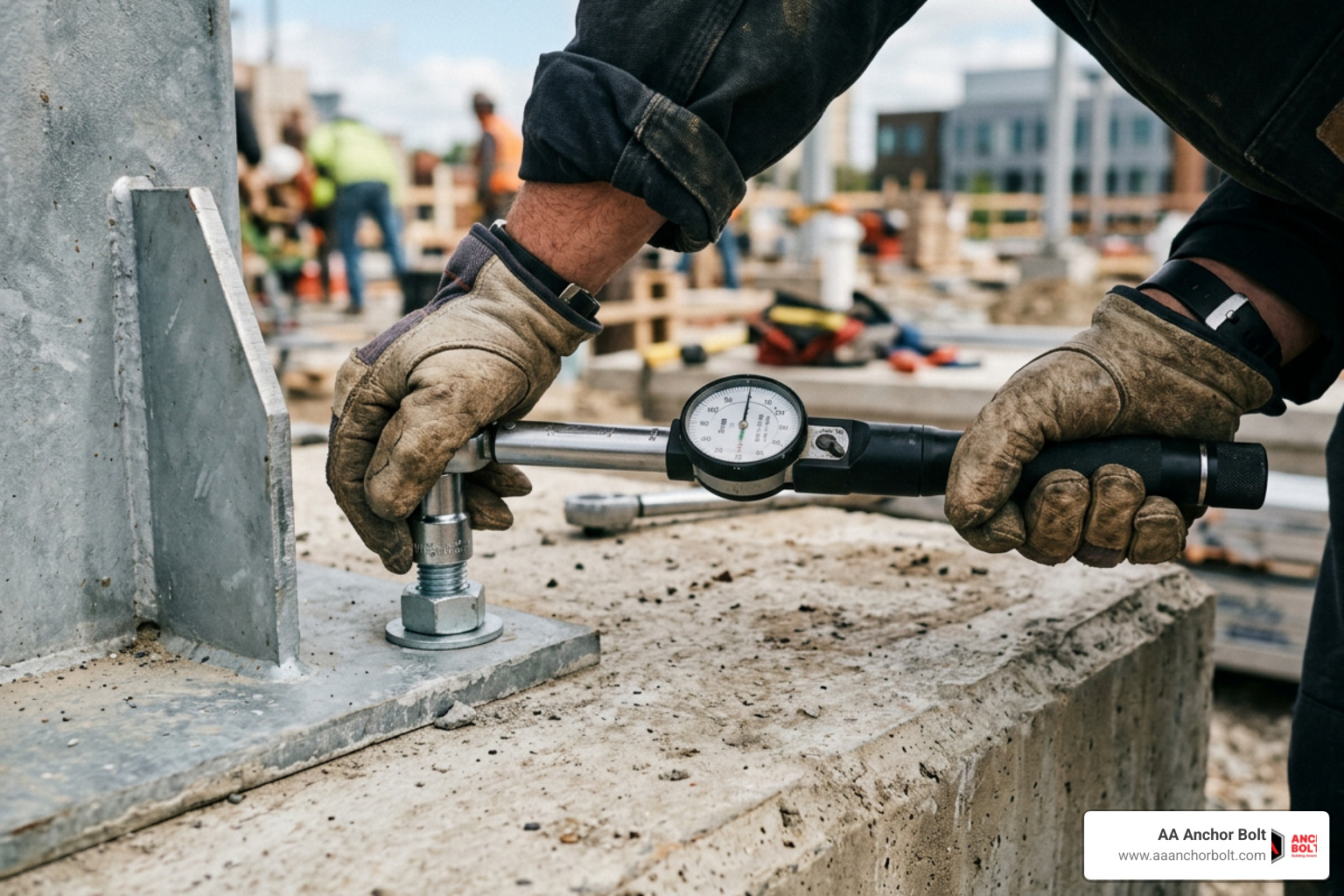
- Apply Torque: Use a calibrated torque wrench to tighten the nut to the manufacturer’s exact specification. For example, a standard 3/8″ x 5″ galvanized wedge anchor must be torqued to between 25 and 30 ft./lbs. to properly set the expansion clip. Under-torquing means the clip won’t expand enough to hold the load; over-torquing can snap the steel stud or crack the surrounding concrete.
Selecting the Right Galvanized Expansion Anchors for Your Project
To select the correct anchor length and diameter, you must calculate your required embedment depth and fixture thickness using this simple formula:
$$\text{Minimum Anchor Length} = \text{Fixture Thickness} + \text{Minimum Embedment Depth} + \text{Nut & Washer Thickness (approx. 1 Anchor Diameter)}$$
For instance, if you are fastening a 2-inch thick wood post base using a 3/8″ anchor that requires a minimum embedment depth of 1-1/2″, your calculation would look like this:
$$2\text{ in (fixture)} + 1.5\text{ in (embedment)} + 0.375\text{ in (nut/washer)} = 3.875\text{ in}$$
In this scenario, you would round up to a 5-inch long anchor to ensure plenty of thread clearance.
Pro Tip: Wondering how a building inspector verifies that an anchor was installed to the correct depth after the job is finished? Quality wedge anchors feature a letter code stamped directly onto the threaded tip. For example, an “H” stamp indicates an overall anchor length of 5″ to 5.5″. By checking the stamp and measuring the remaining exposed thread, an inspector can easily calculate the exact embedment depth hidden inside the concrete.
Spacing, Edge Distance, and Code Approvals
Expansion anchors place constant lateral tension on the surrounding concrete. If you place two anchors too close together, their internal stress fields will overlap, dramatically reducing their holding power. Similarly, if you install an anchor too close to an unsupported concrete edge, the expansion force can easily shear off the entire corner of the slab.
- Minimum Spacing: The industry standard is to maintain a minimum spacing of 10 anchor diameters between anchors (center-to-center). For a 3/8″ anchor, this means a minimum spacing of 3-3/4 inches.
- Minimum Edge Distance: Anchors must be placed a safe distance away from any unsupported edge. For a 3/8″ wedge anchor, the minimum edge distance is 1-7/8 inches.
- Ultimate Loads: In standard 2,000 PSI concrete, a properly installed 3/8″ x 5″ galvanized wedge anchor provides an average ultimate pull-out load of 1,223 lbs. and an average ultimate shear load of 3,238 lbs. Always apply a safety factor of 4:1 (25% of ultimate load) to determine your safe working load.
- Code Approvals: For structural and municipal projects, look for anchors backed by ICC-ES (International Code Council Evaluation Service) reports and tested under AC193 standards. These reports verify that the fasteners have been rigorously tested for performance in cracked and uncracked concrete, lightweight slabs, and seismic conditions.
Frequently Asked Questions about Galvanized Anchors
Can galvanized expansion anchors be used in brick or hollow block?
No. Standard wedge expansion anchors rely on concentrated lateral forces to create a friction lock. If you attempt to expand a wedge anchor inside hollow brick or lightweight concrete block, the intense pressure will crack the outer shell of the masonry, causing the anchor to spin freely and fail. For hollow block or brick applications, you should use sleeve anchors, adhesive anchoring systems, or specialty Zamak light-duty anchors designed to expand gently over a wider surface area.
How does hot-dip galvanizing affect the tensile strength of expansion bolts?
Because hot-dip galvanizing requires submerging carbon steel into a molten zinc bath at approximately 840°F (450°C), the extreme thermal exposure can act as a mild tempering heat treatment. For high-tensile structural bolts, this thermal cycle can cause a minor reduction in ultimate tensile strength of about 5% to 10%. When designing high-load structural connections, engineers must account for this potential reduction or opt for mechanically galvanized anchors, which are coated at room temperature.
When should you upgrade from galvanized to stainless steel anchors?
While galvanization provides excellent protection in standard outdoor and damp environments, the zinc coating will eventually sacrifice itself and corrode. You should upgrade to solid 304 or 316 stainless steel expansion anchors if your project is located in a high-salinity coastal area (subject to salt spray), submerged in water, or exposed to highly corrosive industrial chemicals, fertilizers, or pool sanitizing agents.
Conclusion
Securing structural elements to concrete demands fasteners you can trust. Galvanized expansion anchors provide the perfect blend of mechanical holding power and long-term corrosion resistance, ensuring that your heavy equipment, structural columns, and outdoor framing stay exactly where they belong.
At AA Anchor Bolt, we understand that structural integrity starts at the foundation. As a Michigan-based, family-owned manufacturer, we specialize in producing top-tier custom anchor bolts and specialty fasteners tailored to the demanding needs of modern construction and infrastructure.
What sets us apart? We maintain nearly a million pounds of raw steel in-house at our Michigan facility, giving us full domestic production control. This massive inventory allows us to offer some of the fastest turnaround times in the industry, delivering custom-engineered fasteners to your jobsite exactly when you need them.
Ready to secure your next project with domestic quality and rapid delivery? Explore our full range of Products, learn more about our custom manufacturing Services, or Contact our team of structural fastener experts today to request a quote. If your project calls for heavy-duty structural anchoring, don’t forget to check out our specialized F1554 anchor bolts designed for maximum load capacity in heavy infrastructure.