Demystifying ASTM F1554 Grades 36, 55, and 105
What Are Anchor Bolts F1554? A Quick-Answer Guide
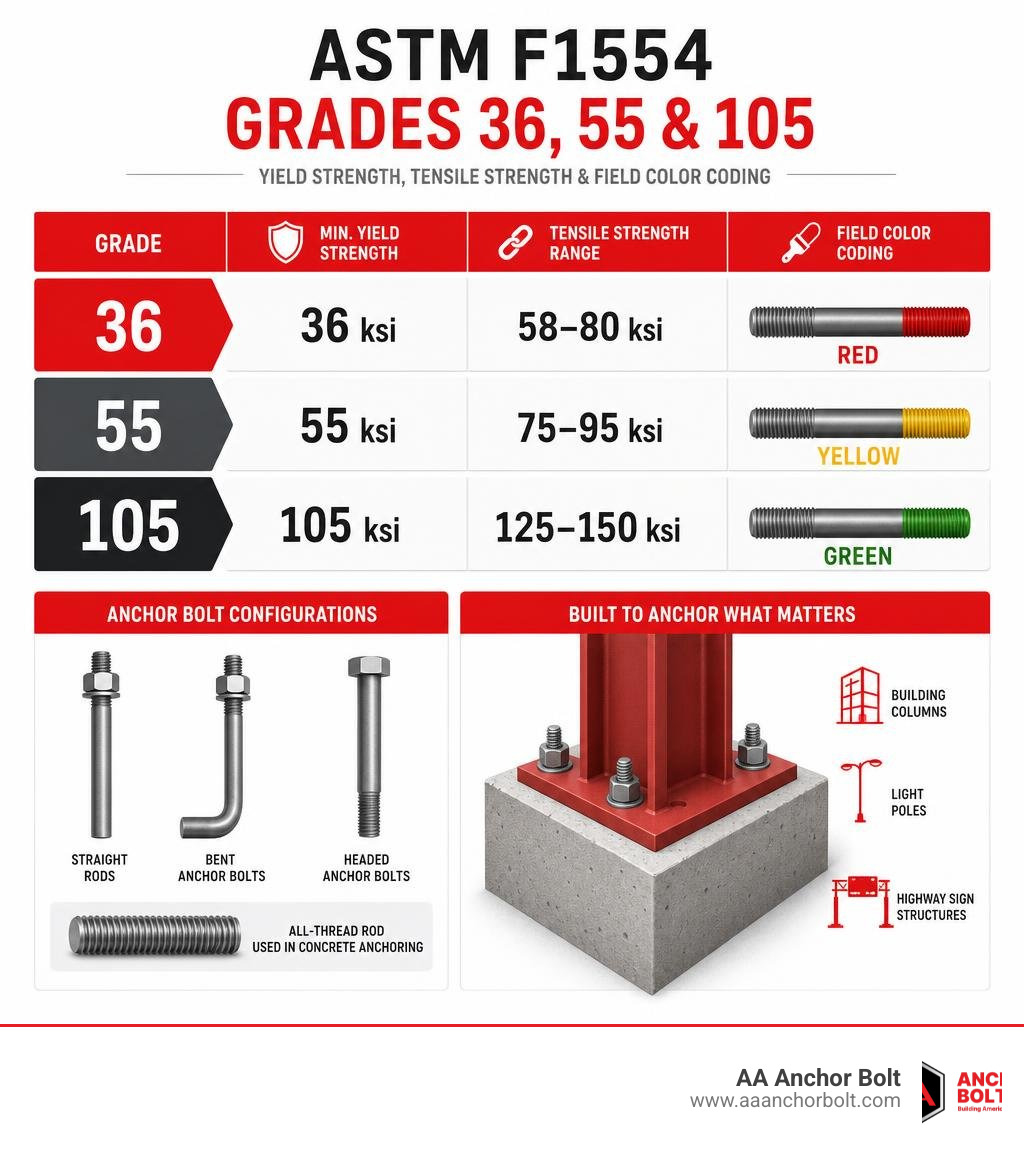
Anchor bolts F1554 are steel fasteners defined by the ASTM F1554 standard, first introduced in 1994. They are designed specifically to anchor structural supports — like building columns, light poles, and highway sign structures — to concrete foundations.
Quick answer: ASTM F1554 at a glance
| Grade | Min. Yield Strength | Tensile Strength Range | Common Use |
|---|---|---|---|
| 36 | 36 ksi | 58–80 ksi | General structural anchoring |
| 55 | 55 ksi | 75–95 ksi | Higher-load structural applications |
| 105 | 105 ksi | 125–150 ksi | High-strength, limited applications |
The standard covers three bolt configurations:
- Straight rods
- Bent anchor bolts
- Headed anchor bolts
It also covers all-thread rod used in concrete anchoring. It does not cover mechanical expansion anchors or deformed rebar anchors.
For contractors working on tight deadlines, knowing which grade to spec — and why — can save serious time and prevent costly rework in the field. The wrong grade, the wrong hardware, or missing a supplementary requirement can hold up an entire pour.
This guide breaks down everything you need to know: grades, mechanical properties, hardware compatibility, supplementary requirements, and how F1554 stacks up against other common specs like A307 and A193.
Understanding the Role of Anchor Bolts F1554 in Construction
When we look at modern infrastructure, the strength of a structure is only as reliable as the connection between its steel columns and its concrete foundation. That is where anchor bolts f1554 come into play. Prior to the mid-1990s, structural engineers had to rely on a patchwork of different steel specifications—often borrowing standards meant for structural plates or general-purpose fasteners—to specify anchor rods. This created massive confusion on jobsites and in fabrication shops.
To solve this problem, the American Society for Testing and Materials introduced the ASTM F1554 Standard Specification in 1994. This specification was designed specifically to govern steel anchor bolts intended to anchor structural supports to concrete foundations.
Unlike general fastener standards, the F1554 specification covers the entire anchoring assembly, ensuring that the chemical composition, mechanical properties, and dimensions of the bolt are tightly controlled. This structural focus ensures predictable performance under both static and dynamic loads.
Under the umbrella of the F1554 Anchor Bolt standard, we manufacture three primary physical configurations to suit different engineering designs:
- Headed Bolts: These feature a forged head (usually a heavy hex head) at the unthreaded end embedded in the concrete. The head provides mechanical pull-out resistance.
- Straight Rods: These are straight, headless steel rods threaded on both ends or fully threaded. They typically rely on a nut and washer combination embedded at the bottom end to create an anchor point.
- Bent Bolts: Commonly referred to as L-bolts or J-bolts, these feature a 90-degree bend (or hook) at the embedded end to grip the concrete.
Understanding these configurations is the first step in selecting the right fastener. However, the real engineering magic lies in selecting the appropriate strength grade.
Comparing the Three Key Grades of ASTM F1554
Selecting the correct grade of anchor bolts f1554 is not just about choosing the strongest steel available. In structural design, ductility—the ability of a material to deform plastically before fracturing—is often just as important as raw yield strength.
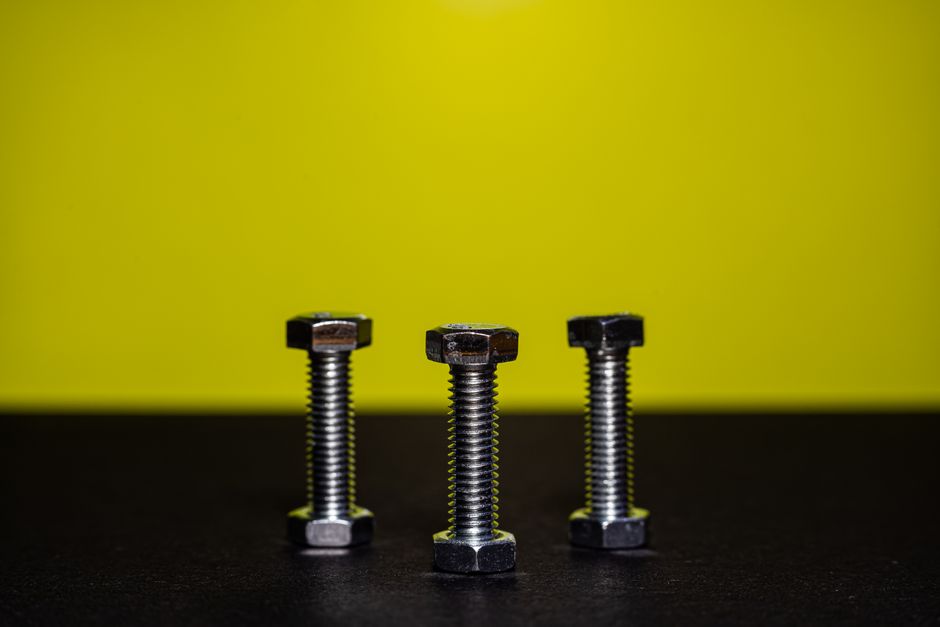
The ASTM F1554 standard divides anchor bolts into three distinct grades based on their minimum yield strength, measured in kilopounds per square inch (ksi). Below is a comprehensive look at how these three grades compare mechanically:
| Mechanical Property | Grade 36 | Grade 55 | Grade 105 |
|---|---|---|---|
| Minimum Yield Strength | 36 ksi | 55 ksi | 105 ksi |
| Tensile Strength Range | 58–80 ksi | 75–95 ksi | 125–150 ksi |
| Minimum Elongation (in 2″) | 23% | 21% | 15% |
| Minimum Elongation (in 8″) | 20% | 18% | 12% |
| Minimum Reduction of Area | 40% | 30% | 45% (for < 2" dia.) / 40% (for >= 2″ dia.) |
| Available Diameters | 1/2″ to 4″ | 1/2″ to 4″ | 1/2″ to 3″ |
Let’s take a closer look at the specific characteristics, chemistry, and ideal applications for each of these three grades.
Grade 36 Anchor Bolts F1554
Representing the low-carbon option within the standard, Grade 36 is the most widely specified grade for general structural anchoring.
Manufactured from mild carbon steel, these anchor bolts f1554 offer excellent ductility, with a minimum elongation of 23% in a 2-inch specimen. This high level of ductility makes Grade 36 highly forgiving in seismic or high-vibration environments, as the steel will stretch significantly before failing.
Because of its low carbon content, Grade 36 is inherently weldable without requiring special thermal treatments or strict carbon equivalency testing. It is available in a wide diameter range from 1/2 inch to 4 inches. If your project plans simply call for “F1554 anchor bolts” without specifying a grade, Grade 36 is generally considered the default industry standard.
Grade 55 Anchor Bolts F1554
When structural designs demand more load-bearing capacity than mild steel can offer without increasing the bolt diameter, Grade 55 is the go-to solution.
Grade 55 is typically manufactured from High-Strength Low-Alloy (HSLA) steel or medium carbon steel. It provides a robust 55 ksi minimum yield strength and a tensile range of 75 to 95 ksi. Like Grade 36, it is widely available in diameters ranging from 1/2 inch up to 4 inches.
One critical detail to keep in mind: standard Grade 55 steel is not automatically considered weldable. If your design requires welding—such as tack welding a nut to the anchor plate or welding the rod directly to a structural steel member—you must explicitly specify Supplementary Requirement S1 (Weldability). When S1 is ordered, the steel chemistry is strictly controlled to limit carbon content and carbon equivalency, ensuring safe field welding.
Grade 105 Anchor Bolts
For heavy-duty industrial applications, overhead highway sign structures, high-mast light poles, and massive structural steel building columns, Grade 105 provides the ultimate strength.
With a minimum yield strength of 105 ksi and a tensile range of 125 to 150 ksi, Grade 105 is manufactured from medium carbon alloy steel that has undergone a rigorous quenching and tempering (heat treatment) process. Because of this high-strength chemistry and heat treatment, Grade 105 is available in a slightly narrower size range, from 1/2 inch up to 3 inches in diameter.
It is absolutely crucial to note that F1554 Grade 105 anchor bolts must never be welded. Applying heat to a quenched and tempered alloy steel alters its molecular structure, instantly destroying its heat-treated mechanical properties and leaving the bolt brittle and prone to catastrophic failure.
Recommended Nuts, Washers, and Hardware Compatibility
An anchor bolt is only as secure as the hardware holding it down. One of the greatest benefits of the ASTM F1554 standard is that it doesn’t just specify the bolt—it also outlines the exact matching hardware required to maintain structural integrity. Using an incompatible nut or washer can lead to thread stripping, uneven load distribution, or premature joint failure.
When sourcing complete anchor assemblies from our catalog of Products, we ensure that all nuts and washers strictly conform to the following ASTM compatibility guidelines:
Grade 36 Assemblies
- Recommended Nuts: ASTM A563 Grade A (Hex style for plain finish; Heavy Hex style for hot-dip galvanized finishes).
- Recommended Washers: ASTM F436 Type 1 flat washers.
Grade 55 Assemblies
- Recommended Nuts: ASTM A563 Grade A Heavy Hex (or Grade DH / ASTM A194 Grade 2H for high-stress applications).
- Recommended Washers: ASTM F436 Type 1 flat washers.
Grade 105 Assemblies
- Recommended Nuts: ASTM A563 Grade DH Heavy Hex or ASTM A194 Grade 2H Heavy Hex. Standard carbon steel nuts will strip under the extreme tension required for Grade 105 bolts.
- Recommended Washers: ASTM F436 Type 1 flat washers (heat-treated to match the high-strength properties of the bolt).
Corrosion Protection and Thread Tolerances
Because anchor bolts are embedded in concrete foundations—frequently exposed to moisture and outdoor elements—corrosion protection is a major consideration. The two most common protective finishes are:
- Hot-Dip Galvanizing: Conforming to ASTM F2329, this process applies a thick, durable zinc coating by dipping the steel in molten zinc. It offers superior outdoor corrosion resistance.
- Mechanical Galvanizing: Conforming to ASTM B695 Class 55, this process uses mechanical energy to coat the steel with zinc powder, providing a highly uniform finish without the risk of hydrogen embrittlement.
When anchor bolts f1554 are galvanized, the zinc buildup increases the outer thread diameter of the bolt. To accommodate this, the mating nuts must be tapped oversize (overtapped) in strict accordance with ASTM A563. This ensures smooth assembly on the jobsite while maintaining full thread engagement and load-bearing capacity.
Supplementary Requirements (S1 to S4) and Seismic Design
While the standard grades of ASTM F1554 cover the vast majority of standard building projects, high-consequence structures—such as bridges, high-rise buildings in earthquake zones, and heavy industrial facilities—often require extra testing and quality assurances. The ASTM standard defines several “Supplementary Requirements” (designated as S1 through S5) that engineers can specify during the design phase.
You can find detailed technical sheets on these testing protocols in our Resources section. The most common supplementary requirements specified today include:
- S1: Weldable Grade 55 Steel: As mentioned earlier, standard Grade 55 is not weldable by default. Specifying S1 forces the mill to limit the carbon equivalent ($CE$) of the steel to a maximum of 0.45% (or 0.47% depending on diameter). This chemical control guarantees that the steel can be safely welded in the field without cracking.
- S2: Permanent Manufacturer Identification: By default, ASTM F1554 only requires color-coding on the exposed end of the bolt for field identification. Specifying S2 requires the manufacturer to permanently stamp a unique identification mark or logo onto the end of the bolt, ensuring traceability even after the color paint wears off.
- S3: Permanent Grade Identification: Similar to S2, this requirement mandates that the specific grade (36, 55, or 105) be permanently stamped onto the exposed end of the rod. This is highly recommended for projects where different grades of bolts are used on the same jobsite, preventing dangerous mix-ups during installation.
- S4: Charpy V-Notch (CVN) Impact Testing: In cold climates or dynamic loading applications (like bridges or wind turbines), steel can become brittle and fracture under sudden loads. Specifying S4 requires Charpy V-notch impact testing to measure the steel’s toughness. For Grades 55 and 105, the standard requires the steel to absorb an average of 15 ft-lbs of energy at either +40°F, +15°F, or -20°F (depending on the specific design criteria), with no single test specimen falling below 12 ft-lbs.
The Importance of Controlled Tensile Ranges in Seismic Design
In modern seismic design (such as ACI 318 guidelines), engineers aim to design concrete connections that fail in a “ductile” manner. This means that if a catastrophic earthquake strikes, the steel anchor bolt will stretch and yield (absorb energy) before the concrete foundation breaks or the bond fails.
To achieve this, the actual tensile strength of the steel must be highly predictable. If a bolt is too strong, it won’t stretch; instead, it will pull right out of the concrete, causing a sudden, brittle failure.
ASTM F1554 is specifically designed to prevent this by establishing both a minimum and a maximum limit on tensile strength (58–80 ksi for Grade 36, and 75–95 ksi for Grade 55). This narrow, controlled band of strength gives structural engineers the predictability they need to design safe, resilient structures.
How ASTM F1554 Differs from A307, A36, and A193
Before the introduction of ASTM F1554, it was common practice to specify general-purpose steel standards like ASTM A307, ASTM A36, or ASTM A193 for concrete anchoring. Even in June 2026, we still occasionally see these outdated specifications pop up on old design plans.
Using the wrong standard can lead to serious compliance issues, jobsite delays, and structural vulnerabilities. Here is how ASTM F1554 compares to these other common steel standards:
ASTM A307 Grade A vs. F1554 Grade 36
ASTM A307 is a general-purpose standard for carbon steel bolts, studs, and threaded rods.
- The Issue: A307 Grade A specifies a minimum tensile strength of 60 ksi but does not specify a minimum yield strength. Because yield strength is the foundation of structural anchor design, using A307 introduces dangerous unpredictability into your calculations.
- The History: Prior to 2007, low-carbon anchor bolts were often specified as ASTM A307 Grade C. However, due to widespread industry confusion, Grade C was officially retired and replaced by ASTM F1554 Grade 36.
ASTM A36 vs. F1554 Grade 36
ASTM A36 is a structural steel standard designed for plates, channels, and structural shapes—not for fasteners.
- The Issue: When contractors order “A36 all-thread rod,” they are using a material designed for structural welding and fabrication, not fastener manufacturing. A36 does not govern thread tolerances, fast turnaround dimensional criteria, or fastener-specific testing.
- The Solution: If your project calls for A36 anchor rods, you should always consult the ASTM F1554 Standard Guidelines and transition the specification to F1554 Grade 36, which provides the exact same yield strength (36 ksi) but with proper fastener-specific quality controls.
ASTM A193 Grade B7 vs. F1554 Grade 105
ASTM A193 Grade B7 is a high-strength alloy steel standard designed specifically for high-temperature, high-pressure piping and pressure vessel applications.
- The Issue: While A193 B7 has similar strength properties to F1554 Grade 105 (both have a 105 ksi yield strength), A193 B7 is not optimized for concrete anchoring. It does not carry the same ductility guidelines, bent-bolt dimensional criteria, or concrete-focused supplementary options.
- Dual Certification: In many cases, high-quality alloy steel can be dual-certified to meet both ASTM A193 B7 and ASTM F1554 Grade 105. However, for structural concrete foundations, F1554 Grade 105 remains the superior and legally compliant specification.
Frequently Asked Questions about ASTM F1554
Navigating structural fastener standards can raise plenty of questions. Below are some of the most common technical inquiries we receive from engineers, fabricators, and contractors.
Can you weld F1554 Grade 105 anchor bolts?
No, you should absolutely never weld F1554 Grade 105 anchor bolts. Grade 105 achieves its high strength through a precise quenching and tempering heat-treatment process. When you apply the extreme heat of welding to this alloy steel, you alter its chemical structure, instantly destroying the heat treatment. This leaves the bolt brittle, weak, and highly susceptible to sudden, catastrophic failure under load. If your design requires welding, you must use Grade 36 or a weldable Grade 55 (with the S1 supplement).
What is the color-coding system for F1554 grades?
To prevent costly mix-ups on busy jobsites, the ASTM F1554 standard establishes a simple, highly visible color-coding system. Manufacturers paint the exposed end of the anchor bolt (the portion that will stick out of the concrete) with a specific color:
- Blue: Grade 36 (indicates mild, highly ductile carbon steel).
- Yellow: Grade 55 (indicates intermediate strength).
- Red: Grade 105 (indicates high-strength, heat-treated alloy steel).
This color-coding allows inspectors and contractors to quickly verify that the correct grade of bolt has been installed before the concrete is poured.
Can Grade 55 be substituted for Grade 36?
Yes, under specific conditions. Per Section 6.4 of the ASTM F1554 standard, a weldable Grade 55 anchor bolt (Grade 55 meeting Supplementary Requirement S1) may be substituted when Grade 36 is specified, at the supplier’s option. This is a highly useful provision when a fabricator needs to fulfill an urgent order but has a temporary shortage of Grade 36 raw material. Because Grade 55-S1 is stronger and fully weldable, it meets or exceeds all structural requirements of Grade 36.
Conclusion
When it comes to securing the foundations of our nation’s infrastructure, there is no room for guesswork. Specifying the correct grade of anchor bolts f1554—and ensuring it is paired with the proper compatible nuts, washers, and supplementary testing—is critical to the safety, durability, and compliance of your structure.
At AA Anchor Bolt, we have spent years mastering the technical details of the ASTM F1554 standard. As a Michigan-based, family-owned manufacturer operating out of Northville, MI, we control every step of our production process. We maintain nearly a million pounds of in-house raw steel, allowing us to offer incredibly fast turnaround times on custom anchor bolts and specialty fasteners.
Whether your project requires standard Grade 36 L-bolts, weldable Grade 55-S1 straight rods, or high-strength Grade 105 headed bolts, we have the machinery and expertise to fabricate exactly what you need.
To learn more about how we can support your next project, explore our Manufacturing Capabilities, browse our full suite of Services, or request a quote for your custom F1554 Anchor Bolt requirements today. Let’s build something strong together!