How to Choose the Right Anchor Bolt Nuts for Your Next Project
The Fast Answer: Choosing Anchor Bolt Nuts for Structural Projects
Choosing the right anchor bolt nuts can make or break a foundation connection — and a wrong spec can mean costly rework on a tight deadline.
Here’s a quick-reference guide to the most common choices:
| Anchor Bolt Grade | Recommended Nut | Nut Style |
|---|---|---|
| F1554 Grade 36 | A563 Grade A | Hex or Heavy Hex |
| F1554 Grade 55 | A563 Grade A | Hex or Heavy Hex |
| F1554 Grade 105 | A563 Grade DH or A194 Grade 2H | Heavy Hex only |
A few key rules to know right away:
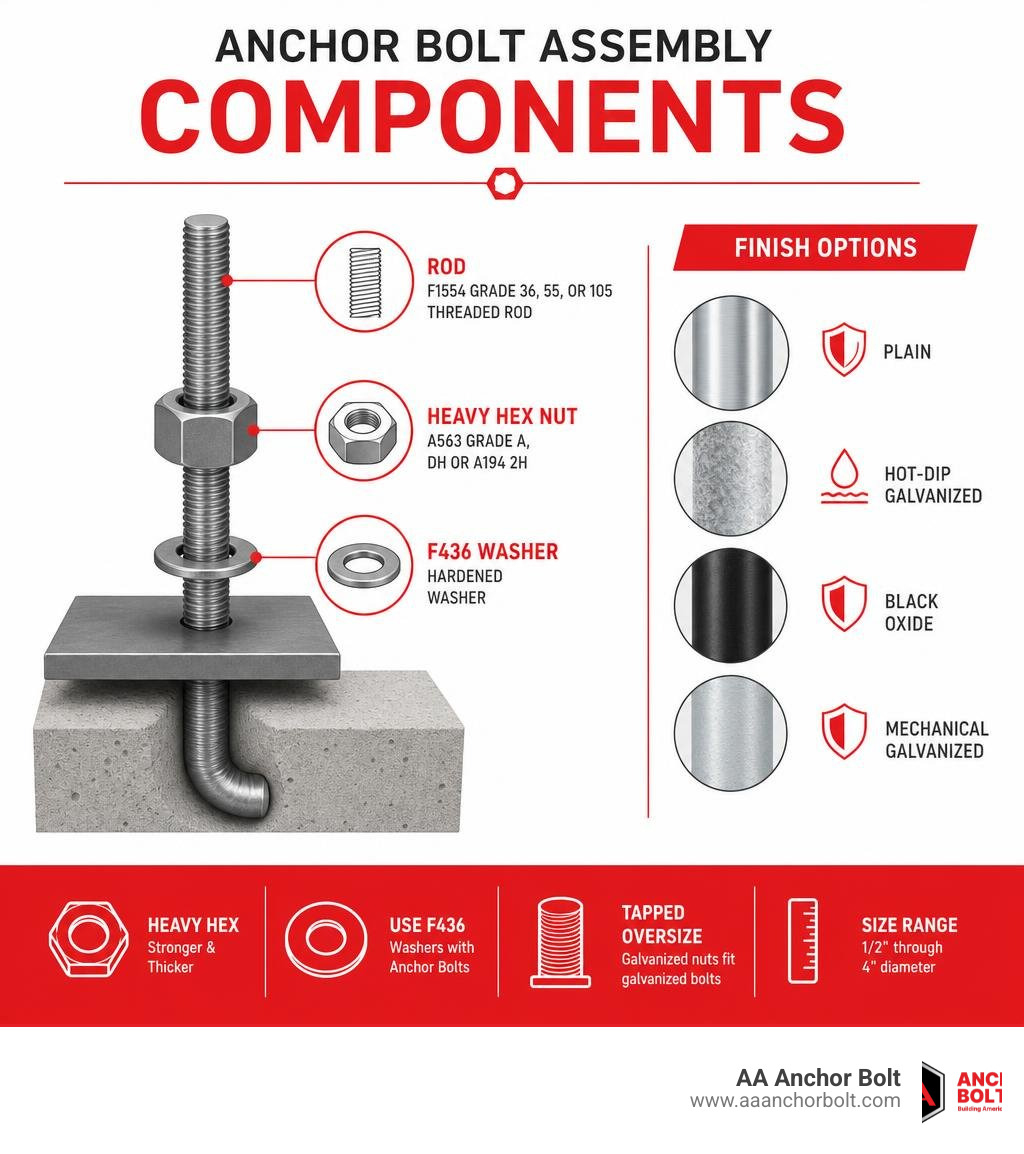
- Always use heavy hex nuts for structural anchor bolt applications — they’re thicker and wider than standard hex nuts
- F436 hardened washers are required with F1554 anchor bolts unless your project specs say otherwise
- Galvanized nuts must be tapped oversize to fit over galvanized bolt threads
- Anchor bolts and nuts are available in diameters from 1/2 inch through 4 inches
If you’re a contractor sourcing hardware for a Midwest infrastructure project, the spec decisions above cover the vast majority of what you’ll encounter in the field. The sections below go deeper on dimensions, coatings, torque, and sourcing so you can order with confidence.
Whether you’re pouring foundations for light poles, structural steel columns, or industrial equipment bases, getting the nut spec right the first time saves time, money, and headaches. The wrong grade, finish, or style won’t just slow down your job — it can create a compliance problem with your engineer of record.
This guide walks you through every decision point, from ASTM grades to coating options to where to source stock and custom hardware fast.
Understanding ASTM Specifications and Grades for Anchor Bolt Nuts
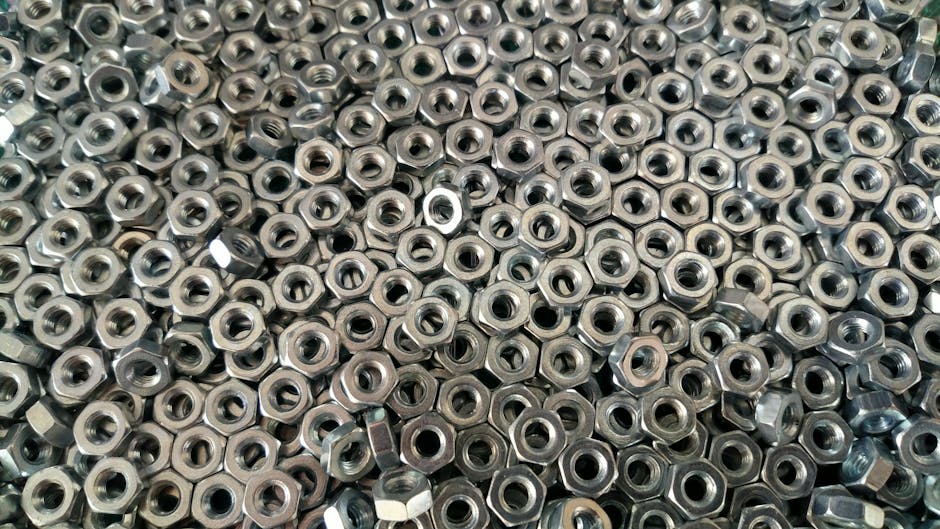
To ensure the structural integrity of any concrete foundation connection, we have to look closely at the governing ASTM specifications. When we talk about anchor bolt nuts, we are primarily dealing with two major material specifications: ASTM A563 and ASTM A194. Project teams that need to verify current publication details should reference the standards publisher, ASTM International, in addition to the engineer’s project specifications.
The Standard Specification for Carbon and Alloy Steel Nuts (Inch and Metric) (ASTM A563) covers the chemical, mechanical, and dimensional requirements for carbon and alloy steel nuts used in general structural and mechanical applications. Under A563, you will find several key grades:
- Grade A: This is the most common, economical grade of nut. It is typically supplied as a standard hex or heavy hex nut and is ideal for low-strength applications.
- Grade DH: This is a high-strength, heat-treated (quenched and tempered) carbon steel nut designed to handle massive proof loads. Grade DH nuts are required for heavy-duty structural bolting.
- Weathering Steel (Grade C3/DH3): For projects exposed to the elements without protective coatings, weathering steel nuts contain specific alloying elements (like copper, chromium, and nickel) that form a protective, rust-like patina over time to resist atmospheric corrosion.
Alternatively, ASTM A194 is another critical standard you will encounter. While originally written for high-temperature and high-pressure piping applications, A194 Grade 2H heavy hex nuts are frequently used in structural anchor bolt assemblies. Because Grade 2H nuts undergo rigorous quenching and tempering heat treatments, they possess high proof load strengths that make them an excellent, widely accepted alternative to A563 Grade DH nuts.
Hex Nuts vs. Heavy Hex Nuts: Dimensions, Tolerances, and Thread Specifications

A common point of confusion on the job site is the difference between a standard hex nut and a heavy hex nut. While they might look similar from a distance, heavy hex nuts are slightly thicker and wider across the flats. This extra bulk is not just for show; it increases the thread engagement length and provides a larger bearing surface to distribute high clamping forces across structural washers and steel baseplates.
For structural anchor bolt applications, heavy hex nuts are almost always the default choice. The increased width across flats ensures that your wrench or impact socket has a secure grip during high-torque installations.
Thread Specifications and Overtapping
Most anchor bolts in the United States utilize Unified National Coarse (UNC) threads. For example, a standard 3/4″-10 specification indicates a 3/4-inch nominal diameter with 10 threads per inch.
When nuts are hot-dip galvanized to protect against corrosion, the zinc coating adds physical thickness to the bolt threads. To allow the nut to spin freely onto a galvanized bolt, the nut must be tapped oversize after the hot-dip process. The standard overtapping allowances are strictly controlled by ASTM A563 to ensure the threads do not strip under tension.
Here is a quick look at how standard hex and heavy hex dimensions compare for common anchor bolt diameters:
| Nominal Diameter (Inches) | Hex Nut Width Across Flats (Inches) | Heavy Hex Nut Width Across Flats (Inches) | Hex Nut Thickness (Inches) | Heavy Hex Nut Thickness (Inches) |
|---|---|---|---|---|
| 1/2″ | 13/16″ | 7/8″ | 7/16″ | 31/64″ |
| 3/4″ | 1-1/8″ | 1-1/4″ | 41/64″ | 47/64″ |
| 1″ | 1-1/2″ | 1-5/8″ | 55/64″ | 63/64″ |
| 1-1/4″ | 1-7/8″ | 2″ | 1-1/16″ | 1-7/32″ |
Selecting the Right Nut for F1554 Rods, Coatings, and Accessories
Matching Anchor Bolt Nuts with F1554 Grade 36, 55, and 105 Rods
To keep your project compliant and safe, you must match the strength grade of your F1554 Anchor Bolt with a nut of equal or greater proof load capability.
- Grade 36: This is our standard, weldable carbon steel anchor bolt with a 36 ksi yield strength. We recommend pairing these with economical A563 Grade A heavy hex nuts.
- Grade 55: Offering a 55 ksi yield strength, these high-strength low-alloy rods are commonly used for light poles and traffic signals. They also pair perfectly with A563 Grade A heavy hex nuts.
- Grade 105: These are heat-treated, high-strength rods with a 105 ksi yield strength. Because of the extreme tension these rods hold, they require high-strength A563 Grade DH heavy hex nuts.
The 2H Substitution Rule: In the fastener industry, A563 Grade DH nuts in sizes 1 inch and larger can be incredibly difficult to source because they are rarely mass-produced. Fortunately, ASTM allows us to substitute A194 Grade 2H heavy hex nuts in their place. Because 2H nuts are mass-produced for high-pressure piping, they are highly available, cost-effective, and fully approved as a high-strength alternative.
Coating Options and Corrosion Resistance
Depending on where your foundation is located, you will need to choose the appropriate finish for your bolts and anchor bolt nuts:
- Plain Finish: Uncoated black steel. Best for temporary installations or bolts that will be completely encased in concrete away from moisture.
- Hot-Dip Galvanized (HDG): The industry standard for outdoor exposure. The hardware is dipped in molten zinc, creating a thick, durable metallurgical bond. That HDG nuts require a specialized wax lubricant and dye coating from the manufacturer to prevent galling during installation.
- Mechanically Galvanized: Zinc powder is cold-welded to the steel using glass beads. This provides a smoother, more uniform finish than HDG, making it popular for smaller, close-tolerance fasteners.
Our domestic manufacturing process in Michigan ensures that all galvanized coatings and overtapping allowances strictly adhere to environmental and structural codes.
Essential Accessories: Washers, Plates, and Sleeves
An anchor bolt assembly is only as strong as its weakest component. To complete your system, you will need to pair your nuts with the correct accessories:
- F436 Hardened Washers: These are flat, heat-treated washers designed to handle the high clamping forces of structural bolts without collapsing or deforming. They are required by code for almost all F1554 installations.
- F844 Unhardened Washers: These are larger, softer washers used primarily in light-duty applications where high tension is not required.
- Plate Washers: Custom-cut square or round steel plates that provide a massive bearing surface, typically used at the embedded end of the anchor rod to prevent the bolt from pulling out of the concrete.
- Anchor Sleeves: Plastic or corrugated metal sleeves placed around the top of the anchor rod during the concrete pour. These create a small void, allowing for minor alignment adjustments of the bolt before the final grouting process.
Explore our full range of structural accessories on our Products page.
Installation Best Practices, Torque, and Sourcing
Torque Recommendations and Tightening Methods
When it comes to tightening anchor bolt nuts, “gut tight” with an impact wrench is rarely enough for structural inspections. Proper installation torque ensures the bolt is pre-tensioned correctly to prevent loosening under dynamic wind or seismic loads.
For structural steel column bases, the turn-of-nut method is highly reliable. The nut is first brought to a “snug-tight” condition (the point where a worker using an ordinary spanner wrench or a few impacts of an impact wrench has brought the plies into firm contact). From there, the nut is rotated an additional fraction of a turn (often 1/3 to 1/2 turn, depending on bolt length and thread pitch) to achieve the required tension.
For specialized mechanical concrete anchors, such as heavy-duty screw anchors, installation requirements are slightly different. Mechanical screw anchors tap directly into the concrete to create a keyed engagement. Over-torquing these anchors with an impact gun can strip the concrete threads, which is why adhering to the manufacturer’s exact torque limits is critical.
Sourcing Quality Hardware: Stock vs. Custom
When you are managing a major construction project in 2026, waiting weeks for critical foundation fasteners is simply not an option. That is why choosing between standard stock hardware and custom fabrication is a major logistical decision.
At AA Anchor Bolt, our Manufacturing Capabilities and dedicated Services allow us to bridge the gap. We maintain nearly a million pounds of domestic steel in-house at our Northville, Michigan facility. This massive inventory allows us to offer incredibly fast turnaround times on custom-bent anchor bolts, threaded rods, and specialized heavy hex nuts.
By keeping our production entirely domestic, we control the quality from raw material to final shipment, ensuring your project meets all Buy America and local structural requirements.
Frequently Asked Questions About Structural Fasteners
What are the standard sizes for anchor bolt nuts?
Anchor bolts and their matching nuts are manufactured in a wide diameter range from 1/2 inch through 4 inches. The thread series is almost exclusively Unified National Coarse (UNC) for structural applications, though we can supply custom thread pitches for specialized industrial machinery bases. To view detailed dimensional charts, check out our Resources page.
Why are heavy hex nuts preferred over standard hex nuts?
Heavy hex nuts are specifically designed for structural steel and heavy-duty foundation applications. They feature a larger width across the flats and are slightly thicker than standard hex nuts. This larger footprint increases the thread engagement and distributes the massive clamping forces over a wider bearing surface, preventing the nut from stripping or crushing the structural washer under high tension loads.
When can A194 Grade 2H nuts be substituted for A563 Grade DH?
Because A563 Grade DH heavy hex nuts are often unavailable in sizes 1 inch and larger due to limited manufacturing runs, ASTM standards explicitly allow the substitution of A194 Grade 2H heavy hex nuts. Grade 2H nuts undergo rigorous heat-treating and testing processes, making them a safe, highly available, and fully compliant high-strength alternative.
Conclusion
Getting your anchor bolt nuts right is a small detail that makes a massive difference in the safety and longevity of your structural foundations. By understanding ASTM specifications, selecting the correct heavy hex dimensions, and matching your nuts to your F1554 rods, you can keep your project moving forward without costly compliance delays.
At AA Anchor Bolt, we are proud to be a family-owned, Michigan-based manufacturer. With our extensive in-house steel inventory, we specialize in fast turnaround times on custom-manufactured anchor bolts and specialty structural hardware.
Ready to secure your next project with certified, American-made fasteners? Learn more About Us, explore our F1554 Anchor Bolt options, or Contact our team in Northville today for a fast, custom quote!