How to Bend a U-Bolt in 5 Simple Steps
What Is U-Bolt Bending — and Why Getting It Right Matters
U-bolt bending is the process of forming a straight steel rod into a U-shape — with two parallel threaded legs and a curved or angled bend at the top — so it can clamp pipes, axles, springs, and structural members without drilling through them.
Here is a quick answer to what you need to know:
U-Bolt Bending at a Glance
| Question | Quick Answer |
|---|---|
| What shapes are available? | Round, square, semi-round, V-bend |
| What rod diameters are common? | 3/8 inch to 1 inch |
| Minimum bend radius (low tensile)? | 0.50x wire diameter |
| Minimum bend radius (high tensile)? | 0.70x wire diameter |
| Max diameter loss at bend? | 15% of wire diameter |
| Can you re-bend a used U-bolt? | Not recommended for safety-critical use |
| Key finish options? | Zinc-plated, hot-dip galvanized, 304 or 316 stainless |
U-bolts look simple. They are not.
The bend is where most failures start. A radius that is too tight causes necking — a loss of cross-sectional area that can reduce load capacity by 5 to 8%. The wrong bend shape means poor clamping. The wrong material means rust failure in months instead of years.
For Midwest infrastructure contractors working against tight deadlines, a wrong spec on something this fundamental can stall an entire job. This guide walks you through exactly how to bend, size, and install U-bolts correctly — in five clear steps.
What is a U-Bolt and How Does the Bending Process Work?
At its core, a U-bolt is a single-piece industrial fastener manufactured from wire or round metal stock. While it functions as a single unit, its mechanical behavior is a masterclass in force distribution.
When you tighten a U-bolt, you are applying a tensile preload down the straight legs. This tension translates into a uniform compressive force distributed across the curved semi-circle or square top, gripping the target object securely against a mating surface. Because it secures a round or square profile without requiring you to drill holes directly through the supported member, it preserves the structural integrity of both the support and the supported components.
The actual manufacturing of these fasteners relies on precise metalworking. The U-Bolt Application and Design principles dictate that during the bending phase, the metal must undergo controlled plastic deformation.
To achieve this, we start with straight, high-quality steel rods. Through our specialized fabrication Services, these rods are fed into heavy-duty bending machinery. The machine applies a smooth, continuous force, wrapping the rod around a precision-machined die. As the metal bends, the outer fibers of the curve stretch while the inner fibers compress. Managing this transition without creating weak points is the secret to a high-quality finished product.
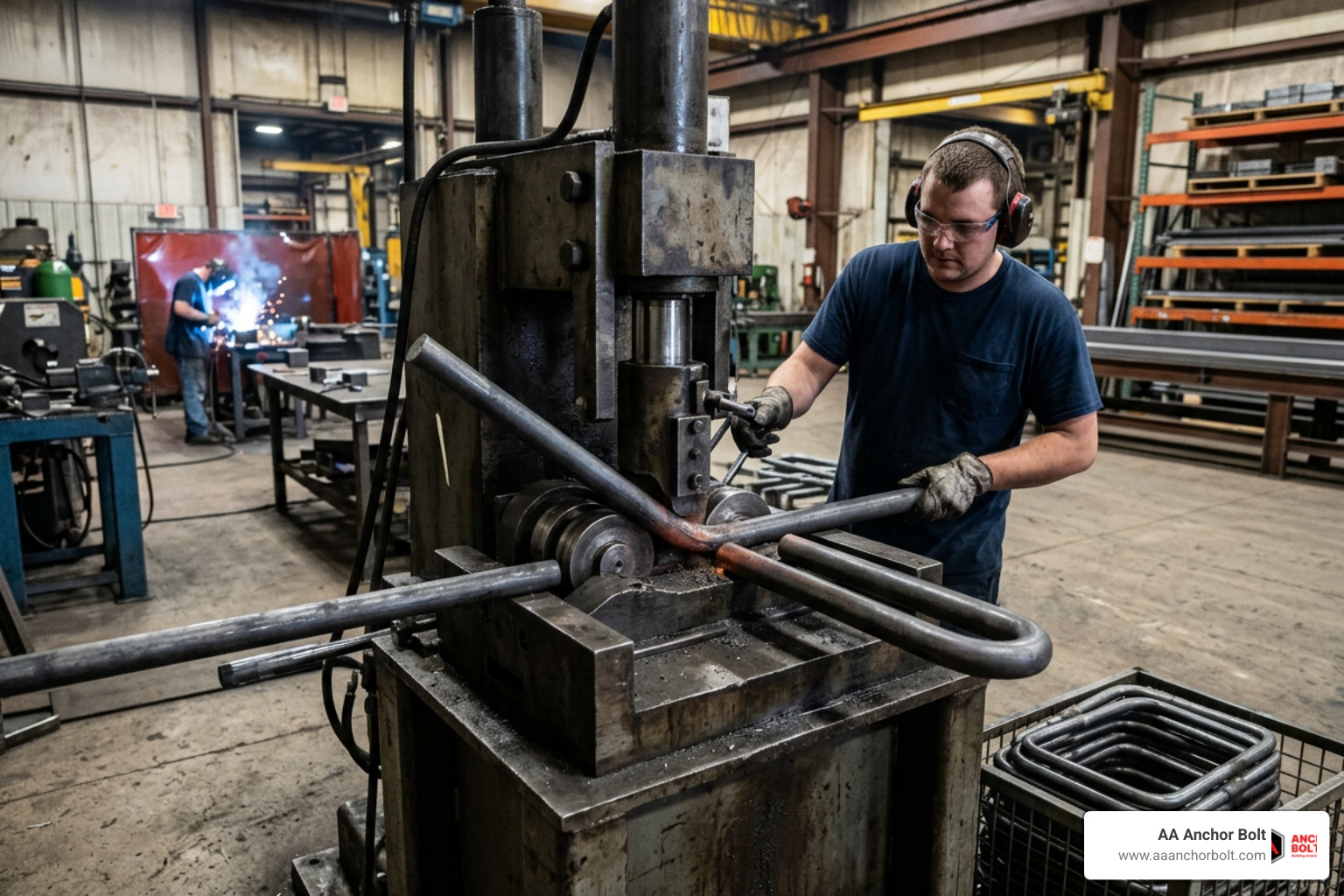
Cold-Bent vs. Forged U-Bolts
When sourcing or manufacturing U-bolts, you will face a classic engineering choice: cold-bent or hot-forged?
- Cold-Bent U-Bolts: These are formed at room temperature. The process of cold-bending actually work-hardens the steel, increasing its yield and tensile strength. For the vast majority of commercial, plumbing, and structural projects, cold bending is highly cost-effective and provides exceptional dimensional accuracy. At AA Anchor Bolt, our advanced Manufacturing Capabilities allow us to cold-form U-bolts with extreme precision.
- Forged U-Bolts: Forged U-bolts are heated to extreme temperatures before being shaped. Heating alters the steel’s internal grain structure, aligning the grain flows perfectly with the contours of the bend. This alignment gives forged U-bolts superior fatigue strength and makes them highly resilient in high-vibration, high-impact environments, such as heavy vehicle suspensions or extreme industrial machinery. However, this process is more energy-intensive and costly.
For most standard applications, cold-bent U-bolts provide the perfect balance of strength, speed of production, and cost-efficiency. Forged U-bolts are reserved for environments where cyclic fatigue is the primary failure threat.
U-Bolt Fasteners vs. Wire Rope Clamps
It is easy for those new to the field to confuse a standard U-bolt fastener with a wire rope U-bolt clamp (often referred to in the field as a “Bull Dog grip”). While they share a similar “U” profile, they are entirely different tools governed by different engineering standards.
- U-Bolt Fasteners: These are designed to secure piping, conduit, structural steel, or vehicle axles. They are governed by fastener standards such as AS 4291 or various ASTM specifications. They are engineered to distribute clamping force over a broad surface area, often working in tandem with backing plates or specialized saddles to prevent crushing the pipe or tube they hold.
- Wire Rope Clamps (Bull Dog Grips): These are rigging hardware, governed by strict rigging standards like AS 3776. Their sole purpose is to clamp two sections of wire rope together to form a temporary loop or eye. They feature a heavy-duty, grooved saddle that fits over the “live” end of the wire rope, while the U-bolt component clamps down on the “dead” end.
Using a standard utility U-bolt in place of a certified wire rope clamp in a rigging setup is incredibly dangerous and can lead to immediate failure under load.
Key Engineering Guidelines for Safe U-Bolt Bending
Bending steel is not just about raw power; it is about managing stress. If you bend a rod too quickly, too tightly, or with the wrong tooling, you introduce microscopic stress concentrations that will eventually cause the fastener to snap under load.

To prevent these issues, manufacturers use dedicated u-bolt bending dies designed to match the specific diameter and material grade of the rod. These dies ensure the force is applied evenly, preventing the rod from lifting off the forming surface and maintaining a uniform radius throughout the bend.
Another major threat in high-strength steel fabrication is hydrogen embrittlement. During chemical cleaning or electroplating, hydrogen atoms can penetrate the steel. If these bolts are not properly baked afterward to drive out the hydrogen, the stress concentrated at the bend radius can cause sudden, brittle fractures under normal workloads.
Minimum Bend Radius and Necking Limits in U-Bolt Bending
One of the most critical rules of thumb in u-bolt bending is respecting the minimum bend radius. If the bend is too sharp, the material on the outside of the curve will stretch excessively, a phenomenon known as “necking.”
Necking results in a direct loss of cross-sectional area. In standard low-tensile steels, necking typically causes a 5% loss of area. However, in high-tensile materials bent around tight radii, this reduction can jump to 8%. Any loss of cross-sectional area directly diminishes the load-carrying capacity of the bolt.
To maintain a safe structural margin, we follow these industry standards:
- Low-Tensile Materials: The minimum inside bend radius must be at least 0.50 times the wire/rod diameter.
- High-Tensile Materials: The minimum inside bend radius must be at least 0.70 times the wire/rod diameter. (For alloys with low ductility or toughness, this should increase to 0.80 times or more).
- Maximum Diameter Loss: The total diameter loss at the apex of the bend must never exceed 15% of the original rod diameter.
Using a specialized U-bolt bender helps fabricators maintain these exact ratios, keeping the rod firmly pressed against the die so that the material flows smoothly without thinning out.
Thread-to-Bend Distance and Flattening Rules
Another common pitfall is placing the threads too close to the start of the bend. When a rod is bent, the metal adjacent to the bend experiences plastic deformation. If this deformation zone overlaps with the threaded portion of the rod, the threads will distort, making it impossible to thread the nuts on properly. Even worse, the thread roots can act as starter cracks, leading to rapid fatigue failure.
- The Two-Diameter Rule: The minimum safe distance between the end of the bend radius and the start of the threads should be at least two times the wire diameter (with a general target of leaving at least one inch of unthreaded straight shank).
- Flattening and Coining: In some applications, the inside curve of the U-bolt is flattened (coined) to increase the contact surface area against the pipe or axle. While this helps distribute the load, a flat that overlaps into a tight bend radius can cause up to a 12% reduction in cross-sectional area due to severe localized necking. If your design requires a flattened surface, you must increase the bend radius to compensate for this loss of material.
These geometry rules are critical for ensuring the structural integrity of any custom-bent fastener.
How to Correctly Size and Select U-Bolt Materials
Sizing a U-bolt incorrectly is a classic “measure once, cry twice” scenario. The single most common mistake in the field is confusing Nominal Pipe Size (NPS) with the Actual Outside Diameter (OD) of the pipe.
For example, if you are supporting a standard 2-inch pipe, you might instinctively order a U-bolt with a 2-inch inside width. However, a nominal 2-inch pipe actually has an outside diameter of 2.375 inches! A 2-inch U-bolt simply won’t fit. You must always measure the actual OD of the object you are clamping and select a U-bolt with an inside width that provides roughly 1/16 to 1/8 inch of clearance.
To help you choose the right material and finish for your specific operating environment, we have put together this comparison:
| Material / Finish | Corrosion Resistance | Best Used For | Notes |
|---|---|---|---|
| Zinc-Plated Carbon Steel | Low (96-200 hrs salt spray) | Indoor, dry environments | Cost-effective; susceptible to rapid red rust outdoors. |
| Hot-Dip Galvanized (HDG) | Medium-High (40-80μm coating) | Outdoor, industrial, infrastructure | Excellent physical durability; rougher thread finish requires oversized nuts. |
| 304 Stainless Steel | High | Food processing, general outdoor | Excellent chemical resistance; prone to thread galling (use anti-seize). |
| 316 Stainless Steel | Excellent (2,000+ hrs salt spray) | Marine, coastal, chemical plants | Contains molybdenum to resist chloride pitting. |
When specifying high-strength structural projects, matching the right material standard is non-negotiable. At AA Anchor Bolt, we manufacture custom fasteners utilizing various grades of the F1554 Anchor Bolt specification, including:
- Grade 36: Low-carbon steel, perfect for general-purpose, weldable applications.
- Grade 55: High-strength, low-alloy steel, offering a higher yield strength for structural designs.
- Grade 105: Heat-treated alloy steel, designed for maximum load-carrying capacity and high-stress environments.
Main Types of U-Bolt Bends
The shape of the bend must match the profile of the object being secured. Using the wrong bend style concentrates the clamping force into tiny, high-stress contact points, which can damage the pipe or cause the bolt to slip.
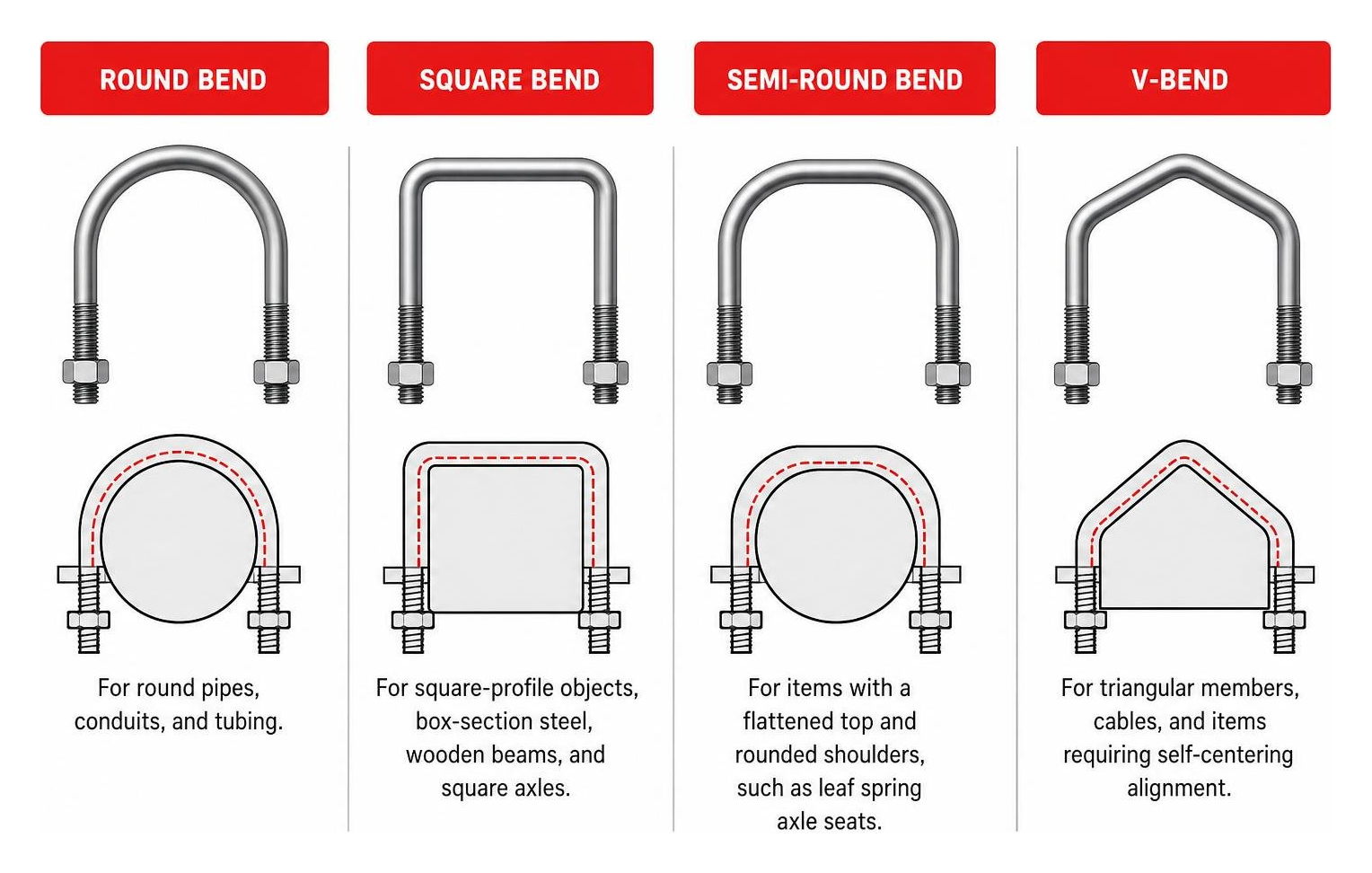
- Round Bend: The most common style. Used for securing round pipes, conduits, and tubing. It provides a uniform 180-degree grip around the circumference of the cylinder.
- Square Bend: Features a flat top with two 90-degree corners. These are designed to clamp square-profile objects, such as box-section steel frames, wooden beams, or square trailer axles.
- Semi-Round Bend: A hybrid shape that bridges the gap between round and square. It is frequently used in automotive leaf spring suspensions where the axle seat has a slightly flattened top but rounded shoulders.
- V-Bend: Designed with an angled apex. These are ideal for securing triangular structural members, anchoring cables, or clamping objects that require self-centering alignment.
Matching these shapes to your specific industrial needs ensures optimal load distribution and prevents premature failure.
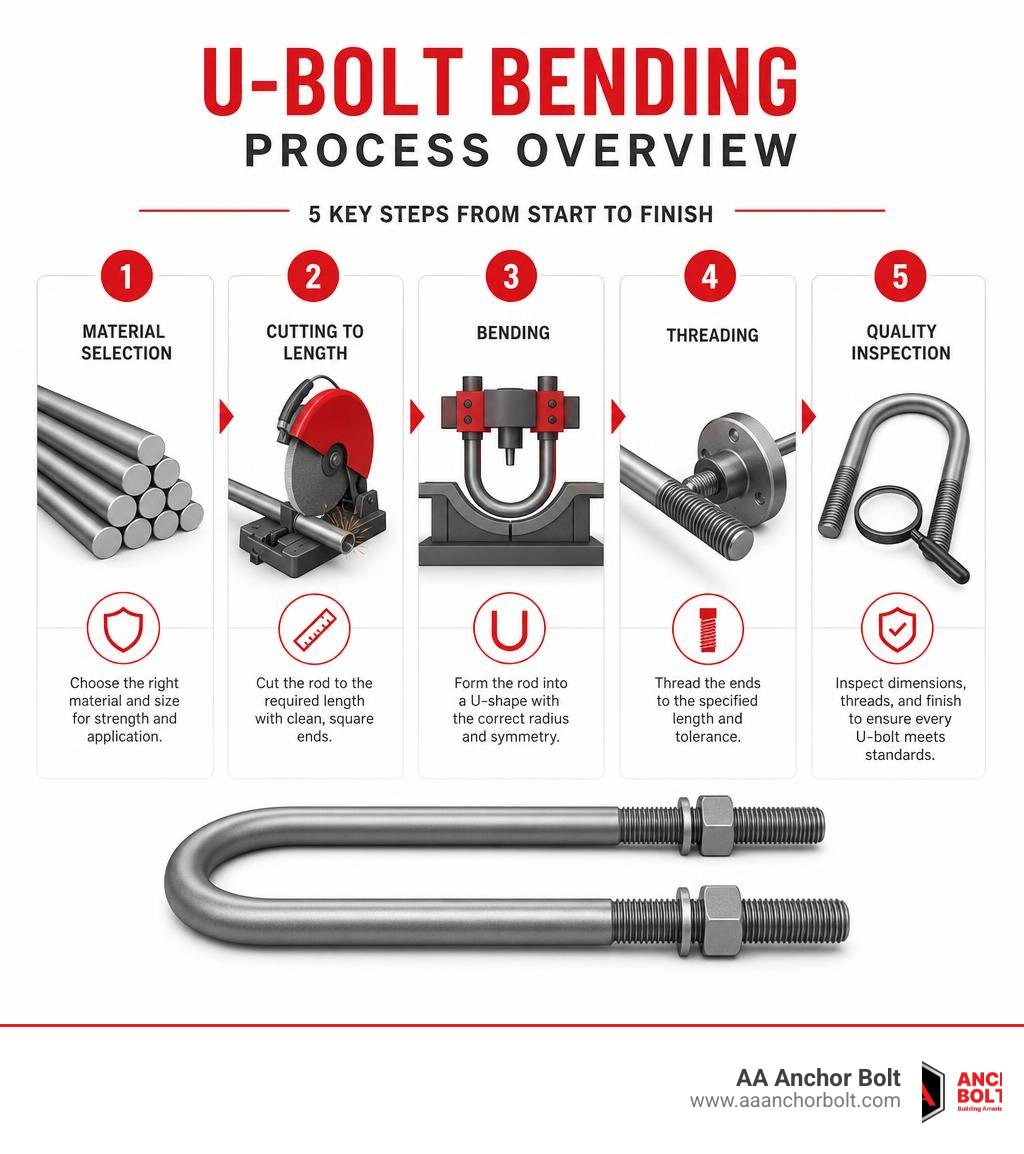
How to Bend a U-Bolt in 5 Simple Steps
When we manufacture U-bolts, we utilize high-precision industrial machinery to ensure consistency across thousands of parts. However, the fundamental physical steps remain the same whether you are using an automated CNC bender in our Michigan facility or working with a manual shop bender.
To achieve a perfect bend, you must account for spring-back — the tendency of the steel to slightly unbend once the forming pressure is released. The harder and higher-tensile the steel, the more spring-back you will experience.
For a medium-tensile steel rod, a professional cold-forming setup can regularly meet a tight centerline-to-centerline width tolerance of +/- 0.030 inches. However, if your U-bolt has extra-long legs (exceeding 20 inches), standard centerline tolerances no longer apply, and you must assign custom, part-by-part tolerances to account for the natural flexibility of long steel rods.
If you need a professional team to handle your custom bending needs with rapid turnaround, partnering with an experienced domestic manufacturer is key.
Step-by-Step Guide to Precision U-Bolt Bending
Here is how we turn raw steel bar stock into a perfectly formed, high-strength U-bolt:
Step 1: Material Selection & Cutting
We select the correct steel grade (such as F1554 Grade 36, 55, or 105) based on the project’s load and environmental requirements. The raw round stock is then cut to the exact “unfolded” length required. This length is calculated by adding the two leg lengths to the circumference of the bend radius, while subtracting a small factor for material stretch during forming.
Step 2: Thread Rolling
We thread the ends of the straight rod before bending. Thread rolling is far superior to thread cutting. Instead of removing metal and creating sharp, weak valleys, thread rolling uses high-pressure dies to cold-flow the steel into shape. This process results in work-hardened, incredibly tough threads that possess a smooth surface finish. Because we use rolled threads, the starting wire must be drawn to the thread’s pitch diameter rather than its major diameter, allowing the displaced metal to rise and form the thread crests perfectly.
Step 3: Die Setup & Alignment
The operator selects the bending die that matches the required inside width and minimum bend radius of the U-bolt. The straight, threaded rod is loaded into the bender and aligned using a centerline stop. This step ensures that both legs will be exactly equal in length after the bend is complete.
Step 4: Cold Forming (The Bend)
The bending arms sweep downward in a single, continuous motion, wrapping the steel rod around the forming die. Our machinery uses a specialized wedge-lock design to hold the rod firmly against the die. This prevents the rod from lifting or shifting, which eliminates the risk of ovaling, twisting, or uneven leg lengths. The machine is programmed to slightly “over-bend” the steel to perfectly compensate for the material’s natural spring-back.
Step 5: Quality Inspection
The completed U-bolt undergoes rigorous quality control. We measure the centerline width, leg length, and thread alignment. We also perform a visual inspection for any tooling marks, surface cracking, or excessive necking at the radius to ensure the bolt meets all design tolerances.
For engineering drawings, weight charts, and detailed material specifications, you can access our library of technical Resources.
Installation Best Practices, Torque, and Applications
Even a perfectly manufactured U-bolt will fail if it is installed incorrectly. The golden rule of U-bolt installation is even, incremental tightening.
If you tighten one nut completely before starting on the other, you will cock the U-bolt. This concentrates all the stress on one side of the bend radius, deforming the bolt and significantly reducing its holding power. Always tighten the nuts in alternating passes (e.g., 50% torque on Nut A, 50% on Nut B, then 100% on both) using a cross-pattern sequence.
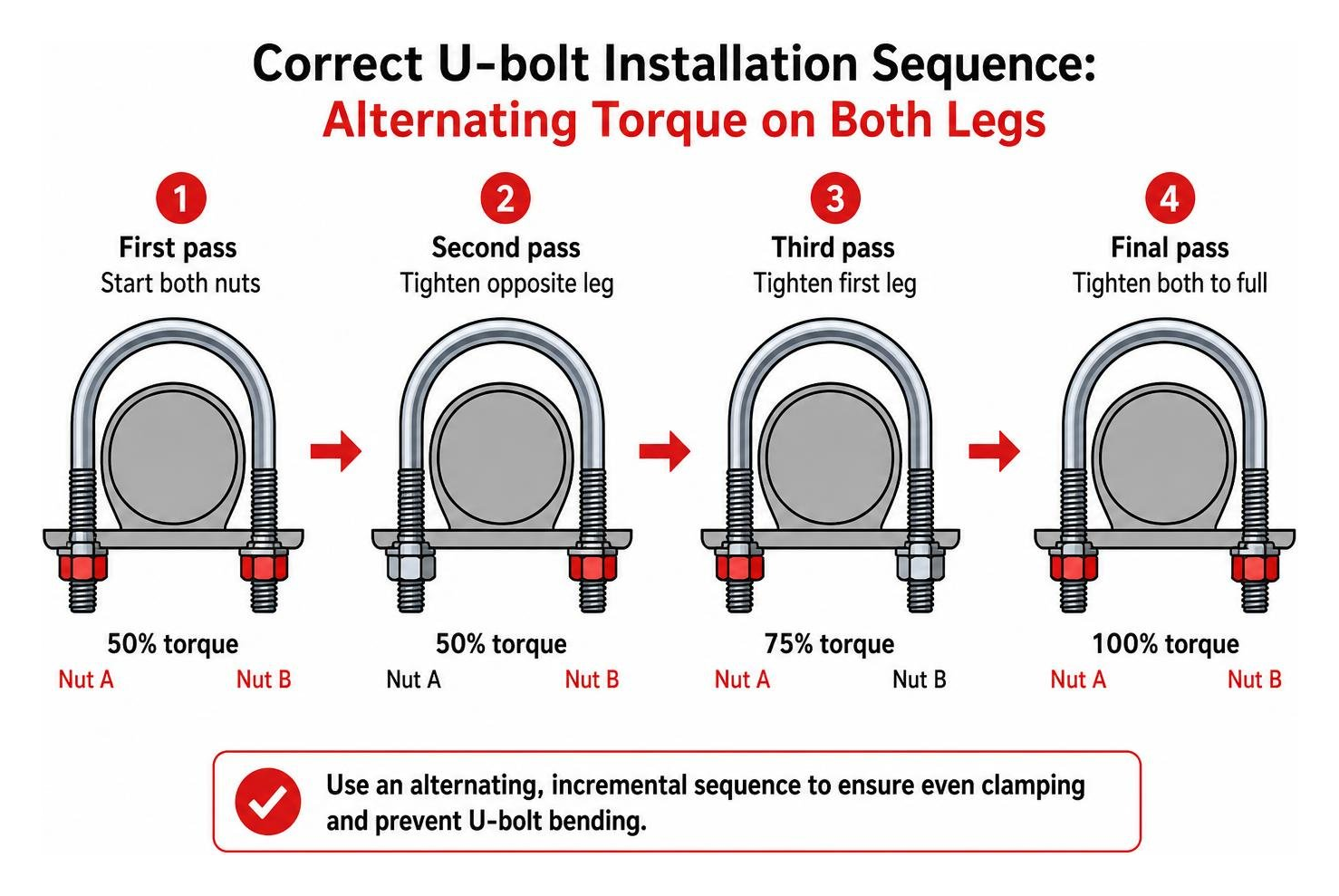
When installing U-bolts in heavy vehicle suspensions or leaf spring packs, they act as safety-critical tension members. These bolts are designed to stretch slightly to lock the spring plates in place. Because they undergo this permanent plastic deformation during their initial torquing, they are considered torque-to-yield fasteners.
Once you loosen or remove a leaf spring U-bolt, its internal steel structure has been permanently altered. Reusing it means it will not hold the correct torque, leading to loose axles, “axle wrap,” and catastrophic suspension failure. Always replace leaf spring U-bolts with new hardware upon disassembly.
In industrial piping systems, U-bolts are governed by codes like ASME B31.3. Here, you must distinguish between two primary installation styles:
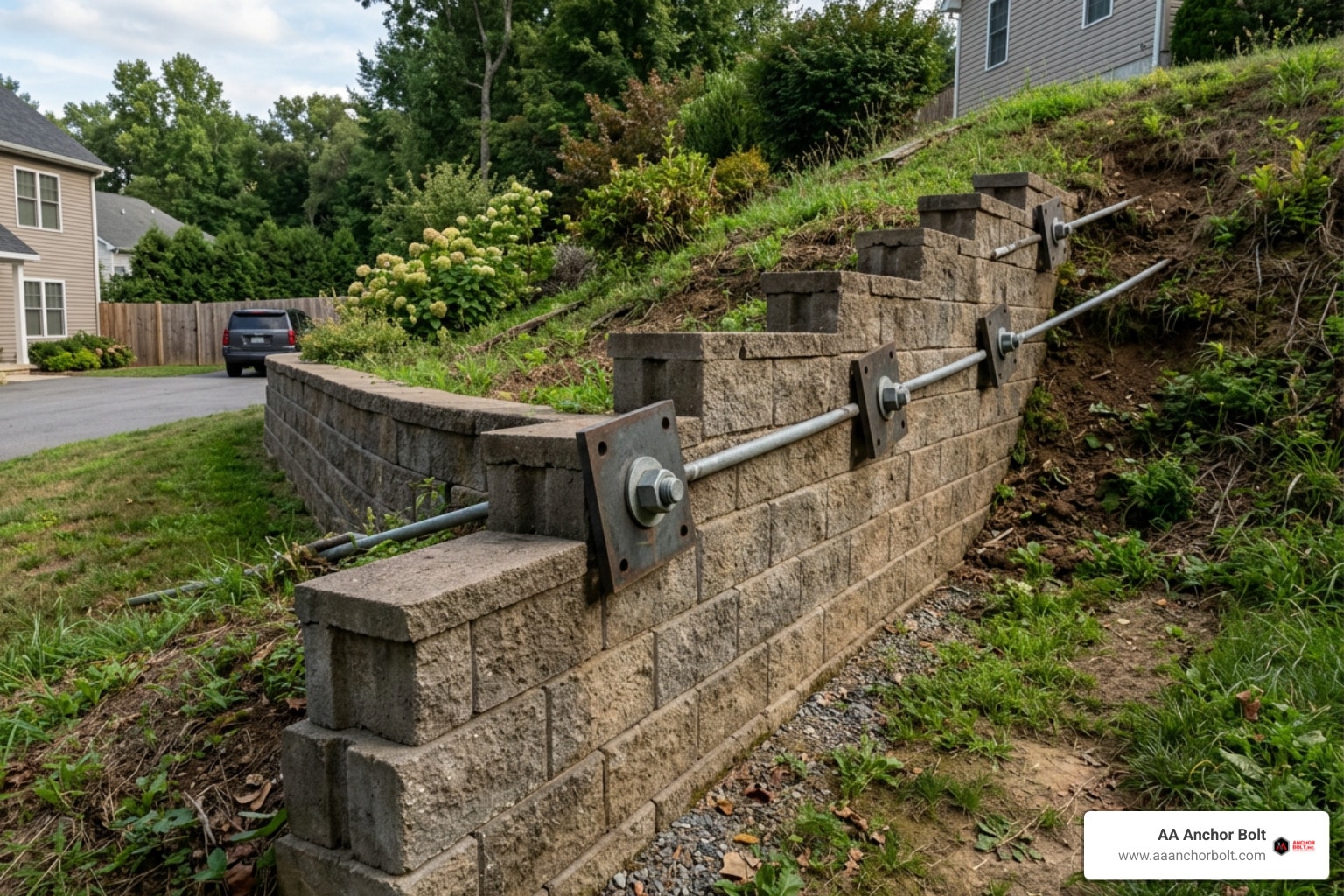
- Gripped U-Bolts: These clamp the pipe tightly against the structural beam, acting as a rigid, 3D anchor.
- Non-Gripped U-Bolts: These function as lateral guides. To allow the pipe to expand and contract thermally without buckling, you must leave a physical air gap of 1.5 mm to 2.0 mm between the top of the pipe and the inside radius of the U-bolt. Over-tightening a non-gripped guide is a common field error that can destroy structural steel supports when the steam or process lines heat up.
To master the nuances of industrial pipe supports, check out the Ultimate Guide to U-Bolt Pipe Support: Types, ASME Installation, and Field Applications – EPCLand.
Frequently Asked Questions about U-Bolt Bending
Can you re-bend an existing U-bolt for safety-critical applications?
Absolutely not. Bending steel causes localized work-hardening and plastic deformation. If you attempt to re-bend a used U-bolt — especially one from a heavy-duty application like a vehicle’s leaf springs — you are forcing the steel through a second cycle of extreme stress.
This dramatically increases the risk of micro-cracking and metal fatigue. The bolt will lose its elastic properties, preventing it from holding the proper torque, and will likely snap under load. For peace of mind and structural safety, always source new, custom-bent hardware from trusted domestic manufacturers.
Why do U-bolts fail at the bend radius?
The bend radius is the natural weak point of any U-bolt. During the bending process, the outer fibers of the steel are stretched, resulting in a slight reduction of cross-sectional area (necking).
If the bend radius is designed too tight, or if the fabricator uses improper tooling, micro-cracks will form along this outer curve. When the bolt is put into service, these micro-cracks act as stress concentration points. Under cyclic loading, thermal expansion, or vibration, these cracks will propagate through the steel, leading to a sudden, catastrophic fatigue failure.
What is the difference between rolled and cut threads on a bent U-bolt?
Cut threads are made by physically carving away steel from a full-diameter rod. This process leaves sharp, jagged microscopic valleys that act as stress risers, making the threads prone to stripping and fatigue cracking.
Rolled threads, on the other hand, are formed by squeezing the steel between heavy-duty dies, forcing the metal to flow into the thread shape. This cold-working process work-hardens the steel, making rolled threads up to 30% stronger and highly resistant to stripping. Additionally, rolled threads have a much smoother surface finish, which reduces friction during installation and ensures more accurate torque readings.
Conclusion
At AA Anchor Bolt, we understand that a U-bolt is never “just a piece of bent metal.” Whether it is anchoring a massive structural column, guiding a high-pressure steam line, or securing heavy transportation equipment, the safety of your project relies on the structural integrity of that bend.
As a family-owned, Michigan-based manufacturer, we control every step of our domestic production process. With nearly a million pounds of raw steel kept in-house at all times, we can deliver the fast turnarounds, custom dimensions, and rigorous quality control that your job demands.
Ready to get started on your next project? Browse our full range of high-quality, custom-manufactured Products today, or get in touch with our team for a fast, reliable quote.