The Complete Guide to F1554 Anchor Bolt Specs
What You Need to Know About the F1554 Anchor Bolt (Fast Answer)
An F1554 anchor bolt is a steel anchor rod manufactured to ASTM F1554 — the primary standard governing anchor bolts used to secure structural supports to concrete foundations. It comes in three strength grades:
| Grade | Min. Yield Strength | Tensile Strength Range | Common Use |
|---|---|---|---|
| 36 | 36 ksi | 58–80 ksi | Light poles, general structural |
| 55 | 55 ksi | 75–95 ksi | Building columns, sign structures |
| 105 | 105 ksi | 125–150 ksi | Heavy-load, high-strength applications |
If you work on infrastructure projects — bridges, highway signs, steel-framed buildings — you’ve run into the ASTM F1554 specification. It’s the go-to standard for structural anchor bolts in the U.S., and for good reason.
Before F1554 existed, contractors and engineers pieced together anchor bolt specs from standards that weren’t really designed for the job. The result? Material variability, incompatible hardware, and anchors that didn’t behave the way the design assumed.
F1554 changed that. Introduced in 1994, it gave the industry a single, focused standard — one that covers not just the rod itself, but also compatible nuts and washers, weldability requirements, and identification marking. Today, it’s the specification you’ll see called out on nearly every structural anchor bolt detail in commercial and infrastructure construction.
This guide breaks down everything you need to know: grades, mechanical properties, hardware compatibility, supplementary requirements, design considerations, and what to look for when ordering.
What is the ASTM F1554 Anchor Bolt Specification?
At its core, the F1554 Standard Specification for Anchor Bolts, Steel, 36, 55, and 105-ksi Yield Strength is the definitive industry standard for steel anchor bolts intended for anchoring structural supports to concrete foundations. Published by ASTM International, this specification ensures that the fasteners holding up our buildings, bridges, and highway signs possess highly predictable chemical and mechanical properties.
Unlike generic steel fasteners, an f1554 anchor bolt is engineered specifically for concrete embedment. This concrete-to-steel connection is a critical load transfer path. If the steel behaves unpredictably under tension or shear, the entire structural calculation falls apart. By specifying ASTM F1554, engineers can design foundations with absolute confidence in the raw steel’s performance.
The specification is highly versatile, covering three distinct configurations of anchor bolts:
- Straight Rods: Threaded on both ends or fully threaded, often used with a nut and washer embedded in the concrete to act as the head.
- Bent Bolts: Commonly referred to as L-bolts, these feature a 90-degree hook at the unthreaded end to provide mechanical anchorage in the concrete.
- Headed Bolts: These have a forged heavy hex, square, or tee head on the embedded end, offering robust pull-out resistance.
Scope and Structural Applications of the F1554 Anchor Bolt
The structural applications for the F1554 Anchor Bolt are incredibly broad. You will find them anchored deep in concrete footings across a wide array of public and private projects:
- Structural Steel Buildings: Securing heavy structural steel columns to concrete piers and slab foundations.
- Traffic Signal and Street Lighting Poles: Resisting the constant wind loads and vibration forces acting on overhead poles.
- Highway Sign Structures: Anchoring large overhead truss systems that span across multi-lane highways.
- Industrial Machinery Bases: Fastening heavy, vibrating manufacturing equipment safely to factory floors.
Because these applications range from light-duty commercial buildings to massive wind-swept highway signs, the standard provides three distinct strength grades to match the load demands of each project.
Historical Context: Transitioning from ASTM A307 to F1554
To appreciate why ASTM F1554 is so widely used today in July 2026, it helps to look at the history of structural anchor specs. Before ASTM F1554 was introduced in 1994, the industry relied on a patchwork of other steel specifications.
The most common was ASTM A307. Specifically, ASTM A307 Grade C was frequently specified for low-carbon steel anchor bolts. However, A307 is primarily a general-use fastener spec. It lacked the rigorous mechanical testing and concrete-specific requirements necessary for critical structural anchoring.
To eliminate confusion, ASTM officially withdrew A307 Grade C in 2007, replacing it entirely with ASTM F1554 Grade 36. This transition was a massive win for structural engineers. It moved the industry away from generic, unpredictable steel fasteners and toward a dedicated, highly regulated anchoring standard.
Mechanical Properties and Grades of ASTM F1554
The ASTM F1554 specification is divided into three distinct grades. These grades represent the minimum yield strength of the steel in kilopounds per square inch (ksi). Knowing the mechanical differences between these grades is essential for choosing the right bolt for your project.
| Mechanical Property | Grade 36 | Grade 55 | Grade 105 |
|---|---|---|---|
| Minimum Yield Strength | 36 ksi | 55 ksi | 105 ksi |
| Tensile Strength Range | 58–80 ksi | 75–95 ksi | 125–150 ksi |
| Min. Elongation (2 in.) | 23% | 21% | 15% |
| Min. Reduction of Area | 40% | 30% | 45% |
| Weldable? | Yes (Standard) | Yes (With S1 Requirement) | No (Heat-Treated Alloy) |
ASTM F1554 Grade 36
Manufactured from low-carbon steel, Grade 36 is the most common and economical grade of the three. It features a minimum yield strength of 36 ksi and a tensile strength range of 58 to 80 ksi.
One of the standout characteristics of Grade 36 is its excellent ductility. It requires a minimum elongation of 23% in 2 inches and a minimum reduction of area of 40%. This high ductility makes it incredibly forgiving in seismic zones or dynamic loading applications, where the steel must stretch and absorb energy before failing. Because of its low carbon content, Grade 36 is also naturally weldable without any special chemical modifications. For more technical background, you can review the Astm f1554 Grade 36 documentation.
ASTM F1554 Grade 55
Grade 55 is a medium-carbon or low-alloy steel that steps up the strength, offering a minimum yield strength of 55 ksi and a tensile strength range of 75 to 95 ksi. It bridges the gap between the economical Grade 36 and the ultra-high-strength Grade 105.
Grade 55 requires a minimum elongation of 21% in 2 inches. By default, standard Grade 55 steel may not be easily weldable due to higher carbon and manganese limits. However, if your project requires welding, you can specify Supplementary Requirement S1 (which we will cover in detail below) to ensure a weldable chemical composition.
ASTM F1554 Grade 105
When your project demands maximum load-carrying capacity in a compact footprint, Grade 105 is the answer. Manufactured from medium-carbon alloy steel, Grade 105 undergoes a rigorous heat-treatment process (quenching and tempering) to achieve its high-strength properties.
It boasts a minimum yield strength of 105 ksi and a tensile strength range of 125 to 150 ksi. Because it is a high-strength, heat-treated alloy steel, it has lower ductility than the other grades, requiring a minimum elongation of 15% in 2 inches.
Hardware Compatibility and Supplementary Requirements
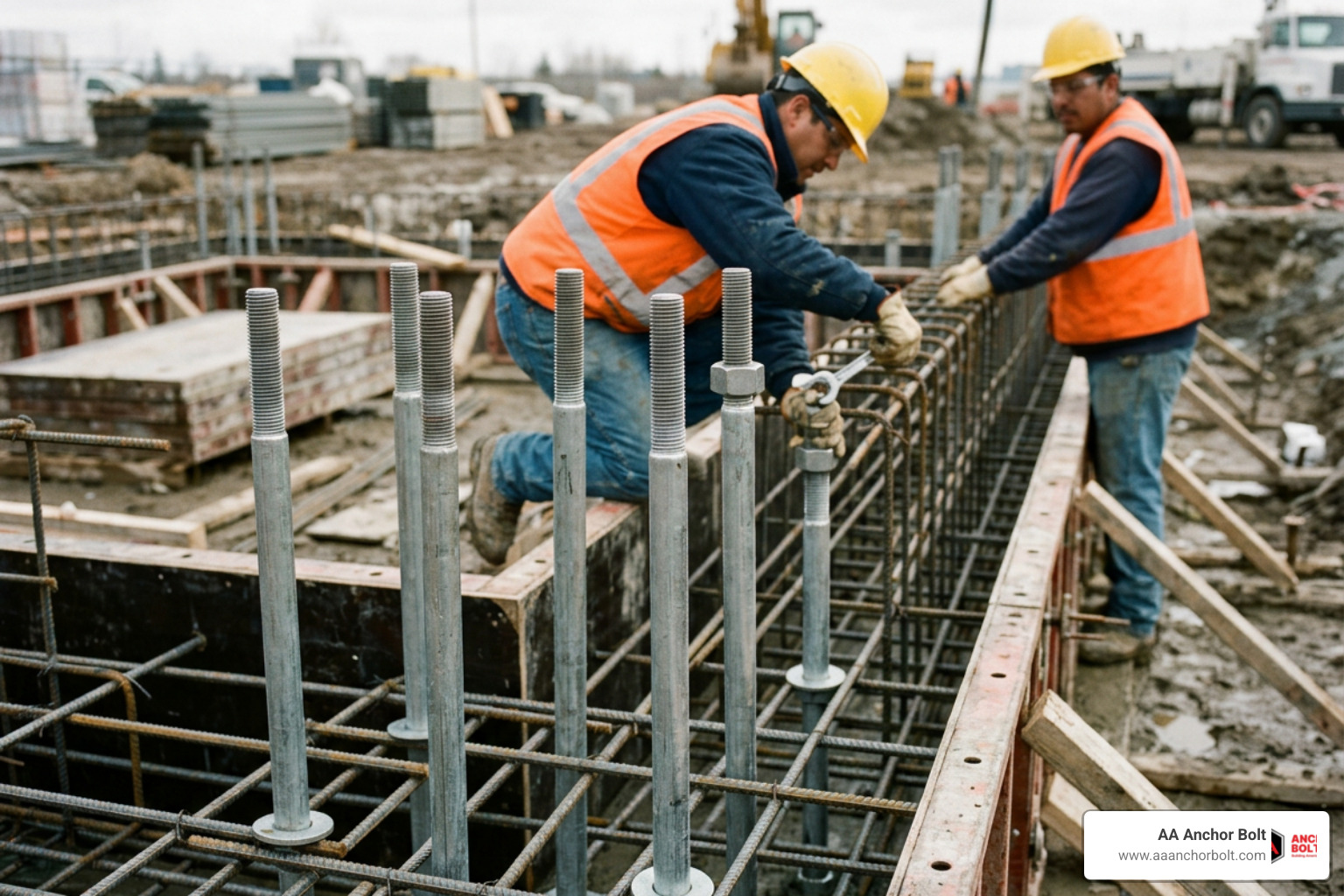
An anchor bolt is only as strong as the hardware holding it together. If you pair a high-strength Grade 105 bolt with a weak, low-carbon nut, the threads will strip long before the bolt reaches its yield point. That is why ASTM F1554 outlines strict hardware compatibility guidelines.
Additionally, the standard specifies Thread Class 2A as the default for imperial threads. This class provides a standard clearance fit that accommodates hot-dip galvanized coatings, which are commonly applied to protect the assemblies from corrosion on outdoor jobsites.
Recommended Nuts and Washers for Each Grade
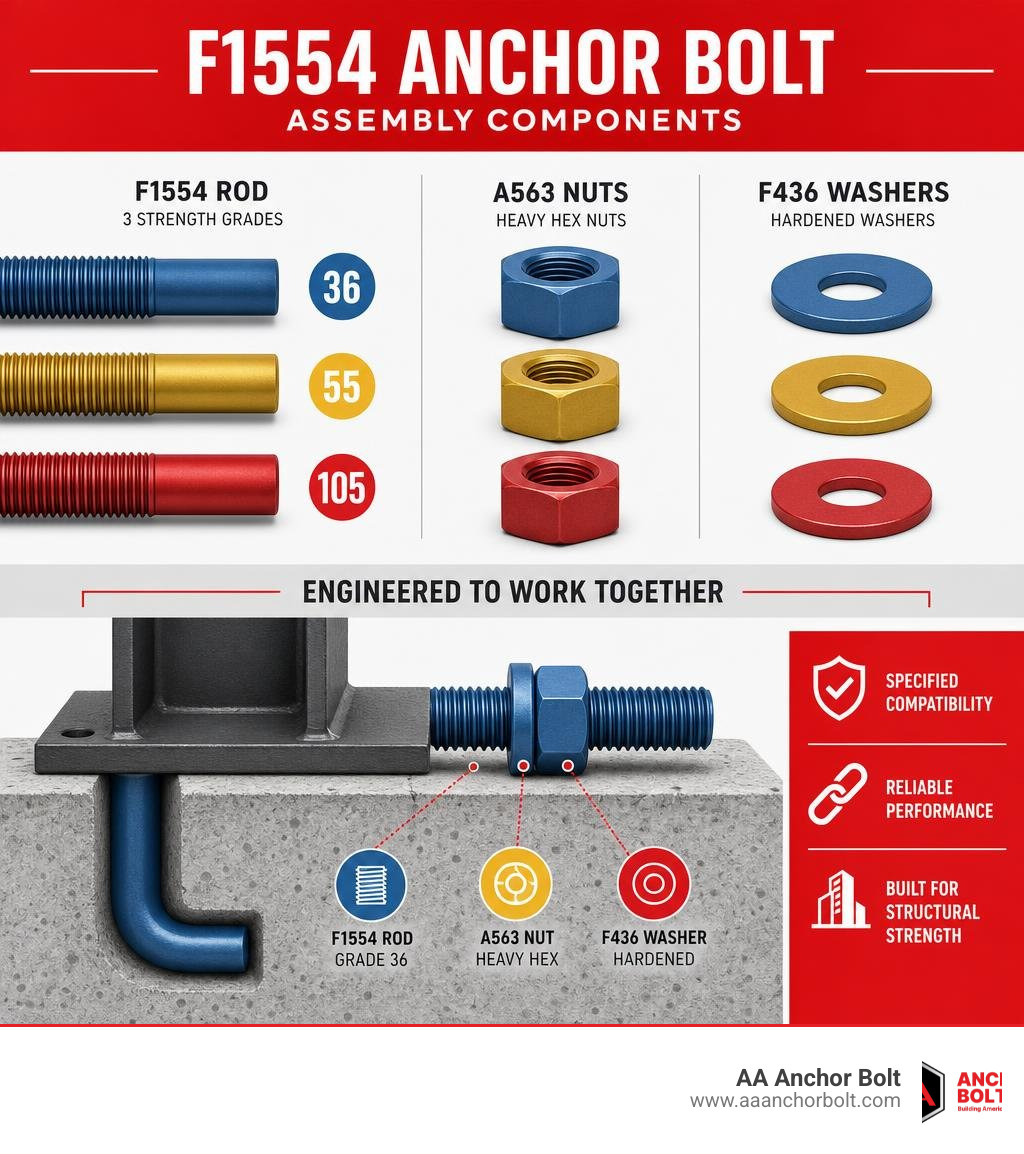
To make life easier for specifiers and contractors, ASTM F1554 includes a clear matrix of recommended nuts (under ASTM A563) and washers (under ASTM F436) for each grade and diameter.
For a deep dive into these hardware pairings, check out our guide on Demystifying ASTM F1554 Grades 36, 55 and 105.
Here is a quick summary of the standard hardware recommendations:
- Grade 36: Typically paired with ASTM A563 Grade A heavy hex nuts and ASTM F436 Type 1 flat washers.
- Grade 55: Generally paired with ASTM A563 Grade DH or A563 Grade C heavy hex nuts and ASTM F436 Type 1 flat washers.
- Grade 105: Requires high-strength ASTM A563 Grade DH or ASTM A194 Grade 2H heavy hex nuts alongside ASTM F436 Type 1 structural washers.
When these assemblies are hot-dip galvanized, the zinc coating adds thickness to the threads. To ensure the nuts can still thread onto the bolts, the nuts must be overtapped in accordance with ASTM A563. This overtapping is carefully calculated to maintain full thread engagement and tensile strength.
Supplementary Requirements: Weldability (S1) and Charpy Impact Testing
The standard ASTM F1554 specification covers all the basics, but some projects require extra quality controls. That’s where Supplementary Requirements (S-codes) come in. When ordering, you can specify these optional tests and requirements:
- S1 (Weldable Grade 55): By default, Grade 55 is not guaranteed to be weldable. Specifying S1 restricts the chemical composition (limiting carbon and carbon-equivalent content) to ensure the steel can be safely welded in the field or shop without cracking or losing its mechanical properties.
- S4 & S5 (Charpy V-Notch Impact Testing): For structures subjected to dynamic, seismic, or wind-induced fatigue loads, toughness is critical. Specifying S4 requires Charpy V-notch impact testing at +40°F, while S5 requires testing at -20°F. For both Grade 55 and Grade 105, the minimum Charpy V-notch energy requirement under supplementary requirement S4 is an average of 15 ft-lbs for three specimens, with no single specimen falling below 12 ft-lbs.
Grade Identification and Color Coding for the F1554 Anchor Bolt
On a busy, chaotic jobsite, keeping track of different steel grades can be a nightmare. To prevent installers from accidentally putting a Grade 36 bolt where a Grade 105 bolt belongs, ASTM F1554 establishes a highly visible color-coding system for field identification:
- Blue: Grade 36
- Yellow: Grade 55
- Red: Grade 105
Typically, the manufacturer paints the exposed end of the anchor bolt with the corresponding color. However, paint can chip, fade, or get covered in concrete splatter.
If you want permanent traceability, you can specify Supplementary Requirement S2 (which adds a permanent manufacturer’s identification mark to the end of the bolt) or S3 (which adds a permanent grade identification stamp, such as “36”, “55”, or “105”, directly onto the steel).
Engineering Design and Post-Installed Adhesive Applications
Designing concrete foundations and their steel connections requires adherence to strict engineering codes. In the United States, structural engineers rely on standard design frameworks like ACI 318 Appendix D (for concrete anchorage) and AISC Design Guide 1 (for base plate design) to calculate the capacities of an f1554 anchor bolt.
Designing for Combined Tension and Shear
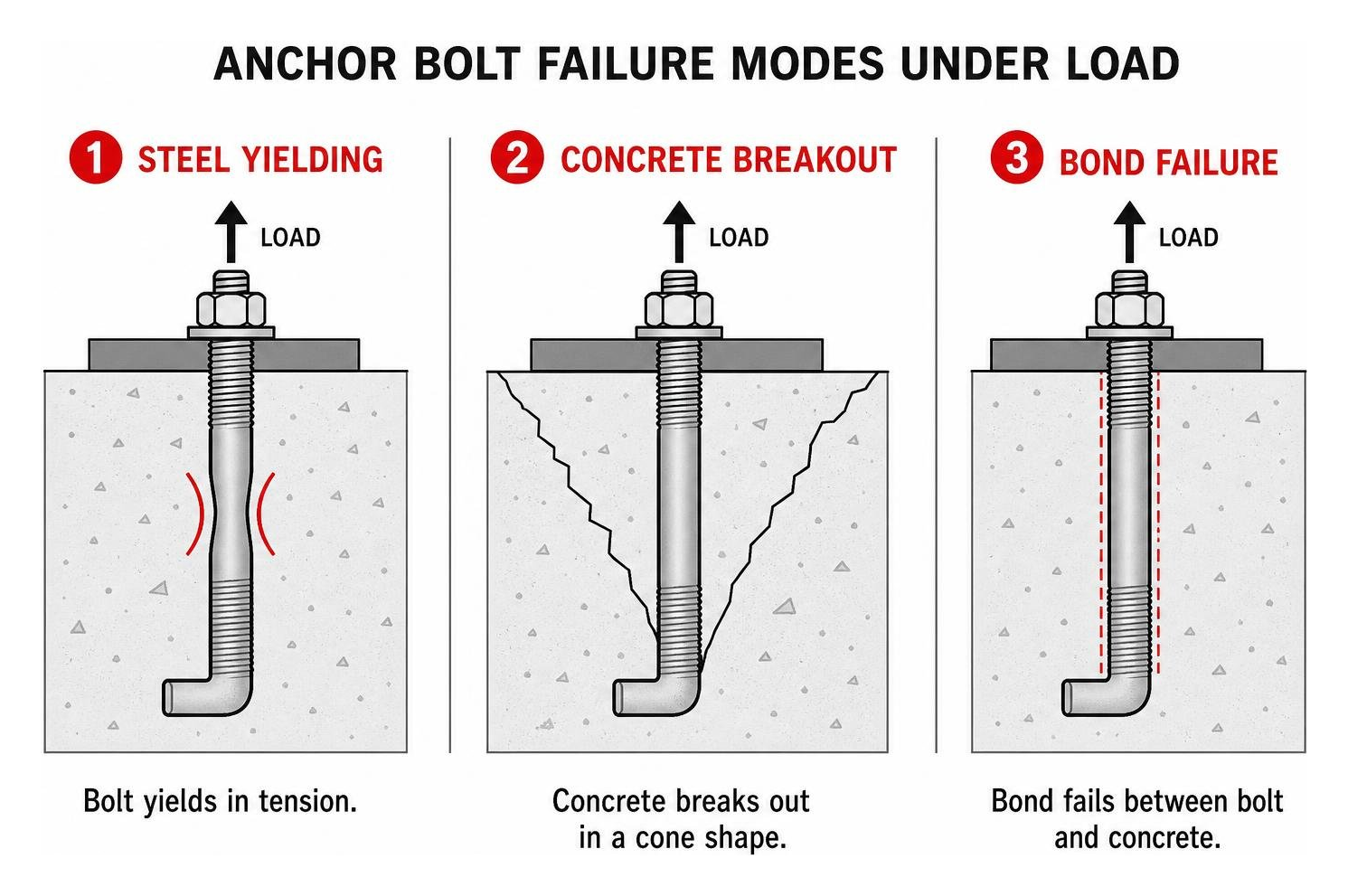
In real-world applications, anchor bolts are rarely subjected to pure tension or pure shear alone. Wind blowing against a highway sign pushes the structure sideways (shear) while trying to overturn it (tension).
To design for these combined forces, engineers use interaction equations defined by codes like AISC J3.7. The design process involves checking several limit states:
- Steel Strength in Tension: The physical limit of the bolt material itself under tension.
- Steel Strength in Shear: The shear capacity of the bolt, which is often reduced if oversized base plate holes prevent all bolts from sharing the shear load equally.
- Concrete Breakout Strength: Calculating whether the concrete surrounding the bolt will crack and pull out in a cone shape before the steel yields.
- Pullout / Bond Strength: Ensuring the bolt head or L-bend doesn’t slip through the concrete.
By utilizing the predictable tensile and yield properties of F1554 steel, engineers can design a ductile connection where the steel yields safely before a sudden, brittle concrete breakout occurs.
Advantages of F1554 Rods in Adhesive Anchoring Systems
While ASTM F1554 was originally written for cast-in-place anchors, it has become incredibly popular for post-installed adhesive anchoring systems. In these applications, a hole is drilled into cured concrete, filled with a structural adhesive, and an F1554 threaded rod is inserted.
Using an F1554-compliant rod in adhesive systems offers several major advantages over generic threaded rods:
- Predictable Ductile Failure: Because F1554 rods have specified tensile and yield ranges (not just minimums), engineers can count on predictable steel yielding during extreme seismic or overload events.
- Thread Consistency: High-quality threading ensures maximum bond strength with the structural adhesive.
- Jobsite Verification: Head markings and color-coding make it easy for building inspectors to verify that the correct grade of rod was installed in the adhesive.
To understand how these rods behave under design loads, you can read the engineering analysis in What does ASTM F1554 mean in my anchor design? .
Frequently Asked Questions about F1554 Anchor Bolts
For more deep-dive technical documents and guides, head over to our Resources page. Here are some of the most common questions we hear from contractors and estimators:
Can you weld ASTM F1554 Grade 105 anchor bolts?
No, you should never weld Grade 105 anchor bolts. Grade 105 is a high-strength, alloy steel that achieves its mechanical properties through a precise heat-treatment (quenching and tempering) process.
Applying the extreme heat of welding to Grade 105 steel will alter its microscopic grain structure, destroying the heat-treatment. This creates localized brittle zones, drastically reducing both the yield strength and the ductility of the bolt, which can lead to sudden catastrophic failure under load. If welding is required, you must use Grade 36 or specify weldable Grade 55 (S1).
How does ASTM F1554 Grade 36 differ from ASTM A36 steel?
While they share a similar chemistry and the same 36 ksi minimum yield strength, they are governed by different standards for different purposes:
- ASTM A36 is a broad structural steel specification. It covers steel shapes like wide-flange beams, channels, and plates. It does not specifically cover fasteners or threaded anchor rods.
- ASTM F1554 Grade 36 is a dedicated fastener specification. It includes specific requirements for thread tolerances, fastener ductility, packaging, and compatible hardware (nuts and washers) that are completely absent from the A36 structural steel specification.
What is the difference between ASTM A307 Grade A and F1554 Grade 36?
Although both are low-carbon steels, they are not interchangeable in structural designs:
- ASTM A307 Grade A is a general-purpose bolt specification (think standard hex bolts used in non-structural piping or utility applications). Crucially, A307 Grade A has no specified minimum yield strength requirement.
- ASTM F1554 Grade 36 is engineered for structural concrete anchoring. It guarantees a minimum yield strength of 36 ksi, giving structural engineers the mathematical predictability they need to calculate safe load capacities.
Conclusion
At AA Anchor Bolt, we understand that structural integrity starts at the foundation. As a Michigan-based, family-owned manufacturer, we take pride in supporting the construction and infrastructure industries from our Northville, MI facility.
Our unique strength lies in our complete domestic production control and our massive inventory — maintaining nearly a million pounds of in-house steel. This allows us to provide custom manufacturing and incredibly fast turnarounds on straight, bent, and headed anchor bolts.
Whether you need a standard Grade 36 L-bolt or a custom, heat-treated Grade 105 assembly with specific Charpy impact testing, we have the material, the machinery, and the expertise to deliver.
Ready to secure your next project? Explore our comprehensive line of Products or request a quote for your custom F1554 Anchor Bolt requirements today. We look forward to working with you!