Anchor Bolt Threading Machines and How They Work
Step-by-Step Anchor Bolt Manufacturing Process
When we look at anchor bolt production and threading, the journey from raw steel stock to a structural fastener requires precise mechanical control at every stage. Producing a high-capacity anchor, such as a concrete wedge anchor, demands that each blank meets exact dimensional tolerances before any threads are formed. To understand more about structural fastener choices, check out The Concrete Fastener Guide for Heavy Duty Anchoring.
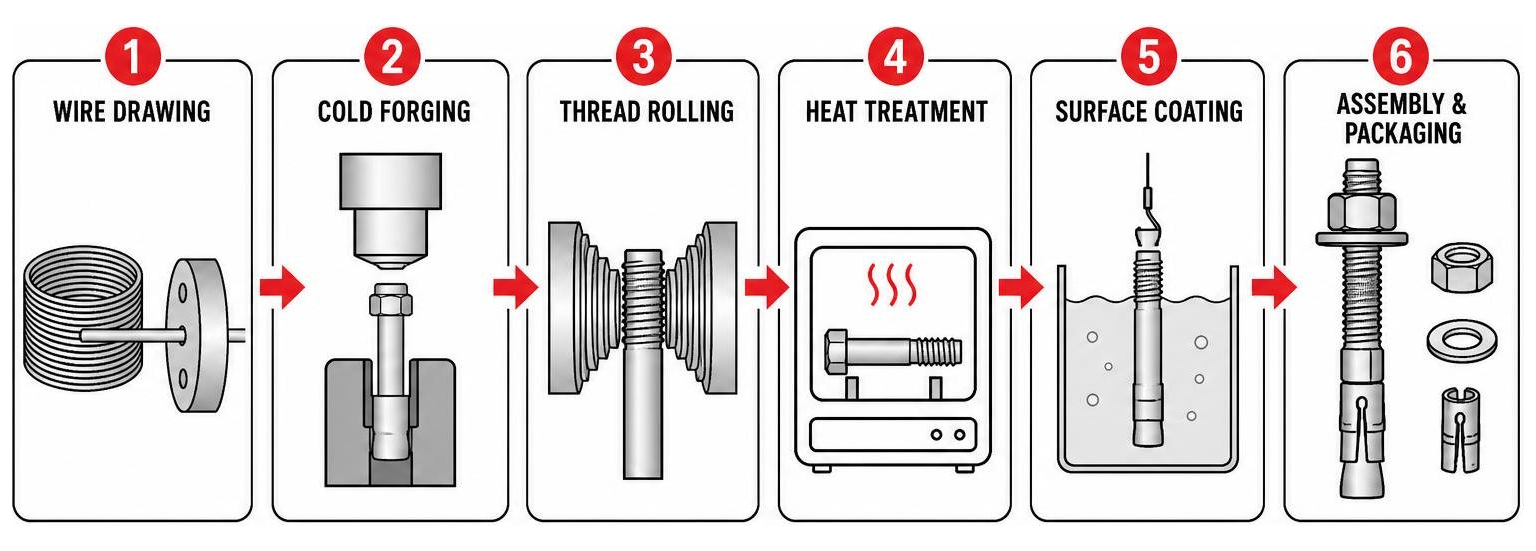
The standard manufacturing workflow consists of six continuous operations:
- Wire Drawing: Large coils of raw steel wire are unreeled and drawn through carbide dies to establish a uniform outer diameter and remove surface imperfections.
- Cold Forging: Precision header machines cut the drawn wire to length and cold-form the bolt features, including the tail step and head architecture.
- Thread Rolling: The shank passes through high-pressure thread rolling dies that displace metal cold to form precise pitch threads without producing chips.
- Heat Treatment: Semi-finished bolts are thermally processed (quenched and tempered) to meet specified hardness and tensile performance ratings.
- Surface Coating: Protective finishes such as electro-zinc plating or hot-dip galvanizing are applied to prevent environmental corrosion.
- Assembly and Packaging: Expansion clips, nuts, and washers are fitted onto the forged body to create complete anchor units ready for jobsite installation.
Cold Forging Role in Anchor Bolt Production and Threading
Cold forging is the foundation of high-speed anchor bolt manufacturing. Rather than heating the steel or cutting away excess material on a lathe, cold forming machinery forces the unheated wire into precision steel dies under heavy tonnage.
This process causes cold forming extrusion, which forces the internal steel structure to follow the exact outer profile of the anchor body. The primary advantage of cold forging is that it preserves uninterrupted grain flow along the entire shaft. Because the microstructural grain of the steel curves smoothly into the shape of the bolt rather than being severed by machine tooling, the tensile strength, shear resistance, and fatigue life of the bolt improve significantly.
Furthermore, cold forging produces zero raw material waste during the forming phase. Dedicated anchor forging equipment completes the finished shank, step taper, and tail mark in a single operation without generating metal chips or shavings.
How Bolt Design Impacts Concrete Installation
Every feature formed during cold forging and thread rolling directly affects how the fastener performs when embedded in concrete. In a expansion anchor assembly, the geometric step on the bolt shank interacts with a stainless steel or carbon steel expansion clip.
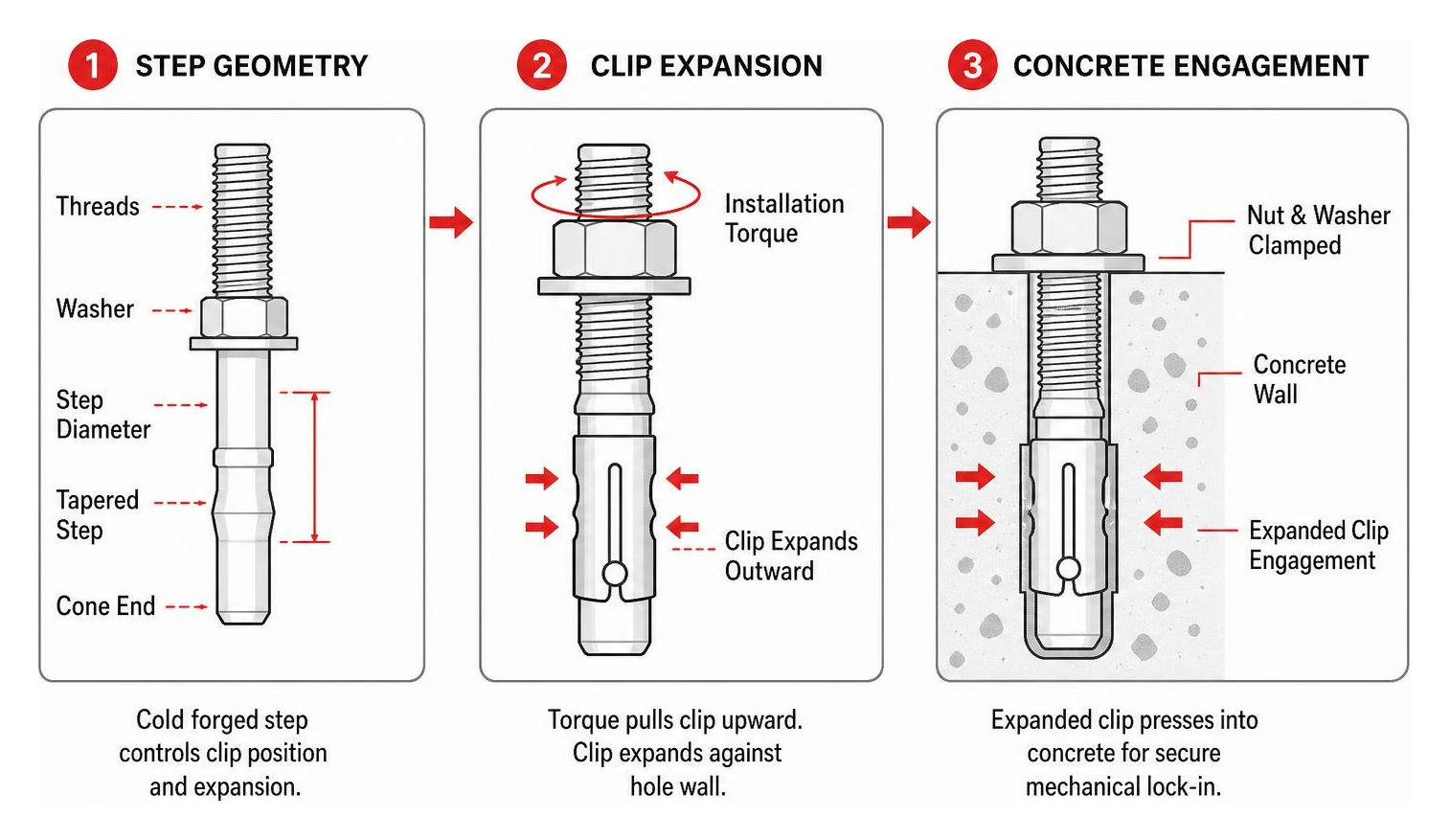
When selecting and manufacturing these fasteners, engineers calculate specific physical metrics:
- Minimum Embedment Depth: Anchor bodies must be long enough to achieve standard embedment requirements (ranging from 1-1/8 inches for 1/4-inch anchors up to 5-1/2 inches or more for 1-1/4-inch anchors) to prevent concrete cone failure under load.
- Installation Torque Limits: Proper cold-formed dimensions ensure the bolt requires exact torque values—such as 4 ft-lbs for 1/4-inch bolts up to 300 ft-lbs for 1-inch anchors—to expand the clip into the concrete wall without spinning inside the hole.
- Thread Protection Features: Installers place the nut flush with the top of the anchor head during hammer insertion to prevent thread deformation when driving the bolt into a drilled hole.
Proper installation requires drilling a hole with an ANSI-standard carbide bit, cleaning out concrete dust with a wire brush and compressed air, hammering the bolt to embedment depth, and applying the proper torque. If you want to learn more about how nuts are paired with these bolts, consult our guide on How to Choose the Right Anchor Bolt Nuts for Your Next Project.
Machinery Types: Dedicated Forging Machines vs. Multi-Station Formers
Choosing the right machinery for anchor bolt production and threading depends on overall volume, length requirements, and capital investment budgets. Manufacturers generally choose between specialized single-process anchor cold forging machines and general-purpose multi-station bolt formers.
| Metric / Feature | Dedicated Wedge Anchor Forging Machine | Multi-Station Bolt Former |
|---|---|---|
| Machinery Purpose | Specialized for wedge anchors and step-shank bolts | General fastener production (hex bolts, rivets) |
| Max Shank Length Capacity | Up to 200 mm shank lengths (e.g., AW23-12L model) | Variable (typically shorter lengths unless specialized) |
| Scrap Rate | 0% raw material waste (net-shape cold extrusion) | 3% to 8% (trimming and multi-pass waste) |
| Capital Investment | Lower initial machine cost | High initial equipment cost |
| Die & Tooling Cost | Low tooling complexity & replacement cost | Complex die sets with higher tooling cost |
| Production Efficiency | High speed (up to 45 PPM on extra-long 12mm anchors) | High speed across diverse standard product lines |
Approximately 90% of regional anchor manufacturers rely on dedicated anchor cold forging machines because of their low maintenance overhead and high dimensional accuracy for concrete expansion hardware. Learn more about single-process anchor production with specialized machinery like the Through bolt expansion anchor forging machine with tail mark.
Forging Machine Specifications and Accessories
Modern anchor cold forging machines incorporate sophisticated mechanical drive assemblies engineered for severe duty. Heavy machine frames weighing around 11,500 kg (nearly 12 tons) provide the rigidity necessary to absorb repetitive high-tonnage impact without deflection.
Key machine components and built-in features include:
- Fingerless Workblank Transfer: High-speed transfer mechanisms transport the cut steel wire from the cutoff station to the forming die without pneumatic fingers. This design eliminates compressed air consumption, reduces maintenance down-time, and increases mechanical stability during rapid cycles.
- Heavy Motor Drives: Standard 15 kW three-phase main motors supply continuous torque needed to cold-extrude medium carbon steel shanks up to 200 mm in length.
- Centralized Lubrication Systems: Automatic lubrication networks maintain a continuous oil film across all high-friction sliding blocks and crankshaft journals, protecting mechanical components against premature wear.
- Tooling Spare Parts & Commissioning: Standard machinery packages ship with replacement punch dies, carbide cutoff knives, feed rolls, and support tooling. Manufacturers typically rely on video commissioning and trial sample testing to verify machine setup before full production runs.
Modern Equipment for Anchor Bolt Production and Threading
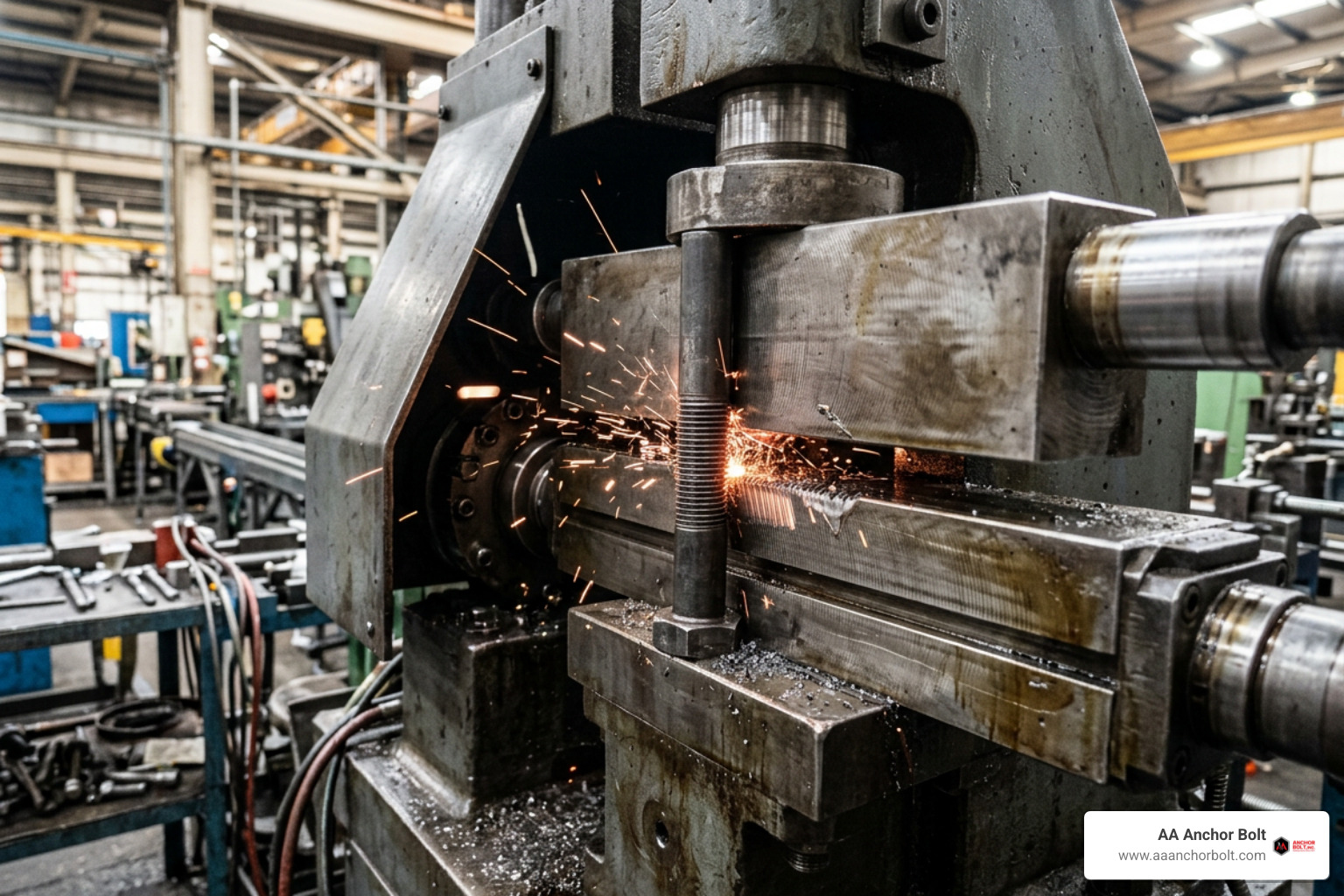
Once the bolt blank has been cold-forged, it moves to the thread rolling department. Thread rolling operates without removing metal, reshaping the smooth shank into precision threads using cold extrusion.
Flat Die Thread Rolling Operations in Anchor Bolt Production and Threading
Flat die thread rolling machines utilize two parallel, hardened steel dies containing the inverse profile of the target thread pitch. One die remains stationary while the matching die moves in a parallel reciprocating motion. As the cold-forged bolt blank rolls between the two dies under pressure, the metal in the shank is displaced. Steel from the roots of the thread is compressed inward, forcing metal upward to form the thread crests.
This chip-free process delivers distinct manufacturing advantages:
- High Surface Accuracy: Flat die rolling routinely achieves up to two grades higher thread accuracy tolerance compared to cut threading.
- Material Economy: Because no material is cut away, blank diameters start at the pitch diameter rather than the major diameter, saving raw material stock.
- Work Hardening: The surface grains of the steel threads are compressed under heavy pressure, yielding a work-hardened surface finish resistant to burrs, galling, and wear.
For structural bolts requiring extreme thread precision and strength, high-speed machines like the Wedge Bolt Rolling Machine deliver fast, repeatable thread profiles for anchor production.
Feeding Systems: Vibratory Hoppers and Drum Types
Achieving maximum output from high-speed thread rolling machinery requires automated feeding hardware designed for specific bolt geometries. Depending on the shank length and head design, different feeding mechanisms are used to maintain continuous operation:
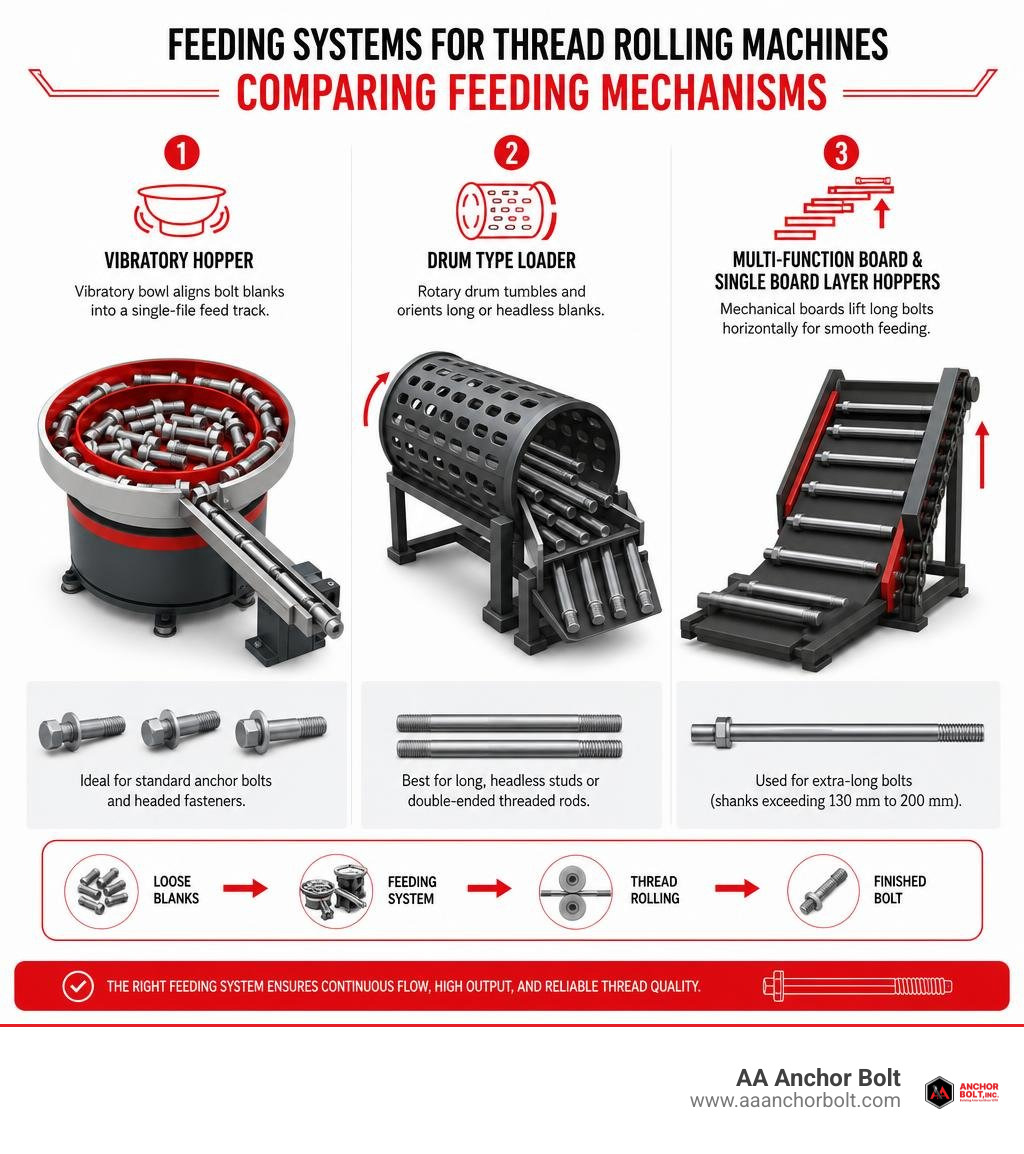
- Vibrator Hopper Feeding: Ideal for standard anchor bolt lengths and headed fasteners. Vibratory bowls use tuned frequency oscillations to align loose bolt blanks into a single-file feed track leading directly into the flat die pusher mechanism.
- Drum Type Loaders: Best suited for long, headless studs or double-ended threaded rods. Rotary drums gently tumble the steel blanks, catching them in slotted chutes to feed heavy workpieces without surface scarring.
- Multi-Function Board & Single Board Layer Hoppers: Used for extra-long bolts (shanks exceeding 130 mm to 200 mm). These mechanical elevators lift long blanks horizontally to prevent jamming in the feed chute.
Machine Selection Guidelines for Different Bolt Sizes and Materials

Matching the proper machine model to the target anchor bolt diameter and material grade is critical to prevent tool breakage and machine stall out. Equipment ratings are benchmarked against high-strength medium carbon alloy steel (equivalent to Grade 10.9 fasteners). If your project requires compliance with standard ASTM anchor specifications, review The Complete Guide to F1554 Anchor Bolt Specs for detailed structural requirements.
Different bolt ranges require specific machinery configurations:
- Small Screws & Light Anchors (M4 to M6): High-speed compact machines like the M6*120MM Automatic Screw Thread Rolling Production Machine process smaller diameters up to 120 mm length under head. These units run with 5.5 kW motors, achieving speeds up to 140 pieces per minute on a machine footprint weighing approximately 1.75 tons.
- Medium Anchor Bolts (M8 to M12): Standard production machines, such as the ARN-12 model, utilize 7.5 kW main motors and 210mm x 190mm x 40mm die blocks to process shanks up to 130 mm under head at speeds up to 65 pieces per minute.
- Long Structural Bolts (M10 to M12 Extra-Long): Heavy-duty units such as the ARH-12L High Speed Bolt Thread Rolling Production Machine feature robust 18.5 kW drive motors and 6-ton frames. These machines handle thread lengths up to 160 mm and total shank lengths under head up to 200 mm at speeds reaching 80 pieces per minute.
Machine Tooling and Parameters for High-Strength Alloys
When rolling threads on high-strength carbon steel or alloy grades, machine components must handle intense shear stress. If you are selecting steel grades for structural anchoring, you can compare material performance in our post Demystifying ASTM F1554 Grades 36, 55 and 105.
To process high-tensile alloys without excessive tool wear, machine operators adjust several key parameters:
- Die Block Hardness: Flat dies manufactured from premium tool steels (such as D2 or M2 high-speed steel) are vacuum heat-treated to 62-65 HRC to withstand repeated compression against alloy blanks.
- Motor Torque and Power Scaling: Processing alloy steel requires larger motor sizing (scaling up from 5.5 kW to 18.5 kW) to sustain smooth flywheel momentum during die engagement.
- Coolant and Lubrication Delivery: Heavy flood coolants wash away debris and dissipate friction heat across the die face during high-speed rolling.
Verify that your raw materials match certified project standards by reading Certified Strength: Why Anchor Bolt Material Certs Matter for Your Next Order.
Frequently Asked Questions About Anchor Bolt Threading
How fast can flat die machines roll threads on wedge anchor bolts?
Production speed depends directly on bolt shank diameter, overall bolt length, and material hardness. Small-diameter fasteners (M4-M6) can reach production speeds up to 140 pieces per minute. Standard M8-M12 concrete wedge anchor bolts typically run at 65 pieces per minute on standard ARN-12 machines, while heavy-duty high-speed models like the ARH-12L reach up to 80 pieces per minute on M10-M12 sizes. Extra-long 200 mm forging machines operate at approximately 45 pieces per minute to accommodate the heavier mass of long steel blanks.
Why does cold thread rolling create stronger threads than cut threading?
Cold thread rolling extrudes the metal under intense mechanical pressure rather than cutting through it. This preserves the natural, continuous grain lines of the steel, contouring them along the roots and crests of every thread. Additionally, the extreme cold work hardening during rolling compresses the surface structure, increasing thread yield strength, shear resistance, and surface micro-hardness while eliminating micro-burrs that cause thread galling during nut installation. For infrastructure applications utilizing rebar threaded components, see our guide on Industrial Rebar Threading Solutions for Maximum Tensile Strength.
What material properties determine the required motor power for a thread rolling machine?
The primary material properties are tensile strength, yield strength, and shear resistance of the steel alloy. Standard machine power ratings are benchmarked against medium carbon alloy steel rated to Grade 10.9 high-strength standards. Higher tensile steels require greater deformation energy during extrusion, necessitating higher main motor power (such as 18.5 kW compared to 5.5 kW for low carbon mild steel) and heavier machine chassis mass to maintain die alignment and prevent equipment stalling.
Conclusion
Mastering anchor bolt production and threading requires combining high-tonnage cold forging equipment with high-speed flat die thread rolling machinery. By eliminating material waste through cold extrusion and strengthening steel grain flow through roll threading, modern fastener manufacturing delivers structural concrete anchors engineered for heavy load capacities.
At AA Anchor Bolt, we combine state-of-the-art production capabilities with absolute control over domestic manufacturing. Located in Northville, Michigan, our family-owned facility maintains nearly a million pounds of in-house raw steel stock, ensuring rapid turnaround and reliable delivery schedules for custom anchor bolts, threaded rods, and specialized construction fasteners.
Explore our full range of structural anchor options on our Products page, view our standard F1554 Anchor Bolt line, or learn how our custom manufacturing equipment can support your next heavy infrastructure project by visiting our Manufacturing Capabilities pillar page. If you need specialized thread rolling, bending, or engineering support, reach out directly through our Services page.