The Concrete Fastener Guide for Heavy Duty Anchoring
When Every Pour Counts: Choosing the Right Anchor Bolt for Concrete
Selecting the right anchor bolt for concrete can be the difference between a structure that stands for decades and one that fails under load. For infrastructure contractors working against tight deadlines, getting this decision wrong is not an option.
Quick Answer: Common Anchor Bolt Types for Concrete
| Anchor Bolt Type | Best For | Typical Strength Range |
|---|---|---|
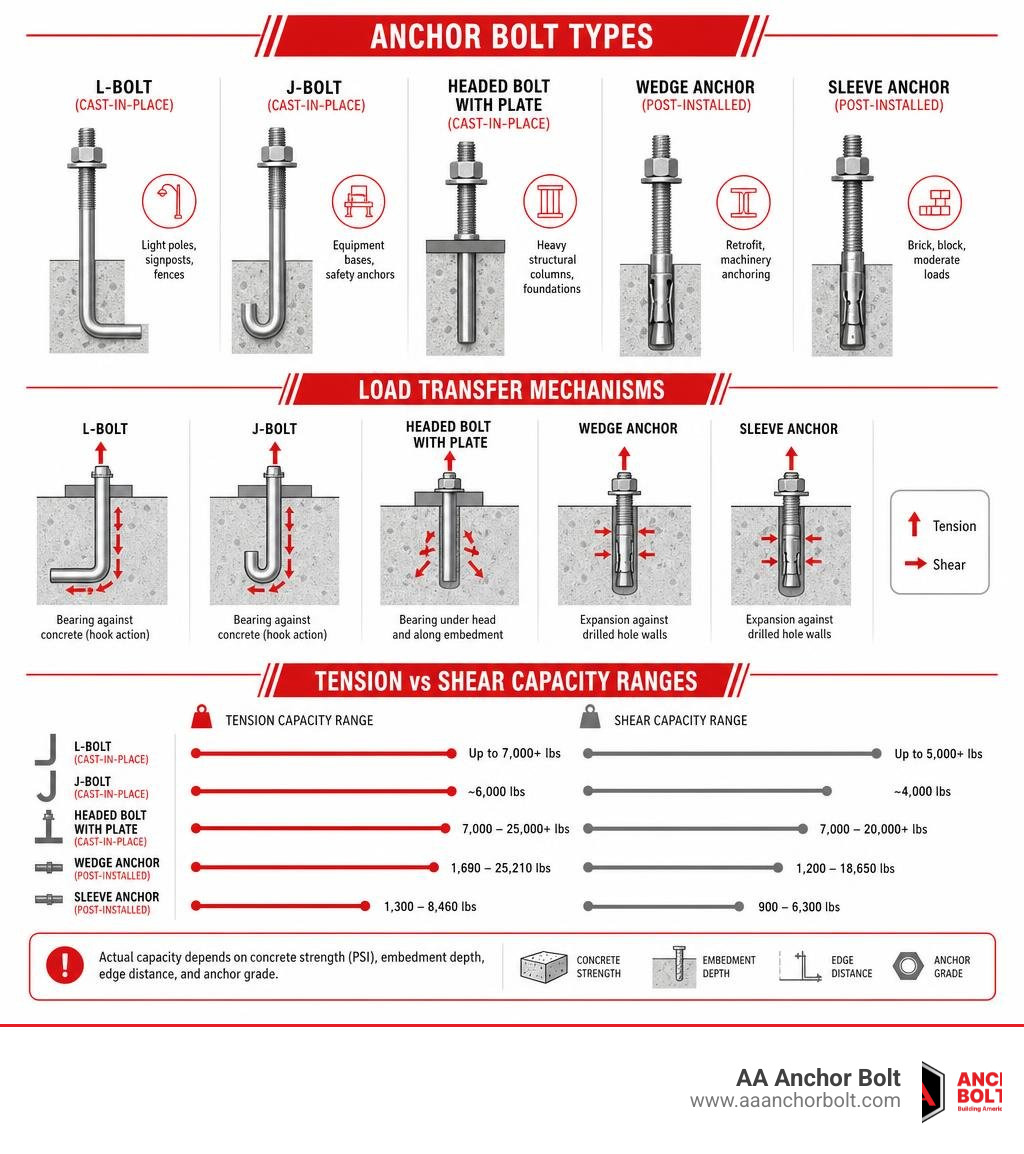
| L-Bolt (cast-in-place) | Light poles, signposts, fences | Up to 7,000+ lbs tension |
| J-Bolt (cast-in-place) | Equipment bases, safety anchors | ~6,000 lbs tension |
| Headed Bolt with Plate | Heavy structural columns, foundations | 7,000–25,000+ lbs tension |
| Wedge Anchor (post-installed) | Retrofit, machinery anchoring | 1,690–25,210 lbs tension |
| Sleeve Anchor (post-installed) | Brick, block, moderate loads | 1,300–8,460 lbs tension |
Note: Actual capacity depends on concrete strength (PSI), embedment depth, edge distance, and anchor grade.
There are two broad categories: cast-in-place anchors (set before the pour) and post-installed anchors (drilled in after concrete cures). For heavy structural work — columns, base plates, industrial equipment — cast-in-place anchors almost always deliver superior holding strength.
The stakes are real. Anchor bolt failures typically trace back to just a few root causes: wrong anchor type, undersized embedment, poor edge distance, or misalignment during the pour. All of these are preventable with the right knowledge and the right supplier.
This guide covers everything you need — anchor types, load capacities, safety factors, installation best practices, and failure prevention — so you can spec and order with confidence.
Selecting the Right Anchor Bolt for Concrete Projects

To select the ideal anchor bolt for concrete, you must evaluate three key variables: structural load requirements (tension and shear), the characteristics of the base material (cracked vs. uncracked concrete), and the surrounding environmental conditions (corrosion risk).
While post-installed mechanical anchors like wedge anchors and sleeve anchors are excellent for retrofits, heavy-duty structural engineering relies heavily on cast-in-place systems. Cast-in-place anchors transfer loads through mechanical interlock at the embedded contact zone, achieving massive bearing pressures that can exceed ten times the concrete’s compressive strength under pure tension.
For post-installed options, engineers often reference technical guides or review general product information sheets to assess performance in uncracked concrete. If you are looking at heavy-duty sleeve anchors, technical product data provides essential details on torque-controlled post-installed options. For a wider view of post-installed mechanical and adhesive solutions, consult manufacturer manuals and documentation to select the appropriate concrete anchoring products.
However, when you are building foundations from the ground up, nothing matches the reliability of cast-in-place options. Let’s compare the primary cast-in-place configurations:
| Configuration | Load Transfer Mechanism | Best Application | Key Advantage |
|---|---|---|---|
| L-Bolt | Mechanical hook interlock | Sill plates, light poles, highway signs | Simple to manufacture, reliable pullout resistance |
| J-Bolt | Mechanical hook interlock | Equipment mounting, safety tie-backs | Hook prevents rotation, easy to align |
| Headed Bolt with Plate | Plate bearing and mechanical interlock | Heavy structural columns, bridges, high-rise foundations | Highest tension capacity, distributes load deeply |
Cast-In-Place Anchor Bolt for Concrete Applications
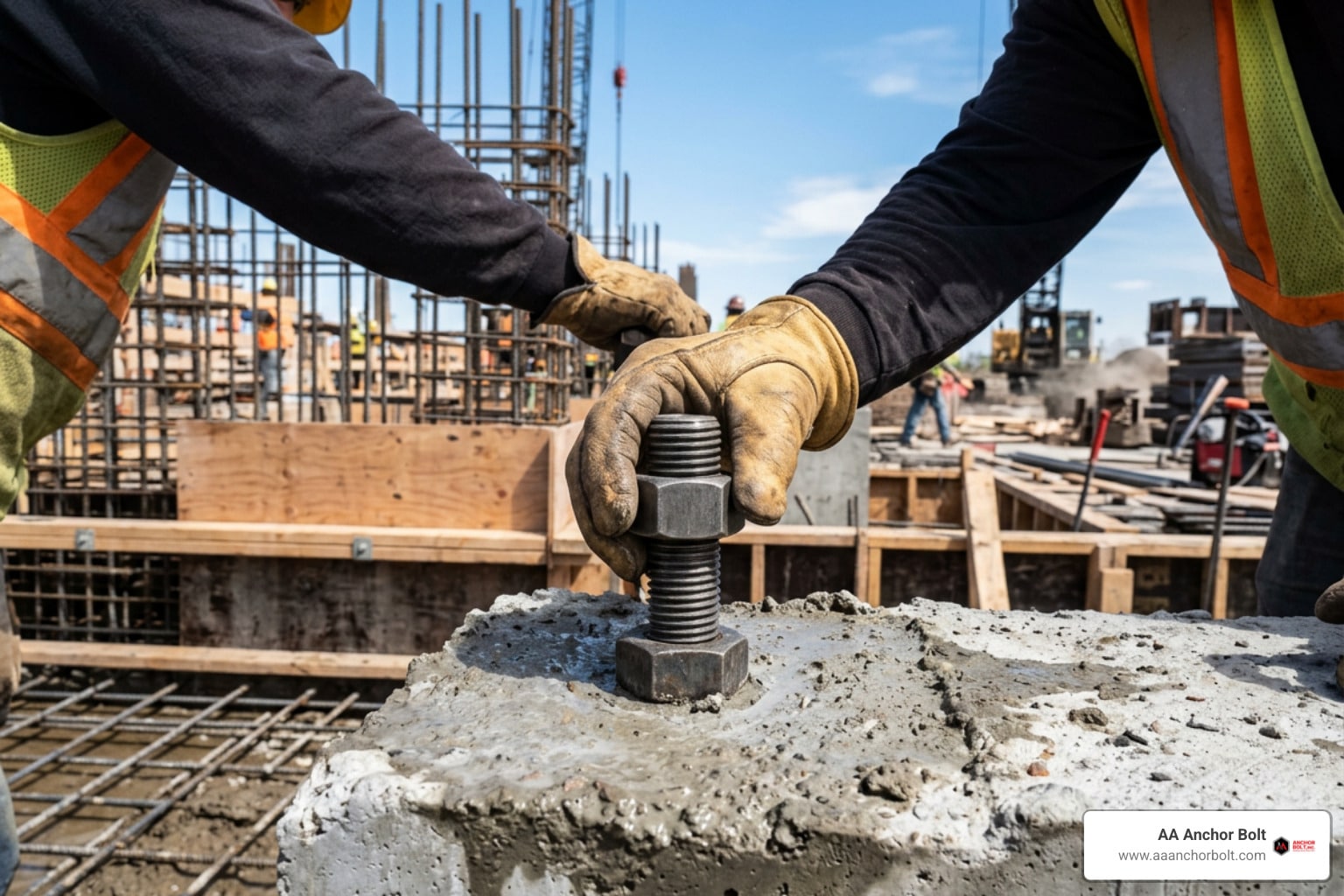
Cast-in-place anchors are embedded directly in freshly poured concrete with the threaded portion left exposed above the surface.
L-bolts are a staple of foundation work. For example, a standard 3/4″-10 x 8″ L-bolt is frequently used to secure structural steel columns, fences, and signposts. The bent leg of the L-bolt creates a powerful mechanical lock in the cured concrete, preventing the fastener from pulling out when subjected to wind or structural tension.
For heavy-duty structural applications, we manufacture these fasteners to rigorous national standards. You can find comprehensive engineering specifications on our F1554 Anchor Bolt Overview page. By matching the correct bolt diameter and embedment depth to your project’s specific load requirements, you ensure the connection remains completely secure over its service life.
Headed Anchor Bolts and Threaded Rods with Plates
When standard L-bolts or J-bolts cannot meet extreme tension demands, structural engineers specify headed anchor bolts or threaded rods equipped with anchor plates.
These assemblies do not rely on a simple bend in the steel. Instead, they use a heavy hex head or a square plate washer threaded onto the bottom of the rod. When concrete is poured around them, the plate acts as a massive bearing surface, distributing tensile forces deep within the concrete foundation.
At AA Anchor Bolt, we specialize in the custom fabrication of these high-strength assemblies. Because we maintain complete domestic production control and house nearly a million pounds of raw steel, we can manufacture custom-length threaded rods, weld plates to your exact specifications, and ship them to your job site with industry-leading turnaround times. To see our full manufacturing capabilities, visit our Products page.
Load Capacities, Safety Factors, and Engineering Design
Calculating the allowable load of an anchor bolt for concrete requires balancing theoretical steel strength with the physical limitations of the concrete. A common rule of thumb for post-installed anchors is to limit the safe working load to 25% of the ultimate load capacity (a 4:1 safety factor). For structural cast-in-place connections, engineering design is governed by strict building codes.
ACI 318 Design Standards for Cast-In-Place Anchors
In the United States, structural concrete anchoring is governed by the American Concrete Institute (ACI) 318 code. Under these strength design provisions, engineers must calculate and verify multiple potential failure modes under ultimate limit states:
- Steel Failure in Tension or Shear: The physical snapping of the steel bolt.
- Concrete Breakout Strength: A cone-shaped chunk of concrete pulling out around the anchor.
- Pullout Strength: The bolt sliding out of the concrete.
- Side-Face Blowout: Occurs when deep, highly loaded anchors are placed too close to a side edge, causing the concrete side wall to blow outward.
For projects exposed to wind loading or seismic design categories, these calculations become even more critical. Under seismic conditions, pullout actions can occur in as little as 0.03 seconds, requiring anchors to perform reliably under rapid cyclic cracking and pulsating loads.
Edge Distance and Spacing Reductions
An anchor bolt is only as strong as the concrete surrounding it. If you place an anchor too close to the edge of a slab, or space multiple anchors too close together, their concrete breakout cones will overlap, drastically reducing their individual load capacities.
To maintain structural integrity:
- Edge Distance: If the distance from the center of the bolt to the free edge of the concrete slab is less than the critical edge distance, you must apply a reduction factor to the allowable load.
- Anchor Spacing: When anchors are grouped closely, the concrete stress fields overlap. Spacing must be kept above minimum limits to prevent premature splitting failure of the slab.
Installation Best Practices and Failure Prevention
Even the highest-grade anchor bolt for concrete will fail if installed incorrectly. Proper installation requires precision, coordination, and a clear understanding of the curing process.
Step-by-Step Installation of Cast-In-Place Anchor Bolts
To ensure maximum holding strength, we recommend following these industry best practices during the concrete pour:
- Use a Rigid Template: Never “wet-stick” (pushing bolts directly into freshly poured concrete by hand). Always secure your anchor bolts using a rigid wood or steel template that mirrors the base plate of your structural column.
- Coordinate with Reinforcement: Align the bolts with the foundation’s rebar layout before the pour to avoid structural interference.
- Protect the Threads: Wrap the exposed threads in plastic or duct tape. This prevents concrete splatter from curing on the threads, which would otherwise ruin thread engagement during final assembly.
- Pour and Vibrate: Pour the concrete carefully around the anchor assembly, using a vibrator to eliminate air pockets and ensure complete concrete consolidation around the bolt’s head or bend.
- Cure to Full Strength: Allow the concrete to reach its specified compressive strength (typically 28 days) before applying structural torque or heavy loads.
For specialized assistance with custom project requirements or alignment templates, explore our dedicated Services page.
Preventing Common Anchor Bolt Failures
By understanding why anchor bolts fail, you can take active steps to prevent issues on your job site:
- Concrete Cone Failure: Prevent this by ensuring proper embedment depth. If the anchor is too shallow, the concrete will pull out in a cone shape long before the steel bolt reaches its yield strength.
- Template Misalignment: If bolts are poured even a fraction of an inch out of alignment, structural columns will not fit over them. This leads to costly field modifications, such as drilling out base plates or retrofitting with post-installed anchors.
- Inadequate Curing: Loading anchor bolts before the concrete has fully cured can cause premature pullout and compromise the long-term structural integrity of the foundation.
To learn more about how we manufacture our fasteners to resist these structural demands, check out our Manufacturing Capabilities page.
Frequently Asked Questions about Concrete Anchors
Why are cast-in-place anchor bolts preferred for heavy-duty structural foundations?
Cast-in-place anchor bolts are integrated directly into the wet concrete pour, allowing the concrete to cure seamlessly around the fastener. This creates a highly efficient load transfer mechanism through mechanical interlock and bearing plates. Unlike post-installed mechanical anchors, which rely on friction against a drilled hole wall, cast-in-place anchors distribute heavy structural tension and shear forces deep into the foundation, making them the gold standard for heavy-duty construction.
How does concrete strength affect anchor bolt capacity?
The ultimate holding strength of any concrete anchor is directly tied to the compressive strength (measured in PSI) of the concrete base material. For example, an anchor embedded in 4,000 PSI concrete will have a significantly higher concrete breakout and pullout capacity than the exact same anchor embedded in 2,500 PSI concrete.
Why is anchor bolt grade (like ASTM F1554) important for structural concrete?
The ASTM F1554 specification is the standard for anchor bolts designed for structural concrete applications. It defines three distinct grades of steel, each offering different yield and tensile strengths:
- F1554 Anchor Bolt Grade 36: A low-carbon steel grade with a 36 ksi yield strength, ideal for light structural applications.
- F1554 Anchor Bolt Grade 55: A high-strength, low-alloy steel with a 55 ksi yield strength, frequently specified for structural columns and highway signage.
- F1554 Anchor Bolt Grade 105: A heat-treated, alloy steel grade with a 105 ksi yield strength, engineered for extreme heavy-duty industrial and infrastructure projects.
Conclusion
When it comes to securing structural steel, heavy machinery, or vital infrastructure, there is no room for compromise. Choosing the correct anchor bolt for concrete requires a deep understanding of load demands, concrete breakout mechanics, and material grades.
At AA Anchor Bolt, we are proud to be a family-owned manufacturer based in Northville, Michigan. We maintain nearly a million pounds of domestic steel in-house, giving us full control over our production and allowing us to offer the fastest turnaround times in the industry. Whether you need standard L-bolts, heavy-duty J-bolts, or custom headed anchor plates manufactured to exact ASTM F1554 specifications, we have the expertise and the inventory to deliver.
For more technical specifications or to learn more about our manufacturing standards, explore our Resources section, or read About Us to see how we support major construction projects across the USA. You can also view our verified industry profile on the A A Anchor Bolt Inc. | Northville, MI – Procore network.
Ready to secure your next project with high-quality, American-made fasteners? Contact our team of anchoring experts today to discuss your project specifications, request a quote, or learn more about our complete line of F1554 Anchor Bolt Overview solutions.