U-Bolt Buying Guide: Don’t Let Your Escalator Components Slip
Why the Right U-Bolt for Escalators Can Make or Break Your Project
If you’re sourcing a U-bolt for escalators, here’s the fast answer:
Best U-bolts for escalator applications by use case:
| Use Case | Recommended Size | Material |
|---|---|---|
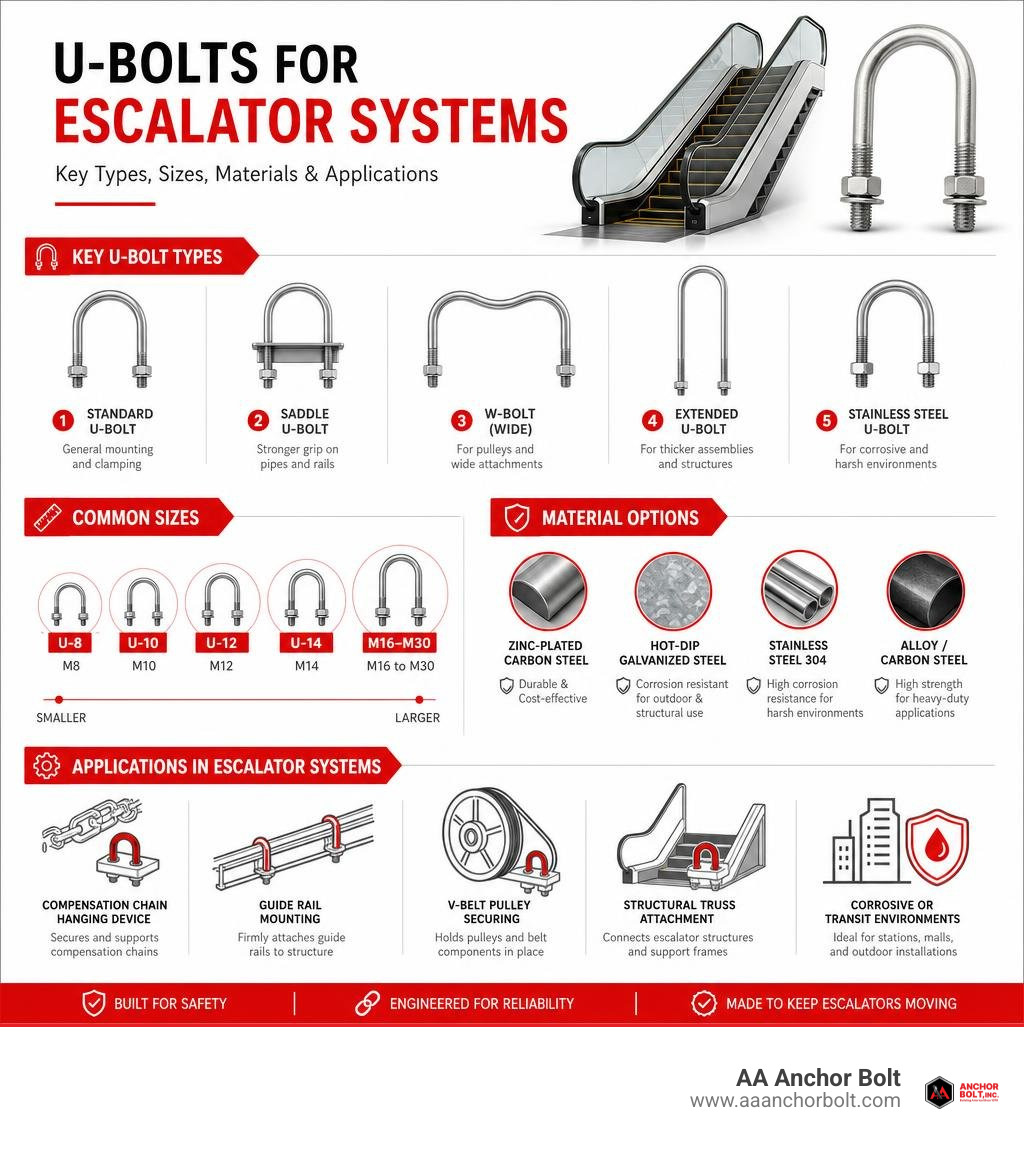
| Compensation chain hanging device | U-8, U-10, U-12, U-14 | Zinc-plated carbon steel |
| Guide rail mounting | M10–M16 | Hot-dip galvanized steel |
| V-belt pulley securing | 89x70mm (W-bolt style) | Alloy/carbon steel |
| Corrosive or transit environments | M8–M14 | Stainless Steel 304 |
| Structural truss attachment | M16–M30 | Hot-dip galvanized A36 steel |
Minimum order quantities typically start at 100 pieces, with bulk pricing starting around $0.80 per piece.
Escalators run continuously — every day, under heavy load, with constant vibration. The fasteners holding their chains, guide rails, and drive components in place are under the same stress, every single shift.
Most contractors don’t think twice about the U-bolts in an escalator system until something fails. By then, the cost isn’t just a replacement part — it’s downtime, liability, and a missed deadline.
Getting the spec right from the start matters more than most people realize.
The problem? Not all U-bolts are the same. Escalator systems use highly specific sizes (U-8 through U-14 for compensation chains alone), require precise material grades, and in many cases must meet international certifications like CE and ISO9001. A generic construction U-bolt won’t cut it.
I’m Pauline Horton, and in this guide I’ll walk you through exactly what to look for — from thread size and material grade to where to source certified fasteners fast — so you can spec the right part and keep your project on track.
U-bolt for escalators glossary:
Understanding the Role of a U-bolt for escalators
At its core, a U-bolt is a curved fastener featuring a U-shaped head with threaded legs on both ends. This specialized design allows it to wrap securely around pipes, conduits, or structural frames, clamping them tightly to a secondary surface using nuts and washers.
In the high-stress world of vertical transportation, a U-bolt for escalators plays a critical role. Escalators are not static structures; they are massive, continuously moving assemblies. As steps circulate and heavy drive chains rotate, they generate constant, multi-directional vibrations. Without high-quality clamping, these vibrations can lead to irregular up-and-down or side-to-side movements. Over time, this mechanical play causes structural wear, misalignment, and eventual component breakage.
By utilizing a robust U-bolt for escalators, maintenance teams and manufacturers ensure:
- Vibration Reduction: Clamping elements tightly to the escalator’s structural truss minimizes the micro-movements that loosen standard fasteners.
- Structural Stability: U-bolts anchor heavy guiding devices and drive components directly to the steel framing, maintaining perfect alignment.
- Even Load Distribution: The curved design distributes clamping forces evenly around the profile of the secured part, preventing localized stress concentration.
Because these fasteners must handle unique curves and tight tolerances, understanding the manufacturing process is incredibly helpful. If you want to know how these specialized shapes are created, check out our guide on how to bend a U-bolt in 5 simple steps.
Technical Specifications and Material Selection
Selecting the right U-bolt for escalators requires a deep dive into metallurgical properties and mechanical limits. Escalator components must meet stringent safety factors — often requiring a safety factor of 4 or greater due to public safety codes.
To help you choose the best material for your specific installation environment, we have put together a comparison table of the two most common high-durability options:
| Feature / Specification | Stainless Steel 304 | Hot-Dip Galvanized (HDG) Steel |
|---|---|---|
| Tensile Strength | High (~75,000 to 90,000 psi) | Medium to High (typically based on A36 or Grade 2/5 carbon steel) |
| Corrosion Resistance | Excellent (highly resistant to moisture and chemical cleaners) | Very Good (sacrificial zinc layer protects against outdoor elements) |
| Vibration Resistance | Excellent (retains structural integrity under continuous stress) | Good (requires locking hardware to maintain torque) |
| Best Suited For | High-humidity environments, transit systems, and indoor luxury commercial spaces | Outdoor escalators, parking structures, and heavy industrial settings |
| Anti-Rotation Design | Standard round bend, requires precise torque | Standard round bend, zinc coating adds surface friction |
Sizing and Thread Standards for a U-bolt for escalators
Escalator systems are designed globally, meaning you will encounter both metric and imperial sizing standards. Standard metric thread sizes for industrial U-bolts range from M6 up to M39, while imperial sizes traditionally span from 1/4 inch to 1 1/2 inches in thread diameter.
In vertical transit applications, specialized sizing conventions are common. For example, compensation chain hanging devices utilize standardized sizes categorized as U-8 (8mm), U-10 (10mm), U-12 (12mm), and U-14 (14mm). These models typically maintain a standard width of 75mm, an overall length of 120mm, and a thread length of 50mm to accommodate heavy-duty coupling hardware.
When replacing parts on older or proprietary systems, referencing a manufacturer’s master catalog is vital. For detailed schematics and dimensional clearances on classic configurations, you can consult the Otis Escalator Catalog .
Material Grades and Corrosion Resistance
The environmental conditions of your escalator installation dictate the material grade you need.
- Stainless Steel 304: This is the gold standard for indoor commercial escalators and transit hubs. It offers exceptional resistance to rust, oxidation, and the harsh chemical cleaning agents used during routine maintenance.
- Hot-Dip Galvanized Carbon Steel: For outdoor escalators — such as those in open-air transit stations or theme parks — hot-dip galvanized steel is highly recommended. The thick zinc coating provides sacrificial protection, ensuring the underlying steel remains structurally sound even when exposed to rain, snow, and temperature fluctuations.
- High-Strength Carbon Steel (SAE Grade 5): When raw tensile strength is the primary concern (such as in heavy drive assemblies), Grade 5 carbon steel with a yellow zinc-chromate plating is preferred, offering tensile strengths up to 120,000 psi.
For a broader look at how specialized U-bolts secure critical equipment in other demanding, high-vibration industries, take a look at our article on U-bolt for data heavy-duty mounts for your precious tech.
Best Practices for Installation and Maintenance
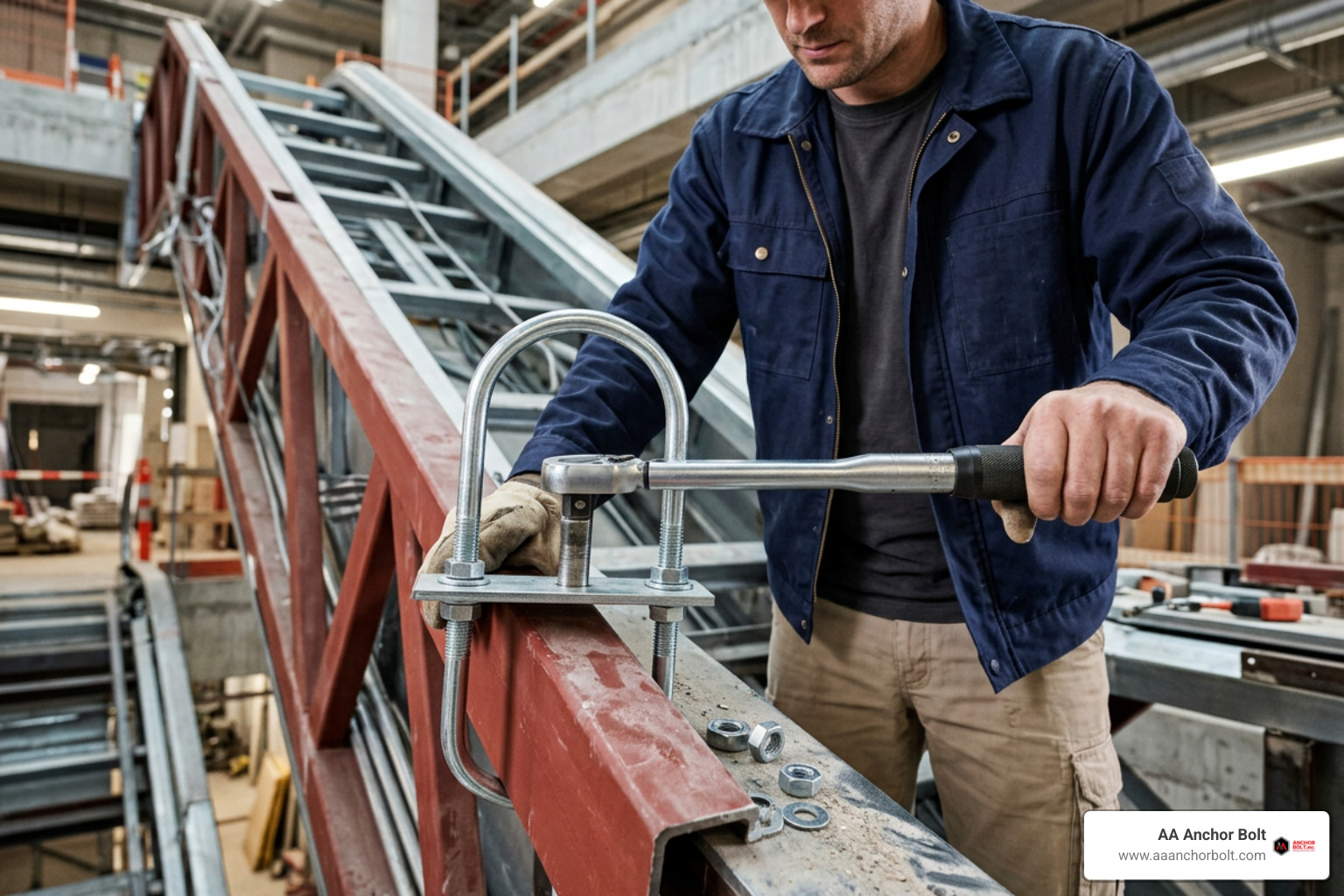
Even the highest-grade U-bolt for escalators will fail if installed incorrectly. To ensure long-term safety and prevent mechanical slippage, follow these installation best practices:
- Match the Bend Radius: Ensure the inner curve of the U-bolt matches the outer diameter of the secured pipe or frame perfectly. Any gap will allow micro-movements, leading to fastener fatigue.
- Use Proper Torque Specifications: Over-tightening can stretch the bolt past its yield point, weakening the steel. Under-tightening allows vibration to back the nuts off. Always refer to the escalator manufacturer’s torque guidelines.
- Implement Double-Nutting or Lock Washers: Due to the continuous vibration of escalator operations, standard nuts can back off over time. Use nylon-insert lock nuts (nyloc), split lock washers, or a double-nutting configuration to lock the assembly in place.
- Apply Thread-Locking Fluid: For high-vibration areas like handrail drives or step chain guides, applying a medium-strength thread-locking compound adds an extra layer of security.
- Establish Regular Inspection Cycles: Inspect U-bolts during routine maintenance. Look for signs of thread wear, backing off, or surface corrosion.
For more insights on securing heavy structural elements to concrete foundations within transit shafts, read our comprehensive the concrete fastener guide for heavy-duty anchoring.
Key Applications in Escalator Systems
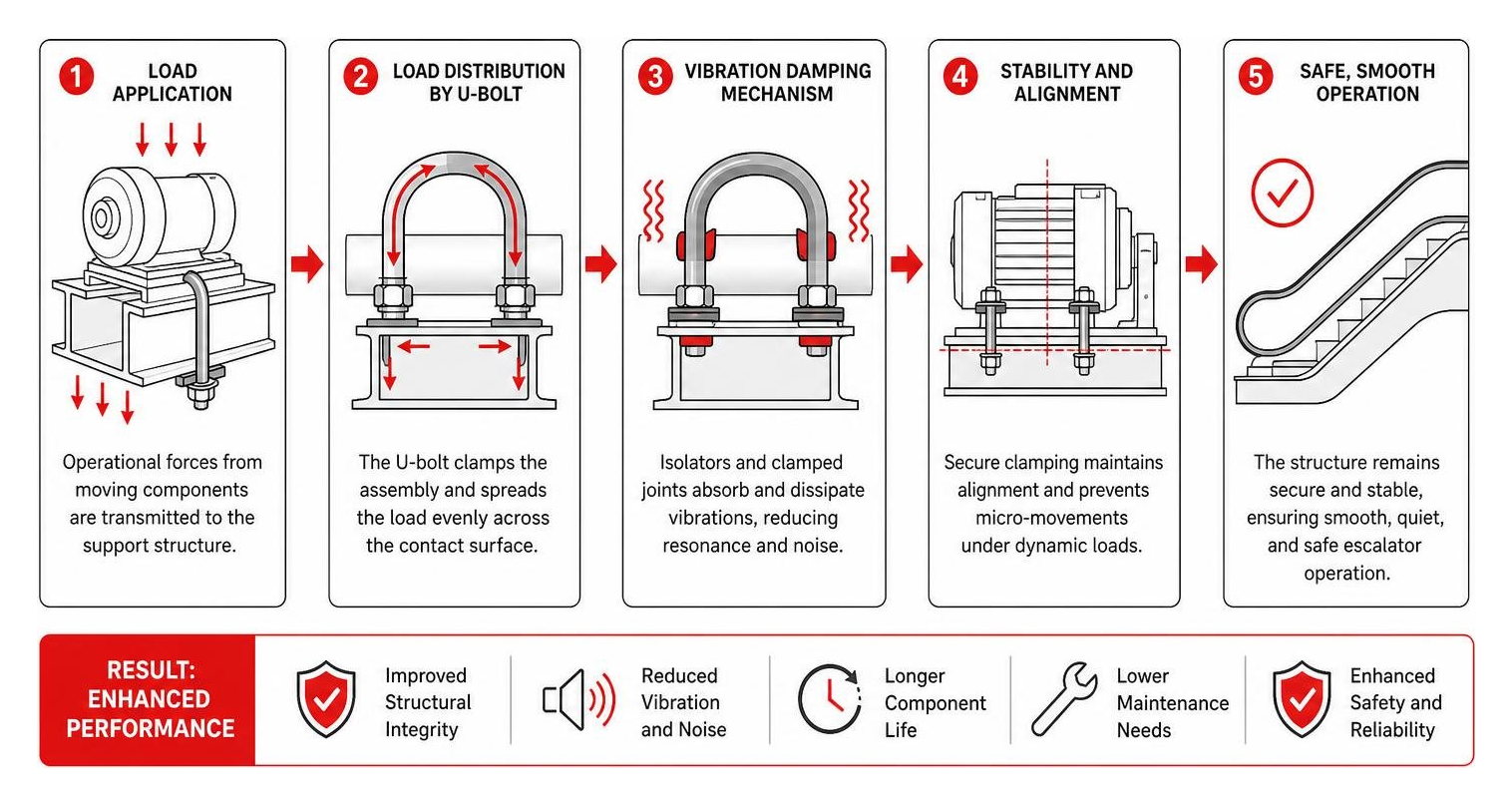
Every moving part of an escalator relies on a rigid structural frame (the truss) to remain aligned. Within this complex mechanical system, U-bolts are deployed in several critical areas to ensure smooth, quiet, and safe operation.
Compensation Chain Assemblies and Hanging Devices
In high-rise vertical transit systems and heavy-duty escalators, compensation chains are utilized to balance the weight of the moving step bands or hoist ropes. These heavy chains must be suspended securely to prevent them from swinging or clashing against the truss.
Hanging devices for these systems rely heavily on U-bolts (specifically sizes U-8 through U-14) combined with heavy-duty S-hooks. These assemblies guide and anchor the compensation chain, absorbing the kinetic energy of the moving system. Sourcing the exact dimensional matches for these assemblies is critical. For a complete breakdown of compatible hardware and schematic numbers, refer to the Escalator Parts – Unitec Parts / escalator-parts-unitec-parts.pdf / PDF4PRO .
Securing Guide Rails and Handrail Drives with a U-bolt for escalators
The handrail drive and guide rail systems are the backbone of passenger safety. Guide rails keep the steps perfectly level, while handrail drives keep the handrail moving at the exact same speed as the steps.
Within these assemblies, specialized bent fasteners are used to secure V-belt pulleys and drive shafts. For instance, the SMH244011 Escalator V-Belt Pulley W-Bolt, 89*70mm is a critical, highly specific bent bolt weighing 1.1kg, designed to keep drive pulleys perfectly aligned under continuous belt tension.
Additionally, maintaining proper handrail tension requires robust drive systems. High-quality handrails, such as the Semperit Handrail Belt for Escalator, SDS Type C600 W=80mm H=28.5mm , must withstand a minimum tensile strength of 25,000 N to meet European Standard EN115. Securing the drive motors and tensioning brackets that pull these heavy-duty belts requires heavy-duty U-bolts capable of resisting immense, continuous shear loads.
When servicing classic workhorse systems, technicians often need exact OEM matches. Whether you are sourcing hardware for older Otis J-UB models or looking for highly specialized step chain pins like the 1705531900_ 1705531900 Escalator Bolt For Step Chain Use For Thyssenkrupp , specifying the correct dimensions and material limits is non-negotiable.
Frequently Asked Questions about Escalator Fasteners
What is the difference between standard construction U-bolts and escalator U-bolts?
While standard construction U-bolts (such as those found in general Best U-Bolts or basic Large U-Bolt catalogs) are excellent for static piping suspension, they are not rated for dynamic, high-vibration environments.
Escalator U-bolts are precision-manufactured to strict tolerances. They feature higher tensile strengths, specific thread pitches to prevent backing off, and exact dimensional widths (like the standardized 75mm spacing for compensation chain guides) designed to interface perfectly with vertical transit hardware.
What certifications should U-bolts meet for escalator safety?
To ensure public safety and compliance with building codes, U-bolts used in escalator and elevator applications should be sourced from manufacturers certified under ISO9001 quality management systems. Furthermore, the fasteners should comply with regional safety standards, such as the European EN115 standard for escalators, and carry CE certification where applicable.
How do you prevent U-bolts from loosening due to escalator vibration?
The most effective way to prevent loosening is by combining high-quality thread-locking compound with mechanical locking devices. Nylon-insert lock nuts (nylocs), split lock washers, or double-nutting are standard industry practices. Additionally, ensuring the U-bolt is torqued exactly to the manufacturer’s specified foot-pounds prevents the fastener from stretching or slipping.
Conclusion
When you are managing an escalator installation, modernization, or repair project, there is no room for error. A single failing fastener can lead to costly downtime, safety hazards, and project delays. Sourcing a high-quality, precision-manufactured U-bolt for escalators is the simplest way to protect your build and ensure smooth, long-term operation.
At AA Anchor Bolt, we manufacture custom anchor bolts, U-bolts, and specialty fasteners right here in Northville, Michigan. With nearly a million pounds of in-house steel and complete domestic production control, we deliver the fast turnarounds and certified quality you need to keep your project moving forward without a hitch.
Ready to spec the perfect fasteners for your next project? Browse our full range of custom capabilities on our Products page, or reach out to our team today for a rapid quote!