The Ultimate Buyer’s Guide to Pipeline U-Bolt Clamps
Pipeline U-Bolt Clamps: A Quick Buyer’s Overview
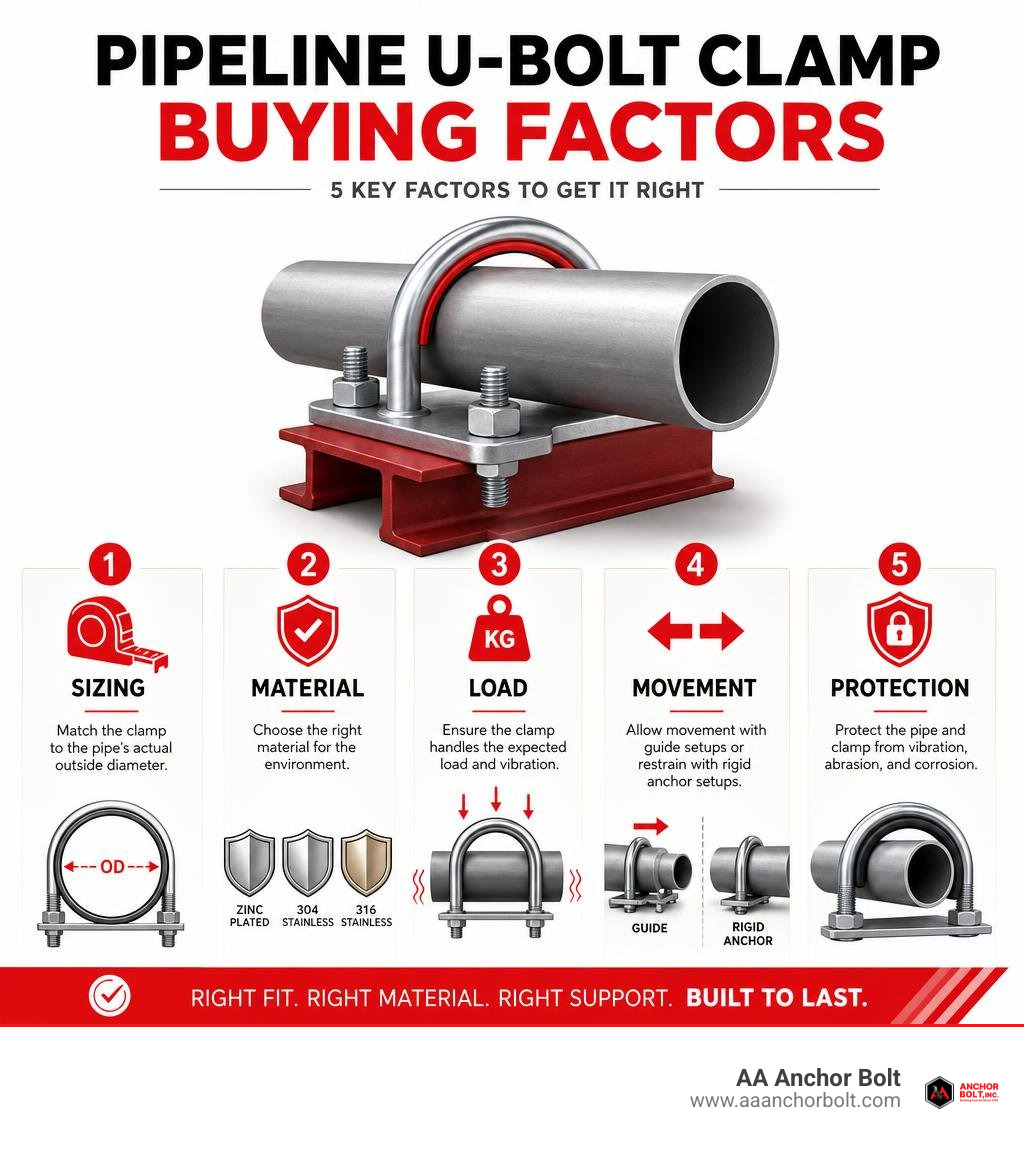
Pipeline U-bolt clamps secure pipe runs to steel, walls, channels, and other structural supports. For a fast purchase decision, choose a clamp that matches the pipe’s actual outside diameter, the expected load and vibration, the mounting depth, and the jobsite’s corrosion exposure.
| Buying factor | What to check |
|---|---|
| Pipe fit | U-bolt inside diameter should fit the pipe OD without forcing or excessive clearance. |
| Strength | Standard-duty options commonly use M8 threads; heavy-duty designs often use thicker rods and M10 threads. |
| Material | Zinc-plated or galvanized steel suits many general applications; 304 stainless resists corrosion well; 316 stainless is a stronger choice for saltwater and harsh chemical exposure. |
| Movement | Use a guide setup when the pipe must move lengthwise from thermal expansion. Use a rigid anchor setup when movement must be restrained. |
| Protection | Choose cushioned, insulated, or coated clamps where vibration, noise, pipe abrasion, or dissimilar-metal contact is a concern. |
For Midwest infrastructure work, the right U-bolt is more than a simple fastener. It can keep a pipeline aligned, reduce vibration, protect the pipe surface, and help crews install reliable supports without welding. Available configurations range from basic steel U-bolts to heavy-duty, rubber-lined, PTFE-coated, and stainless steel options for demanding sites.
I’m Pauline Horton, and this guide will help you compare the key clamp styles and specifications before you place an order.
Pipeline U-bolt clamps terms to learn:
Mechanics and Functions of U-Bolt Pipe Supports
When we look at modern municipal, commercial, and industrial piping networks, pipeline U-bolt clamps are among the most versatile fasteners ever invented. At its core, a U-bolt pipe clamp consists of a U-shaped bent rod with threaded legs on both ends, often accompanied by a saddle, plate, or mounting crossbar. These mechanical supports perform several vital functions: they carry static dead weight, control mechanical line movement, maintain elevation alignment, and insulate lines from damaging vibration.
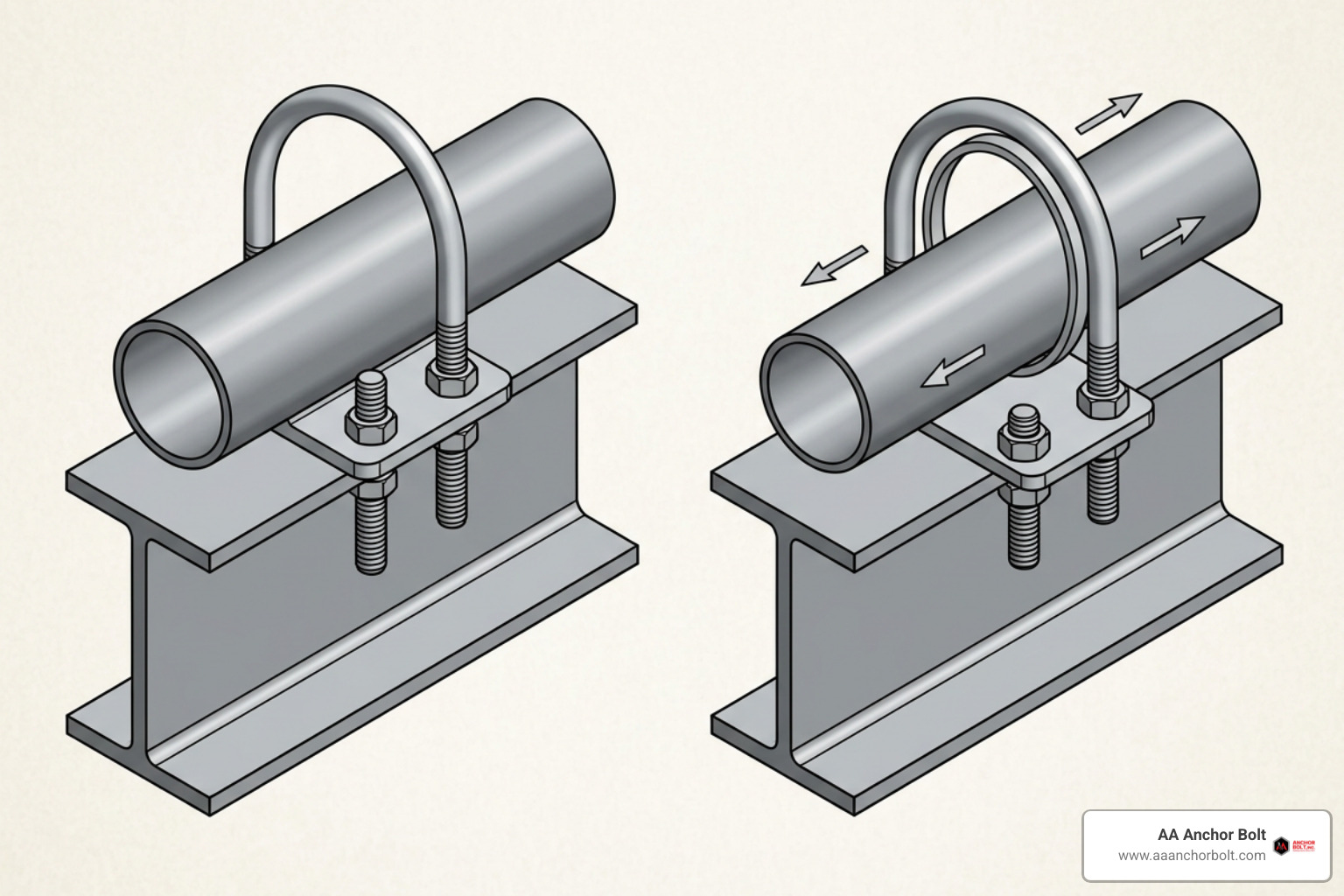
In demanding industrial applications—such as chemical processing, municipal water distribution, high-pressure compressed air, and commercial HVAC—pipes don’t just sit still. Liquids move, pressures surge, pumps pulse, and outdoor ambient temperatures cycle throughout the year. Installing a clamp without understanding its fundamental mechanics can lead to localized stress concentration, cracked pipe walls, or structural failure.
Pipe Guides vs. Rigid Anchors
One of the biggest misconceptions in piping installation is assuming every U-bolt must be cranked down tightly against the pipe wall. Depending on how you torque the hardware, a single pipeline U-bolt clamp can serve as either a rigid pipe anchor or a guided pipe support.
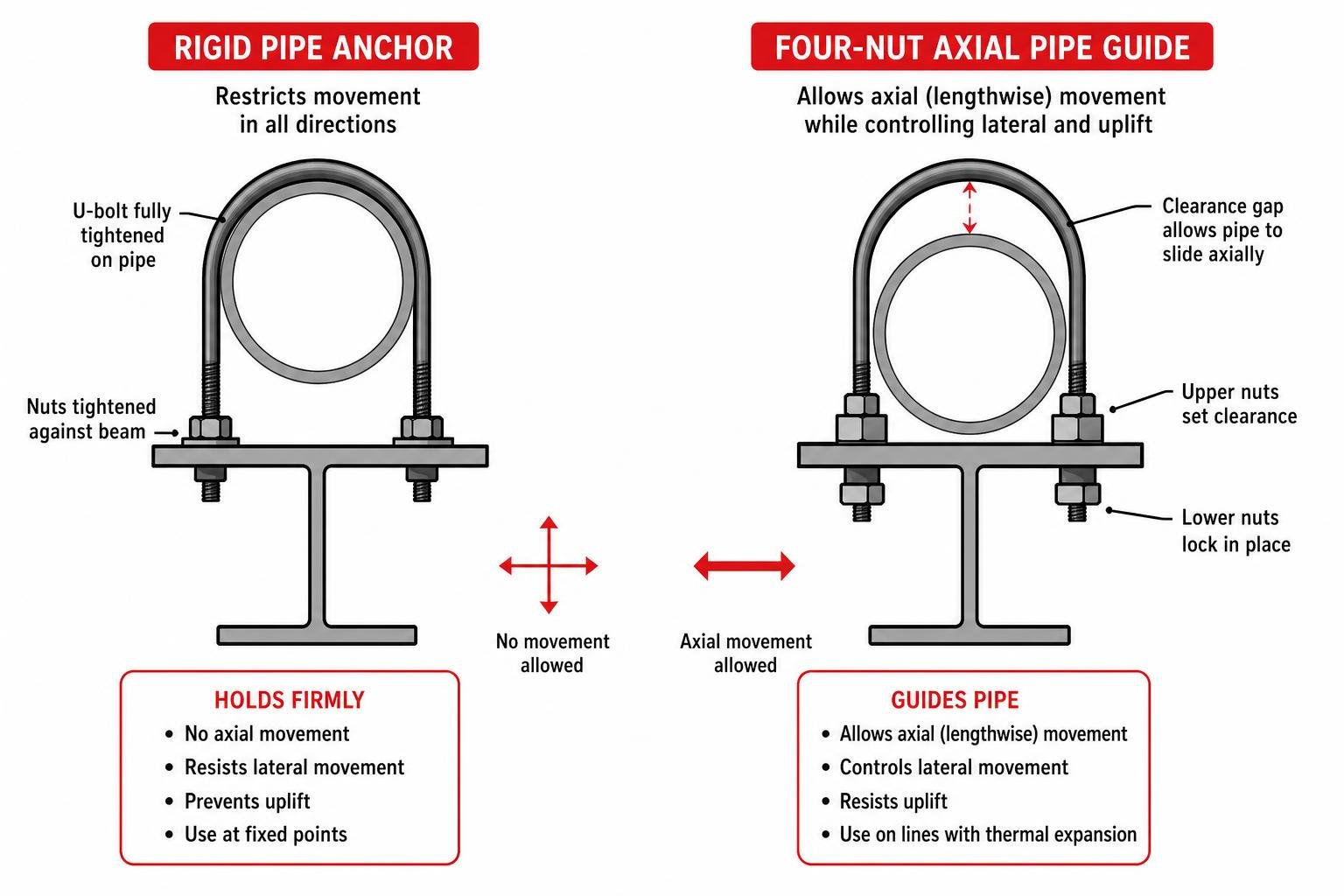
- Rigid Pipe Anchors: When a U-bolt is fully torqued down against the pipe and structural beam, it restricts motion in all directions (axial, lateral, and vertical). This setup is ideal when you need to fix a line in place, such as near pump discharge nozzles or critical directional transitions.
- Pipe Guides (Axial Movement): When transporting hot fluids, steam, or outdoor process media, pipes naturally expand and contract along their longitudinal axis. Tightening a clamp firmly onto a expanding pipe will cause localized bowing, buckling, or severe structural fatigue.
To configure a U-bolt as an axial pipe guide, installers employ a four-nut setup (two nuts positioned above the structural beam, and two below). This creates a precise clearance gap between the U-bolt crown and the outer pipe wall. The clamp restrains lateral sway and uplift while allowing the pipe to slide smoothly longitudinally as temperatures fluctuate.
If you are fabricating custom mounting frames or require specialized leg lengths, refer to our expert guide to U-bolt bending techniques to understand how material yield strength dictates precise leg radius forming.
Types of Pipeline U-Bolt Clamps for Industrial Applications
Piping projects span everything from small 1/2-inch hydraulic conduits to massive 24-inch municipal transmission headers. Choosing the proper clamp configuration ensures your structural mounting hardware matches system pressure ratings and environmental stresses.
Standard and Heavy-Duty Pipeline U-Bolt Clamps
Standard-duty U-bolts are widely utilized across light plumbing, electrical conduit mounts, and residential HVAC runs. These units typically feature M8 thread profiles (or equivalent 5/16-inch rod diameters) and provide adequate clamping strength for static loads. For comprehensive product selections across various structural applications, review standard industrial hardware catalog resources.
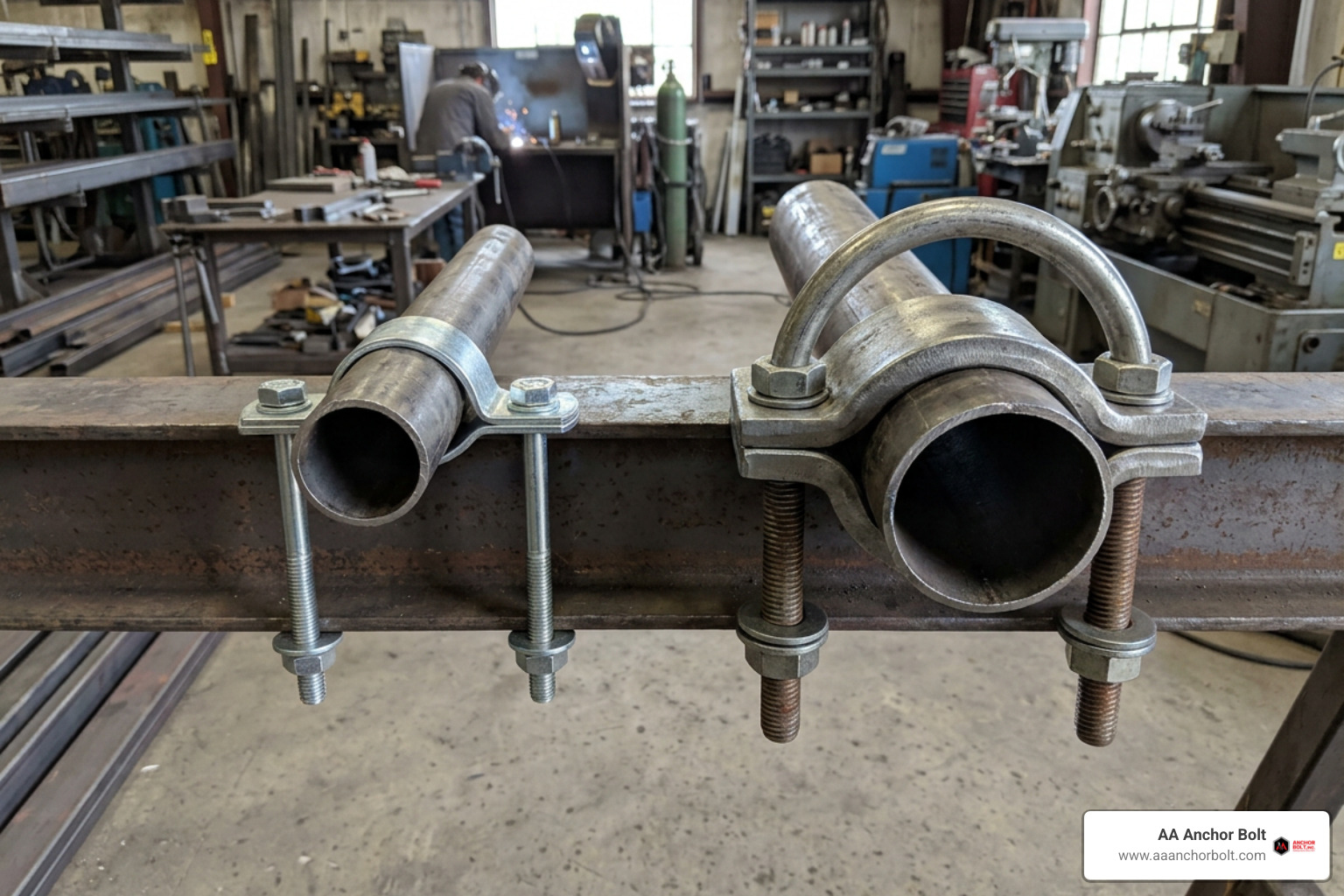
When lines experience hydraulic shock, water hammer, high flow rates, or heavy dynamic loads, industrial contractors step up to heavy-duty pipeline U-bolt clamps.
- Thicker Rod Diameters: Heavy-duty designs upgrade thread sizes from M8 to M10, M12, or even thicker structural rods.
- High Load Support: Enhanced cross-sectional metal area dramatically increases resistance to shear and tensile forces in dynamic environments.
- 360-Degree Full Surround: Many heavy-duty assemblies incorporate split-type mounting hoops or contoured cradle plates that deliver 360-degree contact pressure around the circumference, eliminating point-load deformation.
For specialized industrial pipeline designs, explore heavy-duty pipe clamp hoop options built specifically for extreme structural loads. You can also review standard catalog options to evaluate thread specs across various light and heavy duty formats.
Cushioned and Coated Pipeline U-Bolt Clamps
Bare metal-on-metal clamping creates friction wear, transmits acoustic noise throughout a facility, and accelerates localized contact corrosion. To mitigate these risks, cushioned and coated options are widely specified in high-performance job sites.
- EPDM Rubber Liners: Elastomeric rubber linings wrap around the interior circumference of the clamp hoop or saddle. These cushioned liners absorb mechanical energy, reduce sound levels, and protect sensitive copper, PVC, PPR, or thin-walled stainless pipes from metal abrasion. See how these integrated cushions work by inspecting heavy-duty pipe clamps equipped with protective rubber liners.
- Thermoplastic & PTFE Coatings: Coated U-bolts utilize bonded polyolefin, epoxy, or PTFE coatings. PTFE-coated clamps present an slick, low-friction surface that is exceptionally beneficial for axial pipe guides, allowing high-temperature lines to expand effortlessly without galling or sticking.
Material Selection and Precision Sizing Specifications
Selecting the right alloy and getting your dimensions right down to the millimeter is the difference between a system that lasts for decades and one that fails during initial commissioning.
Uncoated carbon steel clamps are budget-friendly but prone to oxidative rusting if exposed to atmospheric moisture. Zinc-plated carbon steel (standard 3-micron plating) provides excellent cost efficiency for climate-controlled indoor mechanical rooms. For outdoor municipal infrastructure, hot-dip galvanized steel delivers thick zinc protection against rain and soil exposure.
For severe chemical environments, industrial plants rely on stainless steel alloys:
- 304 Stainless Steel: Naturally forms a passive chromium oxide surface film that protects against surface rust, UV radiation, and atmospheric degradation.
- 316 Stainless Steel: Contains added molybdenum (typically 2-3%), providing exceptional defense against pitting corrosion, saltwater, and aggressive chemical processing environments.
For a broad array of metric and imperial sizing matrix options across alloy types, consult standard engineering reference specification charts from the American Society of Mechanical Engineers (ASME) or certified industrial manufacturing documentation.
Sizing Guide: Inside Diameter, Leg Length, and Thread Length
A common point of confusion is sizing a U-bolt by Nominal Pipe Size (NPS) versus actual pipe Outside Diameter (OD). A 2-inch steel pipe does not measure 2.00 inches on the outside; its actual outer dimension is roughly 2.375 inches.
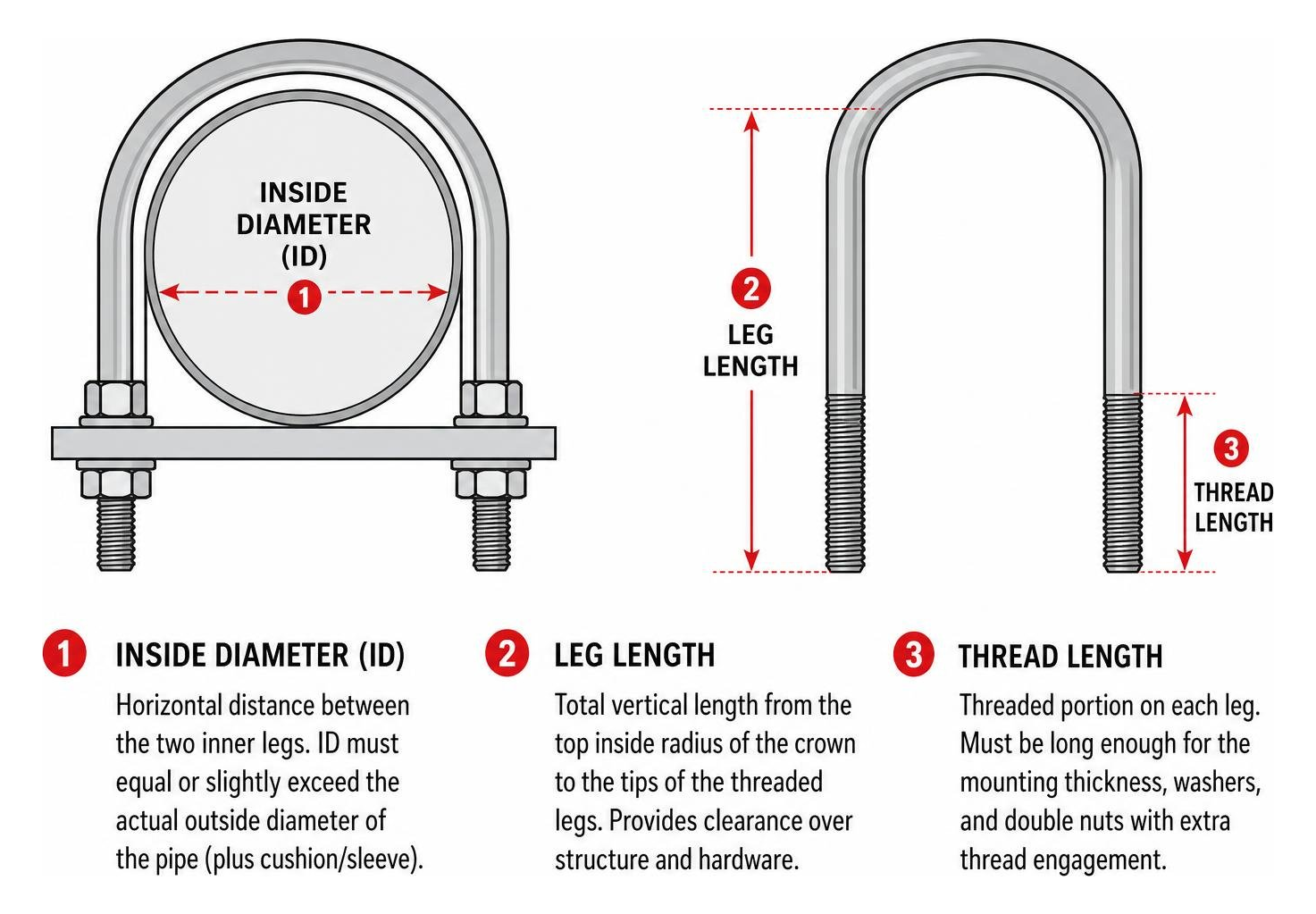
When specifying your pipeline U-bolt clamps, measure and verify these critical dimensions:
- Inside Diameter (ID): The horizontal distance between the two inner legs of the U-bolt. The ID must equal or slightly exceed the actual outside diameter of the pipe (plus the thickness of any rubber cushion or thermoplastic sleeve).
- Leg Length: The total vertical length measured from the top inside radius of the crown down to the tips of the threaded legs. Ensure the leg length provides enough clearance to clear structural beam flanges, mounting plates, and backing washers.
- Thread Length: The threaded portion on the bottom of each leg. Thread length must be sufficient to accommodate structural steel flange thickness, mounting plates, double nuts, and lock washers with extra thread engagement to spare.
Before buying hardware for structural steel framing or heavy equipment, double-check your sizing requirements using our U-bolt buying guide for structural components.
Installation Best Practices and Risk Prevention
Even top-grade stainless steel hardware will fail if installed incorrectly. Field statistics reveal that adopting standardized U-bolt installation methods can reduce labor and repair time by over 50% compared to traditional field-welded supports.
Vibration Dampening and Galvanic Corrosion Control
Vibration caused by high-velocity fluid flow, reciprocating compressors, or external mechanical operation rapidly fatigue rigid piping connections. Adding specialized elastomeric vibration pads under U-bolt supports absorbs up to 80% of mechanical vibration energy, converting dynamic kinetic energy into heat rather than letting it crack your pipeline walls.
Another widespread issue in piping installation is galvanic corrosion. When two dissimilar metals (such as a stainless steel pipe held by a bare carbon steel U-bolt) make direct contact in the presence of moisture, an electrical potential forms. This accelerates severe localized pitting and crevice corrosion at the contact point.
To prevent galvanic corrosion:
- Match materials whenever possible (e.g., pair stainless steel pipes with 316 stainless U-bolts).
- Use non-conductive thermoplastic isolators (TPI) or heavy-duty EPDM sleeves to break electrical continuity between dissimilar metals.
- Ensure fasteners match structural load calculations, similar to parameters detailed in our heavy-duty technology mounting solutions guide.
Frequently Asked Questions About Pipeline U-Bolt Clamps
How do I choose between a pipe guide and a pipe anchor configuration?
Base your decision on whether your piping system requires allowance for axial thermal growth. If your line experiences temperature fluctuations and expands over long straight runs, choose a pipe guide configuration using a four-nut setup to leave a controlled clearance gap. If you need to stop pipe movement completely—such as near pump connections, valves, or directional headers—tighten the clamp rigidly against the structural steel to create an anchor.
How do cushioned or insulated U-bolts reduce vibration and prevent corrosion?
Cushioned U-bolts incorporate EPDM rubber or thermoplastic isolators between the metallic clamp hoop and the outer pipe wall. The elastomeric cushion absorbs mechanical vibration energy, dampening operating noise while protecting the pipe surface from scuffing. Electrically, the insulating sleeve acts as a dielectric barrier, preventing contact crevice corrosion caused by direct contact between dissimilar metals.
What materials offer the best protection in marine and chemical environments?
For severe saltwater exposure, offshore platforms, or aggressive chemical processing facilities, 316 stainless steel offers superior protection due to its added molybdenum content. Combining 316 stainless steel hardware with PTFE coatings or non-conductive thermoplastic isolation liners yields maximum corrosion resistance and prevents material degradation.
Conclusion
Whether you are designing a municipal water distribution line, securing heavy commercial HVAC conduits, or mounting industrial process piping, selecting the proper pipeline U-bolt clamps is paramount to system longevity. Matching actual pipe outside diameters, selecting suitable alloy grades, and installing appropriate guides or anchors keeps your facility safe, quiet, and fully compliant with industrial piping codes.
When standardized off-the-shelf fasteners don’t fit your structural requirements, working with an experienced domestic manufacturer is essential. At AA Anchor Bolt, operating out of Northville, Michigan, we maintain nearly a million pounds of in-house raw steel to deliver fast turnaround times on custom anchor bolts, heavy-duty U-bolts, and specialty fasteners. With complete domestic production control, we deliver precision products engineered to your exact project specifications.
For more information on heavy-duty structural anchoring, explore our comprehensive concrete fastener guide for heavy-duty anchoring. Ready to source industrial fasteners for your next infrastructure build? Take a moment to explore custom U-bolts and industrial products or request a custom quote today!