Threaded Rebar for Commercial Projects: No Welding, No Worries
Why Threaded Rebar for Commercial Projects Is Replacing Traditional Lap Splicing
If you’re sourcing threaded rebar for commercial projects, here’s what you need to know upfront:
- What it is: Rebar with precision-cut threads on the ends, joined by mechanical couplers instead of overlapping bars
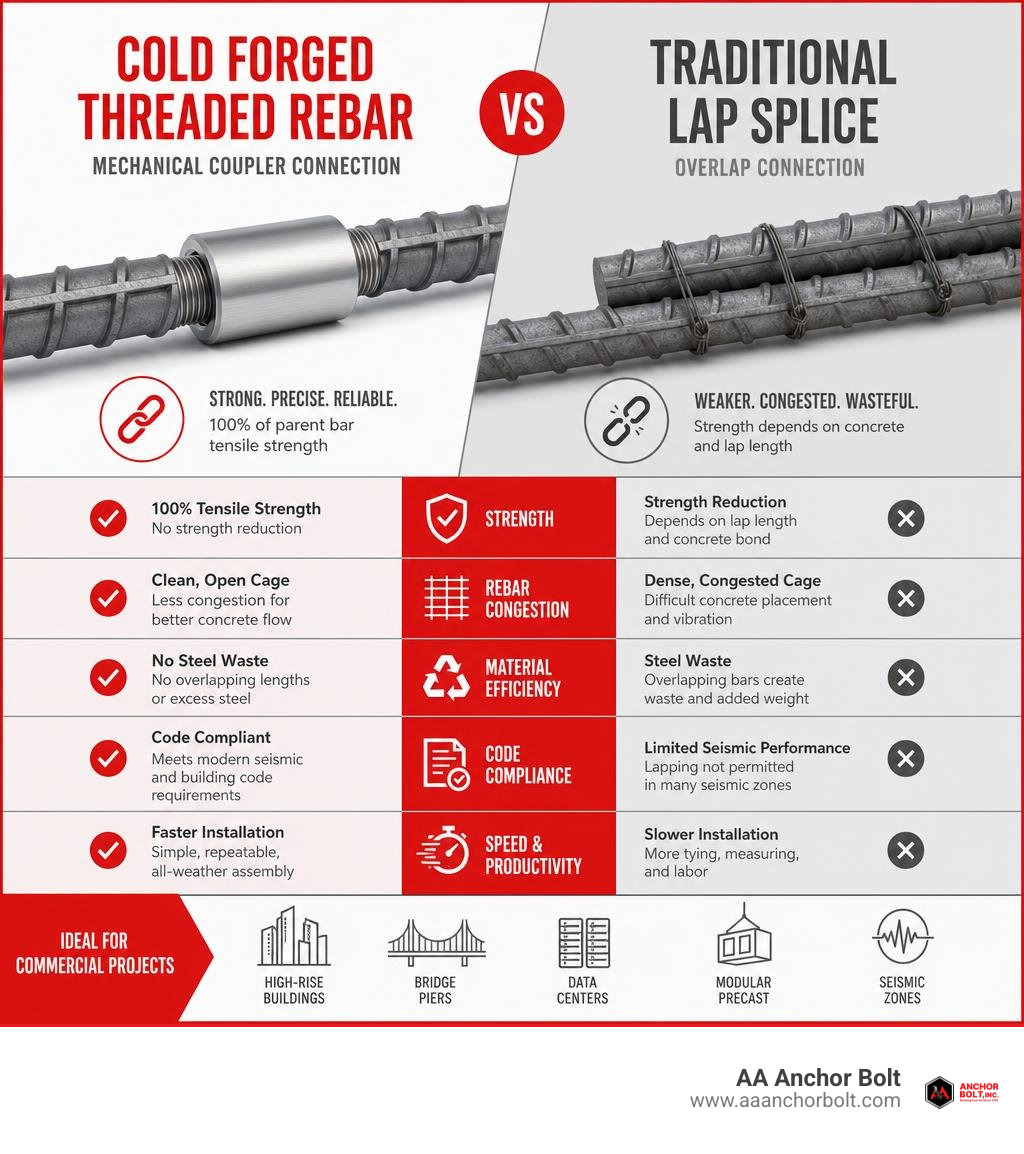
- Why it matters: Delivers 100% of the parent bar’s tensile strength — no strength reduction, no steel waste from overlaps
- Where it’s used: High-rise foundations, bridge piers, data centers, modular precast assemblies
- Key benefit over lap splicing: Reduces rebar congestion, speeds up assembly, and meets seismic code requirements that traditional lapping can’t satisfy
- What to look for: Couplers rated to ISO 15835, matched to your rebar diameter and load type (Standard, Position, or Transition)
The modern commercial construction industry is under pressure. Tighter schedules, stricter building codes, and taller, heavier structures are pushing contractors to find smarter ways to connect reinforcing steel. Traditional lap splicing — the old method of overlapping two rebar lengths and letting the surrounding concrete transfer the load — is increasingly falling short.
The problem isn’t just structural. Lapping creates dense, congested steel cages that are difficult to pour concrete through. It wastes steel. And in seismic zones, it simply doesn’t perform the way current codes demand.
Threaded rebar with mechanical couplers solves all three of those problems at once. That’s why the global rebar thread coupler market was valued at over $4 billion in 2025 and is projected to reach $6.67 billion by 2034.
I’m Pauline Horton, and in this guide I’ll walk you through everything you need — from how cold forging and threading actually work, to which coupler type fits your specific application, to how to source reliably for fast-turnaround commercial work.
Handy threaded rebar for commercial projects terms:
Cold Forging and Threading Mechanics for High-Strength Joints
To understand why mechanical rebar splicing performs so exceptionally under load, you have to look at the cold forging process.
When you simply cut threads directly into a standard rebar stem, you shave away material. That cutting action reduces the bar’s core diameter, creating a structural neck down that weakens the joint relative to the rest of the bar. Under tension, the connection becomes a localized point of failure.
Cold forging solves this issue completely through room temperature hydraulic upset forging:
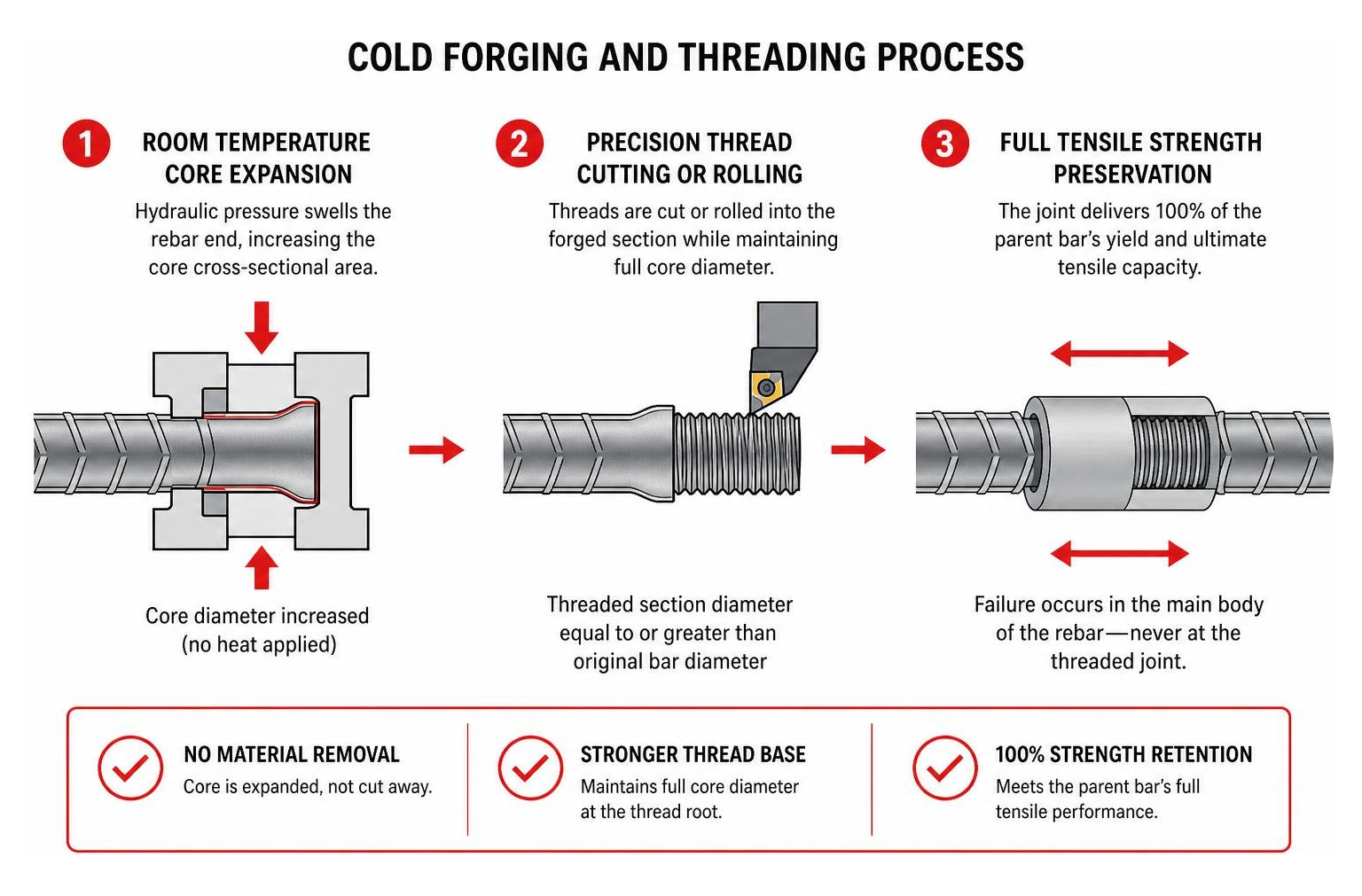
- Room Temperature Core Expansion: The end of the rebar stem is placed into specialized cold forging machinery. High hydraulic pressure compresses the bar end axially at ambient room temperature, causing the metal to swell outward. This increases the local cross-sectional core area without applying thermal stress or changing the structural temper of the steel.
- Precision Thread Cutting or Rolling: Threads are machined into this enlarged, forged section. Because the core was pre-swollen, the minimum diameter at the base of the cut threads remains equal to or greater than the original nominal diameter of the unmachined parent bar.
- Full Tensile Strength Preservation: The resulting mechanical connection delivers 100% of the parent bar’s full yield and ultimate tensile capacity. When tested to destruction, failure occurs in the main body of the rebar bar — never at the threaded joint.
Modern automated equipment and CNC-controlled threading machines make this process extremely efficient on heavy-duty job sites and processing shops. High-capacity machinery processes heavy TMT rebar up to 40mm in diameter and Grade 550D structural steel. By replacing labor-intensive field welding and manual bending, contractors can prepare thousands of threaded rebar ends per shift with micron-level thread pitch consistency.
To explore how these machinery specs interact with structural engineering design, read The Civil Engineer’s Guide to Threaded Rebar and Infrastructure.
Structural Advantages of Threaded Rebar for Commercial Projects
Why are leading engineers rejecting lap splicing in favor of mechanical couplers on commercial jobs? The benefits go far beyond basic load transfer.
First, cold forged threaded rebar eliminates structural lap lengths. In heavy concrete foundations or column splices, traditional code-mandated lap lengths can require overlapping bars by 30 to 60 times their diameter. On large-diameter bars (#11, #14, or #18 rebar), this practice buries massive tonnages of expensive steel inside concrete pours strictly for overlap length. Mechanical couplers eliminate this overlap altogether, cutting total rebar steel tonnage and wastage dramatically.
Second, eliminating lap splices solves rebar congestion. High-density column-to-beam joints packed with double-rebar overlaps restrict the flow of coarse aggregate during concrete placement. This often results in concrete honeycombing, void formation, and costly repair work. Mechanical splices keep reinforcement density at a single-bar layout, allowing self-consolidating and standard concrete mixes to flow freely around reinforcing steel cages.
| Performance Metric | Cold Forged Threaded Rebar Splice | Traditional Lap Splicing |
|---|---|---|
| Load Transfer Mechanics | Direct mechanical continuity across parent steel | Indirect shear transfer through concrete bond |
| Tensile Capacity | 100% of parent bar strength (bar break performance) | Dependent on surrounding concrete strength |
| Steel Wastage | Zero material wasted on lap overlaps | High (30x to 60x bar diameter overlap waste) |
| Rebar Congestion | Minimum (maintains single-bar cross section) | Severe (doubles rebar cross section at splices) |
| Concrete Placement | Maximum aggregate clearance and flow | High risk of voids, honeycombing, and blockage |
| Seismic Code Compliance | Full compliance with Type 1 & Type 2 seismic splices | Restricted or prohibited in plastic hinge regions |
Beyond spatial and material savings, threaded mechanical splices deliver superior performance under dynamic seismic loading. When an earthquake hits, traditional lap splices rely heavily on surrounding concrete to maintain their bond. If the concrete spalls or cracks under cyclic tension and compression, lap splices can slip or fail abruptly. Mechanical couplers form a continuous steel-to-steel mechanical bond that maintains structural ductility even during intense seismic shaking.
Commercial Construction Applications and Modular Prefabrication
The versatility of threaded rebar for commercial projects makes it a primary structural component across several vertical sectors:
- High-Rise Commercial Foundations: Mat slabs and shear wall bases utilize continuous threaded vertical rebar dowels to anchor thousands of vertical kips directly into deep foundation elements.
- Bridge Deck Piers and Infrastructure: Structural bridge columns and expansion joints utilize heavy-gauge threaded bars connected directly to embedded steel anchor plates for long-term fatigue durability.
- Hyperscale Data Centers: Commercial data center foundations require dense grid reinforcement and precise anchor layouts to support severe equipment loads and complex utility routing.
Threaded rebar technology also serves as the foundation for off-site prefabrication and modular construction. By manufacturing rebar cages, shear walls, and precast columns in quality-controlled factory environments, contractors can drop pre-threaded cages directly onto site foundations and screw them together in minutes.
To learn how mechanical splices lock precast modules together on site, check out Get a Grip: How Rebar Splice Couplers Keep Concrete Strong.
Advanced contractors even embed Building Information Modeling (BIM) data and sensor technology directly into structural prefabrication routines. Embedded strain sensors near mechanical splices allow real-time structural health monitoring during construction loading and throughout the structure’s operational lifespan. Modern sustainable practices also pair prefabricated threaded systems with crushed concrete materials from organizations like Kraken Crushed Concrete & Recycling, LLC to maximize green building credits and site circularity.
Standard, Position, and Transition Couplers for Threaded Rebar for Commercial Projects
Matching the correct mechanical coupler geometry to your jobsite conditions is critical for seamless assembly. Commercial reinforcement uses three primary coupler configurations:
- Standard Type Couplers: Designed for applications where at least one rebar bar can be freely rotated around its longitudinal axis. The coupler is pre-threaded fully onto the fixed bar, and the connecting bar is screwed directly into the open coupler body using standard torque settings.
- Position Type Couplers: Used when neither bar can be rotated — such as pre-assembled cage grids, bent starter bars, or heavy curved rebar sections. A position coupler features extended internal threads or split locking sleeves that allow the coupler to thread onto two stationary bars, locking them together without rotating either bar.
- Transition Type Couplers: Designed specifically to join reinforcing bars of different nominal diameters (for instance, stepping down from a #11 / 36mm column bar to a #9 / 28mm bar on upper floors). Transition couplers feature different internal thread diameters on each end, eliminating complex transition lapping and structural offset details.
All three coupler types meet rigorous international performance criteria, including ISO 15835 specs, ensuring dynamic shear resistance, low slip, and full tensile strength transfer across all load cycles.
Global Market Growth and Regional Adoption Trends
The global demand for threaded rebar for commercial projects and mechanical splicing technology is accelerating worldwide:
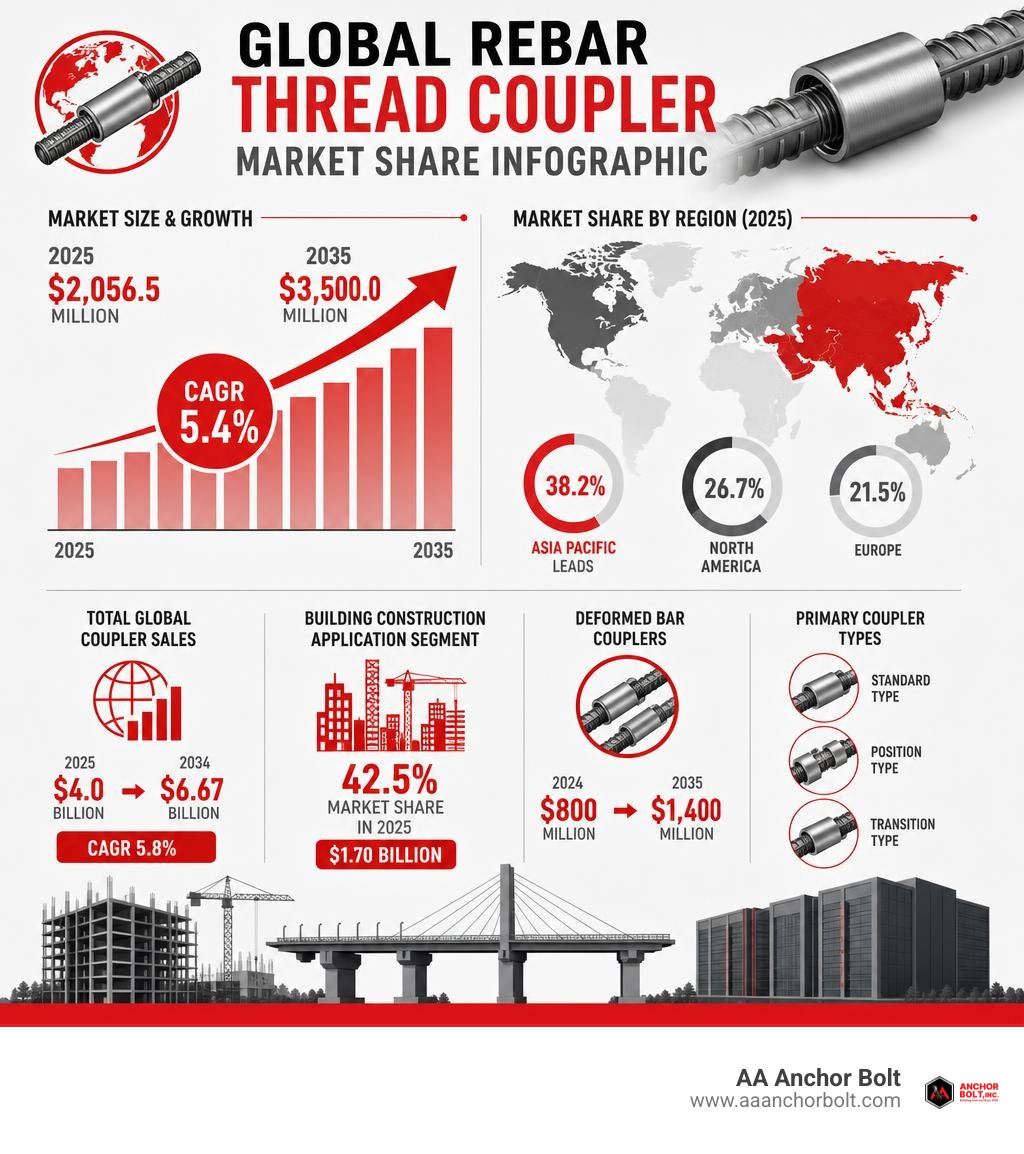
- The Global Rebar Thread Coupler Market was valued at $2,056.5 Million in 2025 and is projected to expand to $3,500.0 Million by 2035, growing at a CAGR of 5.4%.
- Broader industry figures place total global coupler sales at $4.0 Billion in 2025, reaching $6.67 Billion by 2034 with a 5.8% annual growth rate.
- Building Construction represents the single largest application segment, capturing a 42.5% market share in 2025 ($1.70 Billion).
- Asia Pacific leads global adoption with a 38.2% revenue share, followed by North America (26.7%) and Europe (21.5%).
- Deformed Bar Couplers accounted for $800 Million in valuation in 2024 and are projected to reach $1,400 Million by 2035.
This sustained growth is driven by three primary factors: updated seismic building codes, massive government infrastructure investments (which exceeded $3.2 trillion globally in 2025), and the rapid expansion of modular prefabrication. In Scandinavian countries, modular building adoption has driven a 23% annual increase in mechanical coupler usage. Furthermore, new building code updates following recent global seismic events are driving coupler adoption up by 18.3% annually in earthquake-prone regions.
Material options are expanding as well. While standard structural carbon steel couplers dominate high-rise framing, high-corrosion environments — such as coastal marine structures, wastewater facilities, and chemical plants — frequently specify specialized products like Stainless Steel 304 Threaded Rod SUS304 Stainless Steel Rebar Ø22 x 6000mm from China Factory. In other light-duty or non-magnetic concrete pours, engineers may evaluate composite solutions like GatorBar FRP Rebar Used In Commercial Concrete Projects.
Sourcing and Field Implementation Considerations
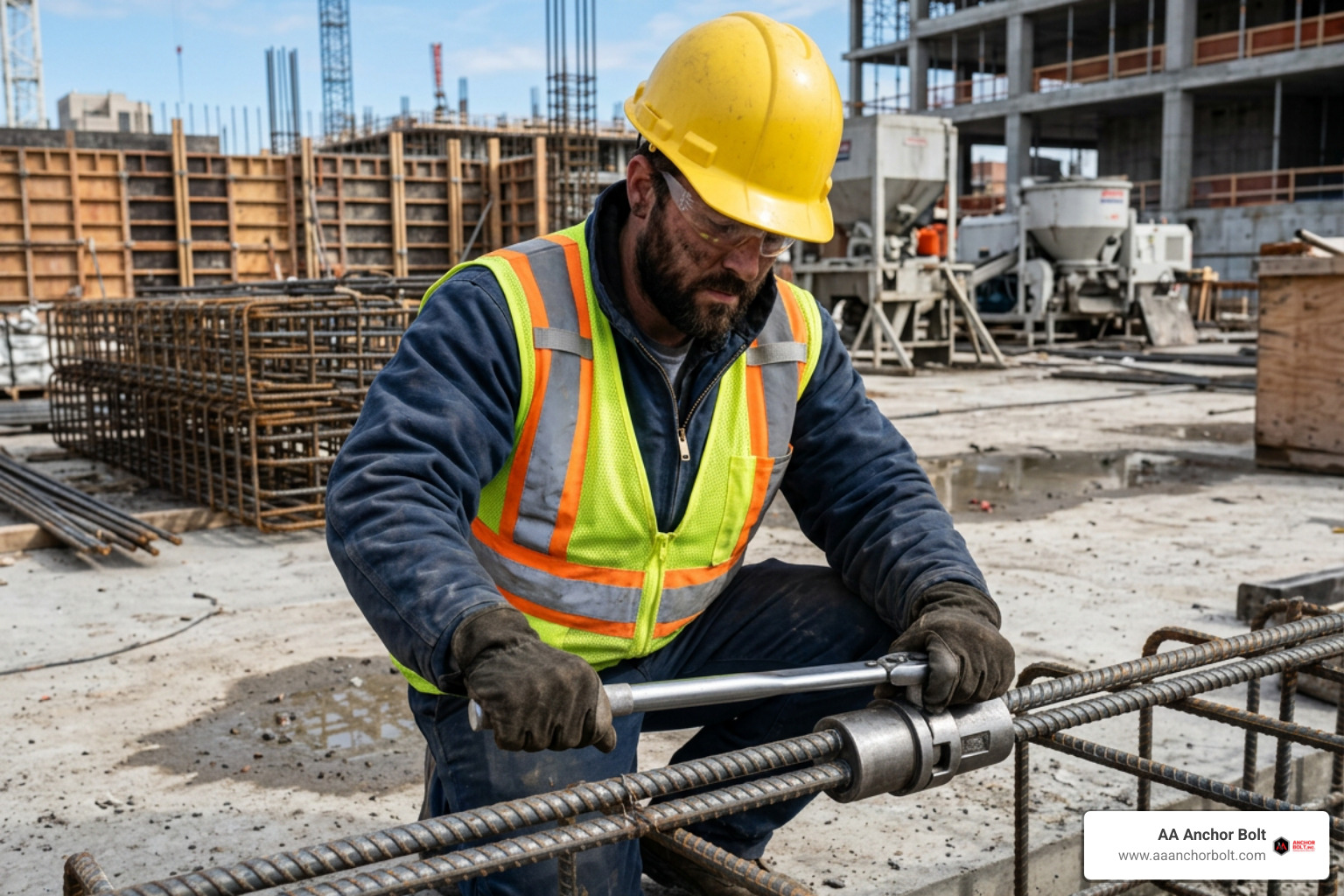
Successful site execution relies on thread precision, clean bar preparation, and proper torque verification. Ironworkers installing mechanical splices should verify that bar ends are cold-forged and cut cleanly without burrs or thread distortion.
Field teams should follow a standardized installation sequence:
- Inspect Threads: Ensure threaded bar ends are clean of dirt, rust scale, and concrete splatter prior to engagement.
- Hand Thread Engagement: Thread the mechanical coupler onto the fixed rebar end until initial hand tightness is achieved.
- Torque Application: Engage a calibrated manual or pneumatic torque wrench to tighten the connection to the engineering specification.
- Visual Inspection: Verify full thread engagement within the coupler housing (many couplers feature visual center stops or indicators).
For site guidance on setting up shop threading and quality control, read How to Master Rebar Threading in Less Than an Hour.
Sourcing Premium Threaded Rebar for Commercial Projects
When project schedules are tight, waiting weeks for custom-threaded bar or specialized anchor bolts can stall concrete pours and break construction budgets. You need a supply chain partner with real inventory, domestic manufacturing control, and rapid response capabilities.
At AA Anchor Bolt, we operate out of our Northville, Michigan facility with nearly a million pounds of raw steel inventory ready for immediate processing. As a family-owned USA manufacturer, we control every step of production — from upset forging and precision threading to custom anchor bolt fabrication.
Whether you need heavy-duty commercial rebar splices, custom anchor studs, or specialty structural fasteners, we deliver fast turnaround times without compromising structural quality.
Explore our full range of structural solutions and heavy fasteners:
- The Complete Guide to F1554 Anchor Bolt Specs
- Demystifying ASTM F1554 Grades 36, 55, and 105
- How to Choose the Right Anchor Bolt Nuts for Your Next Project
- The Concrete Fastener Guide for Heavy-Duty Anchoring
- Explore our complete line of custom anchor bolts on our Products page.
Frequently Asked Questions About Threaded Rebar
How does cold forging prevent loss of cross-sectional area during rebar threading?
Cold forging compresses the rebar end at room temperature using high hydraulic pressure, causing the local metal core to swell outward. When threads are machined into this enlarged bar end, the minimum diameter at the thread root remains equal to or greater than the original bar diameter. This preserves 100% of the bar’s cross-sectional area and tensile yield strength.
What are the main structural differences between standard, position, and transition rebar couplers?
- Standard Couplers: Used when at least one rebar bar can be rotated freely to thread into the coupler.
- Position Couplers: Designed for fixed or bent bars that cannot be rotated; the coupler threads onto both stationary bar ends simultaneously.
- Transition Couplers: Feature two different internal thread sizes to connect reinforcing bars of differing nominal diameters (e.g., joining #11 rebar to #9 rebar).
Why are modern seismic building codes requiring mechanical splices over lap splicing?
During an earthquake, concrete in high-stress plastic hinge zones can crack and spall. Because traditional lap splices rely entirely on intact concrete to transfer load between overlapping bars, concrete degradation can lead to sudden splice failure. Mechanical couplers establish a direct steel-to-steel continuity that maintains structural integrity under cyclic seismic loading regardless of concrete cracking.
Conclusion

Transitioning your commercial pours to cold-forged threaded rebar connections delivers undeniable advantages: zero steel wasted on lap overlaps, eliminated concrete congestion in tight column cages, full 100% parent bar tensile strength, and fast, predictable field assembly.
By eliminating field welding and cumbersome overlap lapping, contractors save labor hours while meeting the most stringent modern seismic codes.
Ready to streamline your structural steel procurement with fast domestic lead times? Contact our team today or explore our full capabilities on our Manufacturing Capabilities page to discuss your upcoming project requirements.