An Essential Guide to Finding Reliable Anchor Bolt Manufacturers
Choosing a Reliable Anchor Bolt Manufacturing Company
A reliable anchor bolt manufacturing company can help keep an infrastructure project on schedule by producing made-to-spec bolts, supplying material documentation, and coordinating corrosion protection when needed.
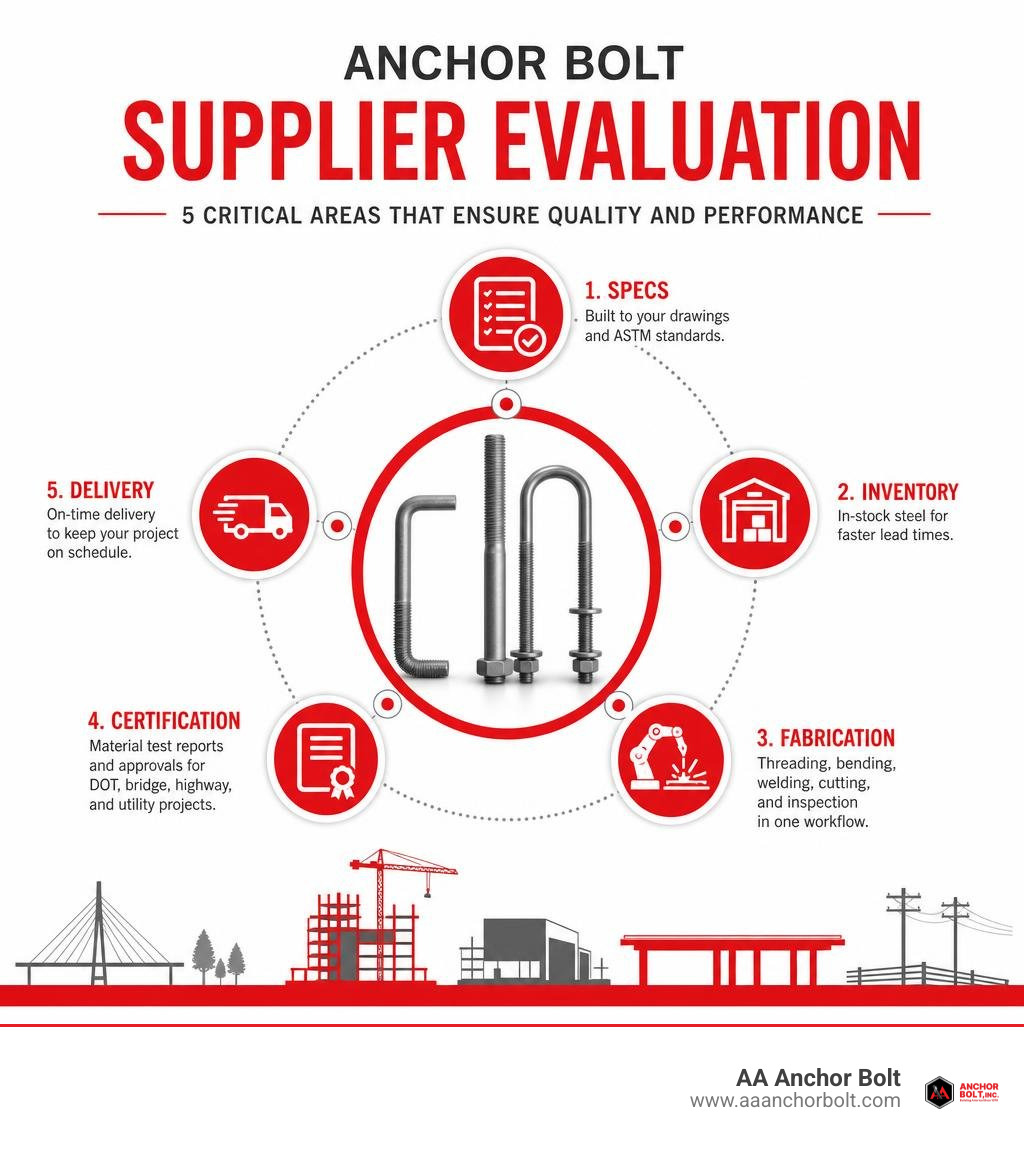
For a fast buying decision, look for a manufacturer that can provide:
- Custom anchor bolts such as L-bolts, J-bolts, U-bolts, straight rods, and specialty fasteners
- ASTM F1554 grades that match the design, including Grades 36, 55, and 105
- In-stock steel to avoid waiting on raw-material deliveries
- Threading, bending, welding, cutting, and inspection capabilities in one workflow
- Material test reports and approvals required for DOT, bridge, highway, and utility work
- Hot-dip galvanizing through qualified in-house operations or trusted regional partners
For Midwest contractors, the difference is often not just bolt quality. It is whether the supplier can start fabrication promptly, verify the specification, and deliver before a concrete pour or steel erection date is missed. AA Anchor Bolt has operated as a family-run manufacturer since 1979 and maintains substantial in-house steel inventory to support responsive custom production.
I am Pauline Horton, and this guide explains how to evaluate manufacturers before your next anchor bolt order.
What to Look For in an Anchor Bolt Manufacturing Company
When evaluating an anchor bolt manufacturing company, structural engineers and purchasing managers must look far beyond standard bolt dimensions. A dependable partner possesses end-to-end technical capabilities, maintains structural raw material inventory, and enforces rigorous metalworking standards.
When structural components arrive at the job site, they must fit pre-drilled templates and embedded footings without requiring field modifications. Achieving this degree of precision demands heavy-duty production machinery, experienced machine operators, and rigorous quality assurance protocols.
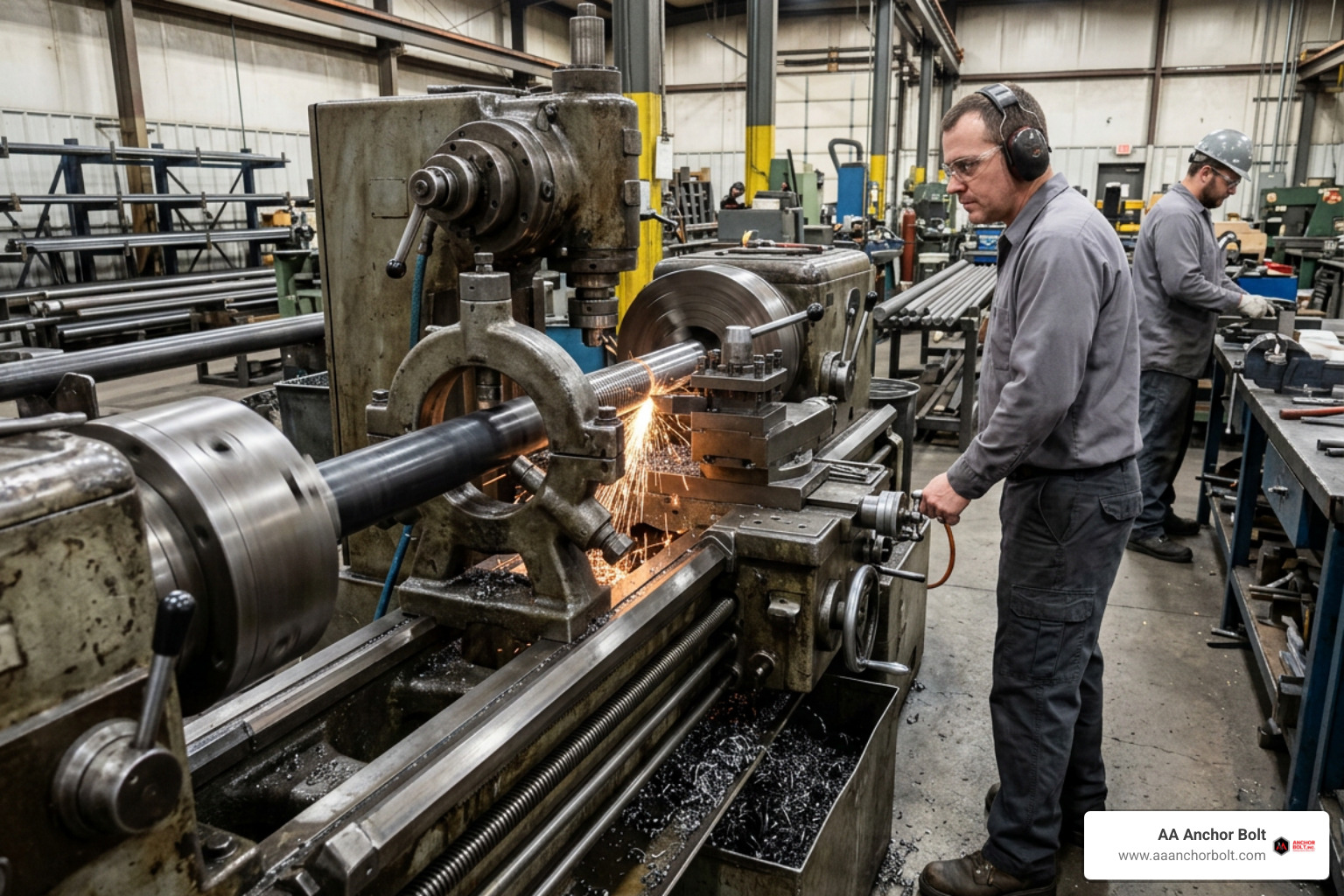
Manufacturing Capabilities and Heavy Machinery
A premier domestic manufacturer invests in specialized tooling to handle custom fabrication in-house. Having full control over equipment guarantees tighter tolerances, immediate job scheduling, and consistent product quality across large production runs.
Our facility in Northville, MI, features top-tier production equipment designed for structural metalworking:
- 140-Ton Ironworker: Punches clean, precise holes up to 3 inches in diameter through thick structural steel plate, allowing us to fabricate custom embedded bearing plates and washers quickly.
- Plate Shearing Capabilities: Capable of shearing steel plates up to ¾-inch thickness by 8 feet wide, or 1-inch thickness by 18 inches wide, creating custom anchor plate assemblies without delay.
- 1600-Amp Stud Welded Systems: Enables rapid attachment of headed studs up to ⅞-inch diameter directly to base plates or embedments.
- Thread Tapping Equipment: Handles specialized internal thread tapping up to 3 inches in diameter.
By consolidating these metalworking processes under one roof, we eliminate cross-town trucking delays and preserve end-to-end quality control. To explore how we turn raw steel into finished structural components, check out our dedicated Manufacturing Capabilities and explore our full range of custom Services.
Types of Fasteners and Custom Bending Options
Every concrete foundation presents unique mechanical anchorage demands. Whether a project requires high pull-out resistance, lateral load shear resistance, or specialized clamping arrangements, an experienced anchor bolt manufacturing company offers diverse geometry options.
We support a full suite of configuration choices:
- Bent Anchor Bolts (J-Bolts and L-Bolts): Poured directly into concrete foundations, utilizing the hooked tail to deliver mechanical resistance against uplift forces.
- U-Bolts (Round and Square): Engineered to secure piping, structural conduits, and heavy steel beams to concrete or structural framing.
- Continuous Thread Rods: Fully threaded studs utilized in concrete formwork, thru-bolting, and structural tie-rod assemblies.
- Specialty Fasteners: Including eyebolts and crane rail hook bolts tailored for heavy industrial equipment installation.
We manufacture thread diameters ranging from ¼ inch all the way up to 5 inches, alongside custom cold and hot bending capabilities up to 3 inches in diameter. You can review our full spectrum of heavy-duty concrete anchors and fasteners on our Products catalog page.
Rolled Threading vs. Cut Threading Mechanics
Understanding thread production methods is essential for selecting fasteners for dynamic load environments. Engineers frequently specify thread forming methods based on tensile performance and mechanical stress considerations.
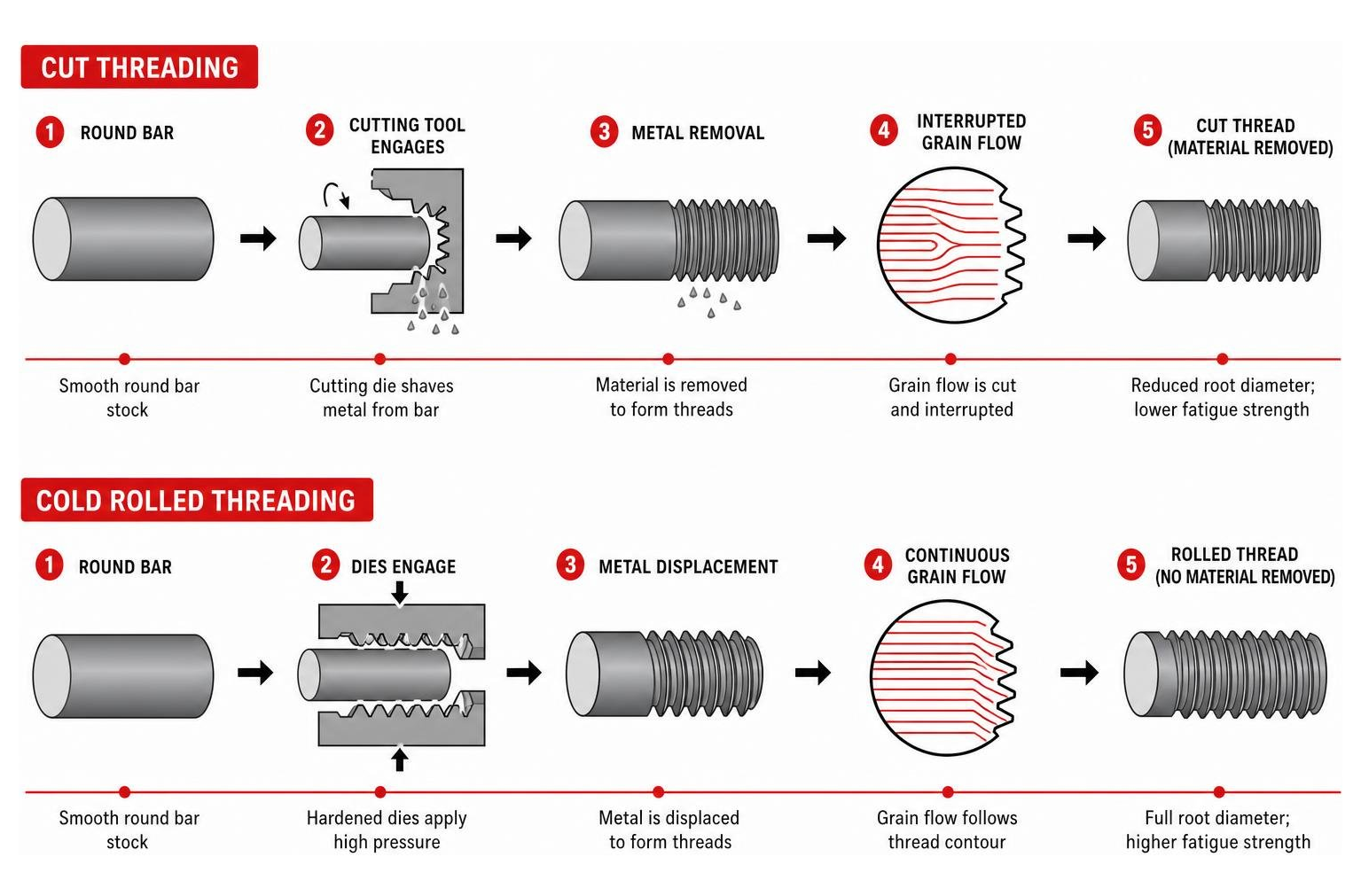
- Cut Threading: Cut threads are produced by physically shaving metal away from a round bar using a cutting die or lathe tool. While this method is highly versatile for unique thread pitches or extreme bar diameters, removing material decreases the root diameter and interrupts the original grain lines of the steel stock.
- Rolled Threading: Rolled threads are manufactured through a cold-forming process where hardened steel dies exert immense hydraulic pressure against the bar, displacing cold steel to form threads. This process burnishes the surface, hardens the material through strain hardening, and preserves continuous grain lines that mirror the thread contour.
Because rolled threads preserve grain continuity, they offer up to 20% greater fatigue strength and enhanced yield resistance compared to cut threads of identical diameter. Discover more about cold-forming dynamics in our article on Blog: Industrial Rebar Threading Solutions for Maximum Tensile Strength.
Understanding ASTM F1554 Specs and Steel Grades
In structural steel design, the primary governing specification for anchor bolts cast into concrete is ASTM F1554. Established by ASTM International, this specification covers straight, bent, headed, and headless anchor bolts across three distinct material strength tiers.
Selecting the right grade prevents premature anchor yield or catastrophic anchorage failure under load. For a deep dive into compliance standards, read our guide on Blog: Demystifying ASTM F1554 Grades 36, 55, and 105 or visit our main product hub for Products: F1554 Anchor Bolt.
| Specification Grade | Minimum Yield Strength (psi / MPa) | Minimum Tensile Strength (psi / MPa) | Welding Characteristics | Primary Applications |
|---|---|---|---|---|
| ASTM F1554 Grade 36 | 36,000 psi (248 MPa) | 58,000 – 80,000 psi (400 – 550 MPa) | Excellent weldability | Light structural columns, highway sign structures, building footings |
| ASTM F1554 Grade 55 | 55,000 psi (380 MPa) | 75,000 – 95,000 psi (517 – 655 MPa) | Weldable (when S1 supplemental requirement is met) | Precast concrete, commercial frame anchorage, light pole bases |
| ASTM F1554 Grade 105 | 105,000 psi (724 MPa) | 125,000 – 150,000 psi (862 – 1034 MPa) | Not recommended for field welding | Heavy industrial columns, high seismic loads, crane runaway rails |
Grade 36 Low-Carbon Steel
ASTM F1554 Grade 36 is manufactured from low-carbon steel, providing high ductility and seamless weldability. It is the designated workhorse for everyday commercial construction, light industrial building frames, and standard concrete footings.
Because of its lower yield threshold, Grade 36 bends reliably without requiring specialized induction heating, making it cost-effective for standard bent anchor bolt configurations. To order custom configurations, see our detailed specifications for Products: F1554 Grade 36.
Grade 55 Moderate-Strength Steel
ASTM F1554 Grade 55 delivers enhanced tensile performance over standard Grade 36 while maintaining cost efficiency. It is extensively specified across transportation, precast concrete foundation work, and mid-rise structural steel erection.
Grade 55 can be modified through a supplemental chemistry requirement (Supplemental Requirement S1) to guarantee weldability. When your structural contract calls for high strength with attachment options, explore our options under Products: F1554 Grade 55.
Grade 105 High-Strength Steel
ASTM F1554 Grade 105 represents the ultimate high-strength standard in concrete anchoring. Manufactured from alloy steel that undergoes rigorous quenching and tempering heat treatment, Grade 105 delivers a formidable minimum yield strength of 105,000 psi.
This grade is crucial in structures subjected to severe vibration, wind loads, dynamic stress, or extreme seismic activity. Due to its heat-treated grain structure, field welding on Grade 105 is strictly prohibited, as high welding temperatures destroy the heat treatment. Review our load ratings and sizing availability for Products: F1554 Grade 105.
Supply Chain Speed, Certifications, and Industry Applications
On complex heavy highway or commercial construction sites, scheduling delays can cause cascading financial losses. Working with an agile anchor bolt manufacturing company ensures raw materials, mechanical testing, and specialized corrosion coatings align with project delivery schedules.
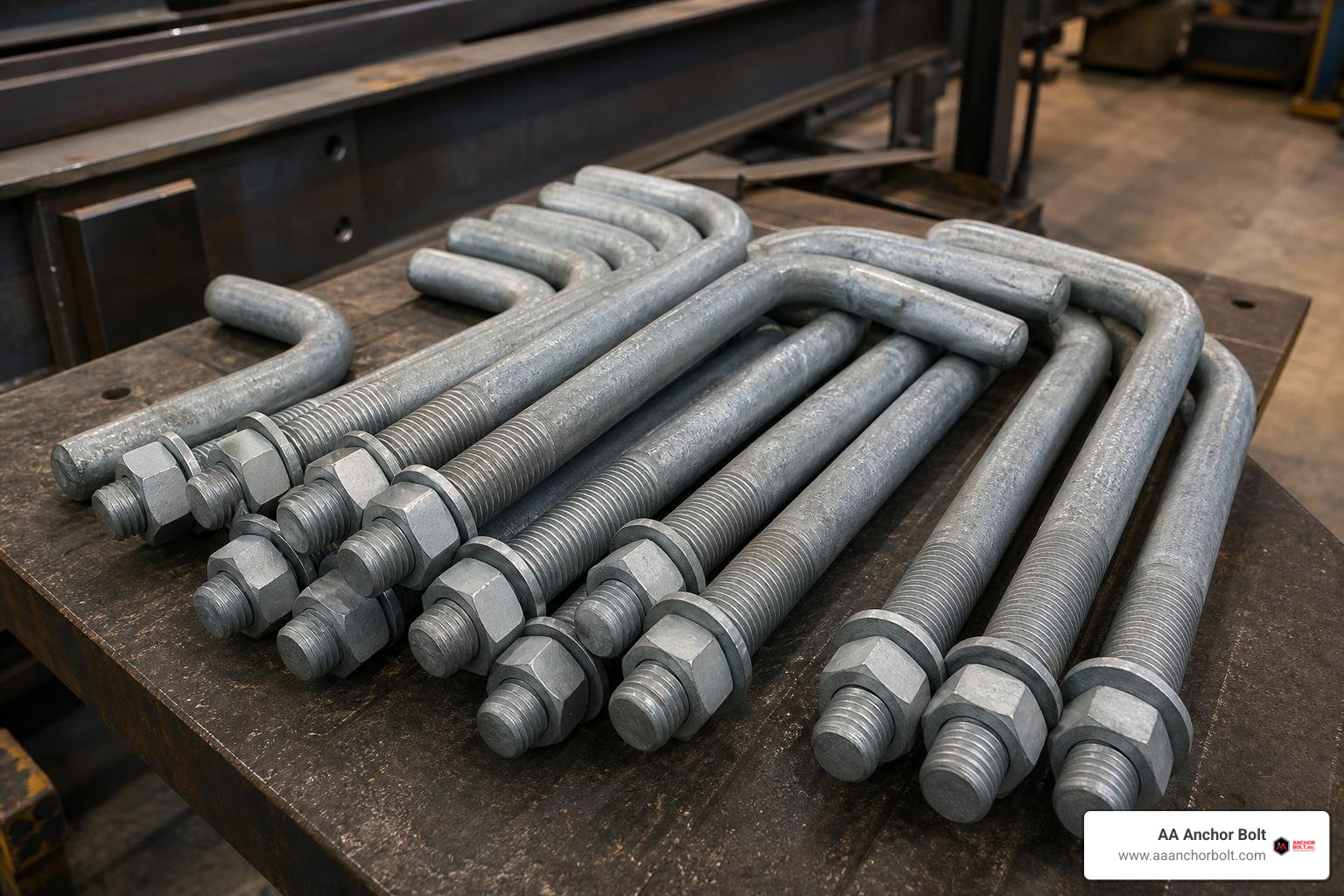
How an Anchor Bolt Manufacturing Company Streamlines Project Lead Times
Standard print-to-order models force fabricators to place steel mill orders only after receiving a customer contract, instantly adding weeks of material lead time. We overcome this friction by maintaining nearly a million pounds of raw steel stock directly in our facility.
By maintaining high-demand rounds, bar stock, and plate in house, we can setup machinery and cut, thread, or bend your fasteners the same day an order is finalized. Raw material readiness transforms supply chain delays into immediate production momentum.
Partnering with a Certified Anchor Bolt Manufacturing Company
Infrastructure projects overseen by the Department of Transportation (DOT), Federal Highway Administration, or regional utility commissions require full material traceability. A non-certified fastener can halt job-site inspections and stall structural pours.
We furnish comprehensive Material Test Reports (MTRs) with our shipments, verifying exact heat numbers, chemical composition, and physical tensile testing. This documentation guarantees that our products satisfy state and federal DOT requirements for bridge decks, highway sign structures, overhead gantries, and guardrail attachments. Learn why certified traceability is non-negotiable in our guide, Blog: Certified Strength – Why Anchor Bolt Material Certs Matter.
Corrosion Protection via Hot-Dip Galvanizing
Anchor bolts exposed to atmospheric moisture, road salt, or aggressive industrial chemicals require robust corrosion protection. Hot-dip galvanizing applies a sacrificial zinc alloy coating that bonds metallurgically with the underlying steel substrate.
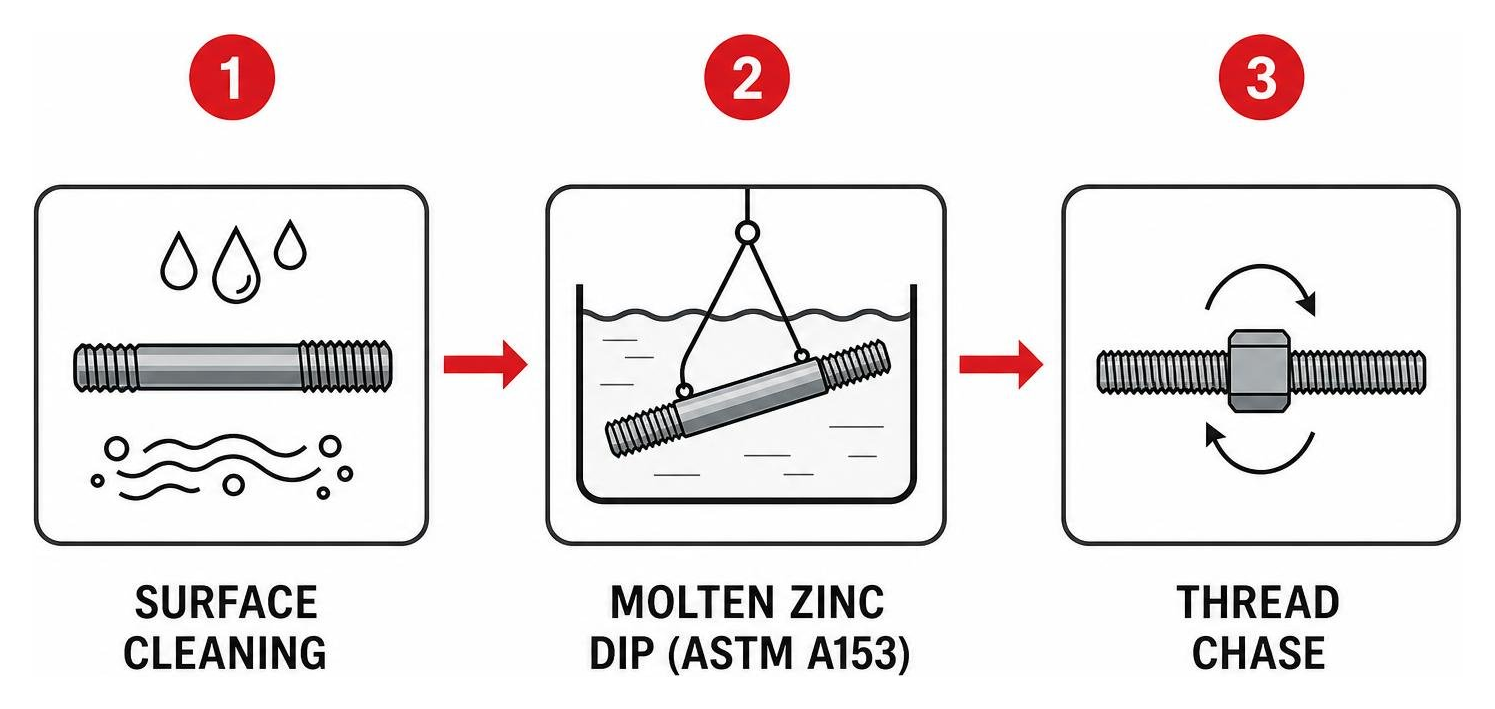
To maintain compliance with ASTM A153 specifications for hardware galvanizing, we coordinate hot-dip galvanizing with certified, trusted regional partners. This partnership allows us to manage your entire order lifecycle, delivering corrosion-resistant, ready-to-install anchor bolts directly to your job site. Read more about selecting proper protective finishes in Blog: How to Choose and Use Hot Dipped Galvanized Anchor Bolts.
Key Industries Served
Custom concrete anchoring fasteners play a vital foundation role across many essential industrial sectors:
- Transportation Infrastructure: Securing bridge bearing pads, highway sign trusses, noise barrier walls, and light poles.
- Renewable Energy & Power Generation: Anchoring wind turbine base rings, transmission towers, solar racking foundations, and electrical substations.
- Commercial Construction: Anchoring structural steel columns, warehouse tilt-up panels, and precast concrete walls.
- Industrial Equipment & OEMs: Securing heavy machinery bases, crane runway rails, dynamic stamping presses, and plant conveyors.
To see real-world application examples, visit our dedicated industry resource hub at Blog Category: Industrial.
The Custom Anchor Bolt Ordering and Fabrication Process
Ordering custom structural components should be straightforward and accurate. Working with an experienced domestic manufacturer eliminates guessing, ensures fast quote generation, and yields defect-free deliveries.
Step-by-Step Custom Order Placement
Our custom ordering process moves quickly from initial engineering plans to final shipment:
- Specification & Blueprint Review: Submit your engineering drawings, dimensions, grade specs, and quantity needs through our direct contact team.
- Technical Quote Generation: Our sales team—bringing over 80 years of combined industry experience—reviews your project specs and issues an itemized quote.
- Material Allocation: Upon contract approval, raw steel stock is selected immediately from our on-site inventory.
- Precision Fabrication: The raw stock undergoes shearing, cold or hot bending, cutting, and thread rolling or tapping to meet exact plan tolerances.
- Finishing & Quality Verification: Fasteners are galvanizing-processed if specified, checked against thread ring gauges, packaged, and paired with MTR documentation before delivery.
If you are ready to request pricing for an upcoming pour, connect directly with our technical sales specialists on our Contact page.
Quality Assurance in Specialized Domestic Manufacturing
As a family-owned business operating since 1979, we prioritize personal accountability and manufacturing excellence. Domestic production control allows us to inspect material quality at every stage of fabrication.
Unlike imported fasteners that carry risk of unknown metallurgy or freight delays, domestic manufacturing delivers total consistency, certified steel origin, and dependable delivery schedules. Discover our operational history and commitment to quality by visiting our About Us page.
Frequently Asked Questions About Sourcing Anchor Bolts
What is the structural advantage of rolled threads compared to cut threads?
Rolled threads are cold-formed under heavy hydraulic pressure, forcing the steel’s grain structure to flow smoothly around the contour of the thread rather than cutting through it. This cold-working process burnishes the surface finish, increases material hardness, and preserves continuous grain lines, resulting in up to 20% higher fatigue resistance and superior tensile strength under dynamic loading.
Why are material test reports (MTRs) necessary for structural anchor bolts?
Material Test Reports provide traceable, certified chemical and mechanical testing data for the exact steel heat used to manufacture your anchor bolts. MTRs prove compliance with ASTM standards (such as F1554 Grade 36, 55, or 105) and are mandated by building inspectors, structural engineers, and state DOT authorities to guarantee job-site safety and structural integrity.
How does in-stock steel inventory impact custom fastener lead times?
Maintaining an in-house steel inventory—such as our nearly one million pounds of raw stock—eliminates delays caused by waiting for steel mill shipments. Instead of waiting weeks for raw material to arrive, custom shearing, bending, and thread rolling can begin immediately, turning long turnaround times into rapid single-day or quick-turn deliveries.
Conclusion
Finding a trusted anchor bolt manufacturing company is essential for meeting tight construction schedules and fulfilling structural engineering standards. By pairing nearly a million pounds of on-site raw steel stock with high-capacity equipment—including a 140-ton ironworker, advanced plate shearing, heavy stud welding, and versatile custom bending—we ensure your foundation components arrive on time and built to exact specifications.
Since 1979, AA Anchor Bolt has combined family-owned commitment with domestic manufacturing precision. Whether you require ASTM F1554 Grade 36, 55, or high-strength Grade 105 anchor bolts, complete with DOT-approved material certifications and hot-dip galvanizing, our experienced team stands ready to deliver.
Explore our full line of custom fasteners and fabrication capabilities on our Products & Services page, or request a quote directly on our main ASTM F1554 Anchor Bolt Hub today!