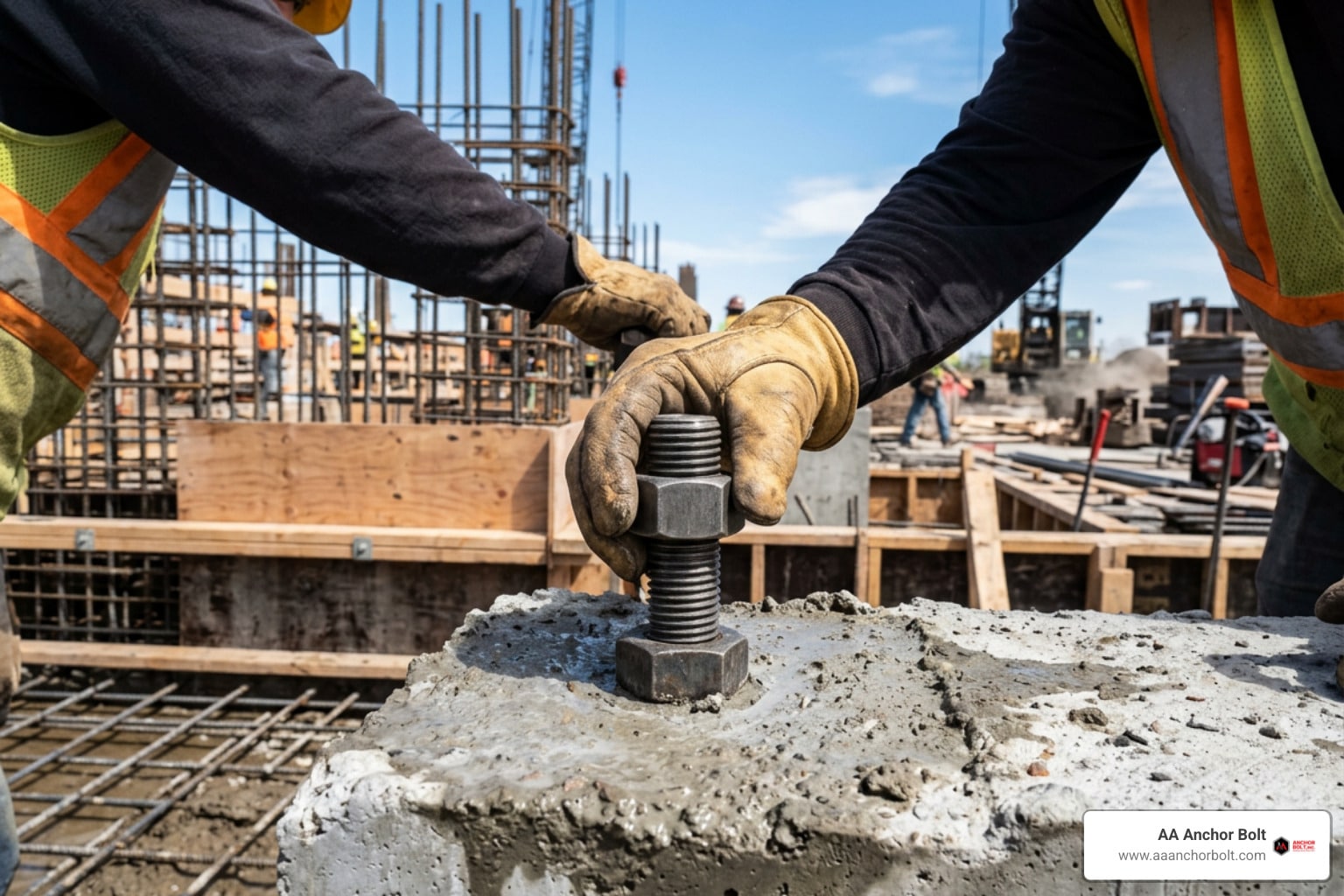
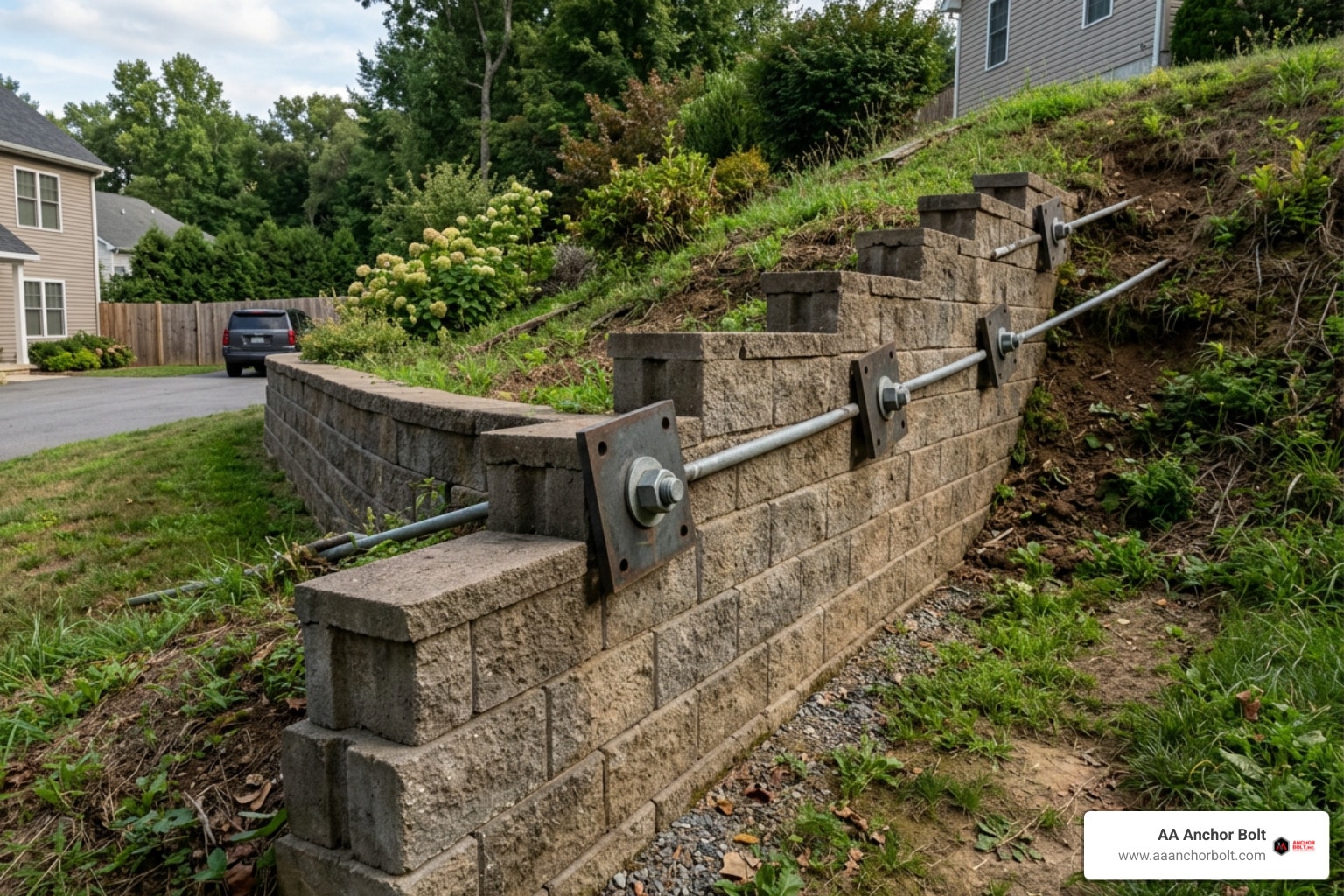
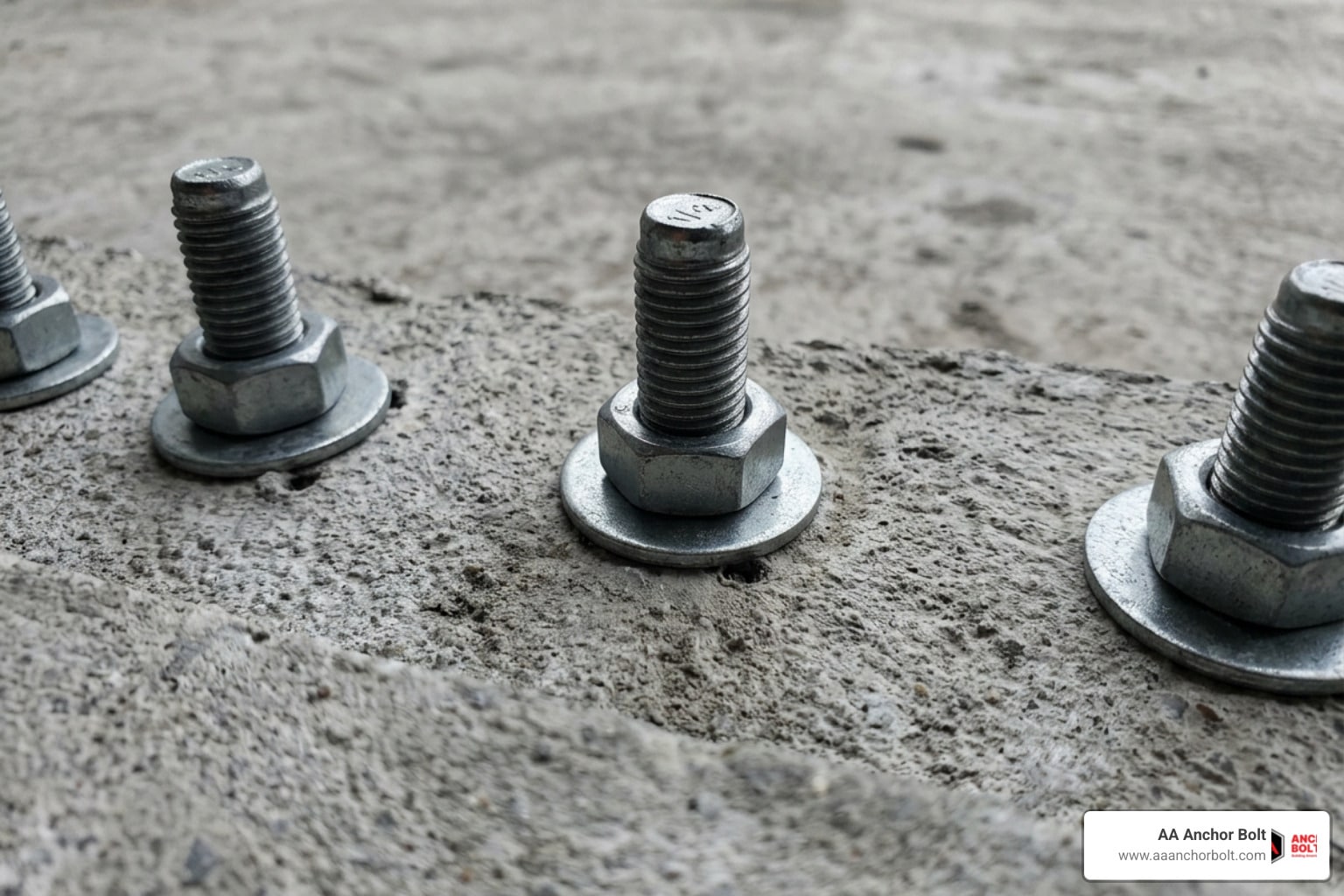
Sourcing USA Made Fasteners for Infrastructure Projects
Source USA-Made Anchor Bolts Without Project Delays
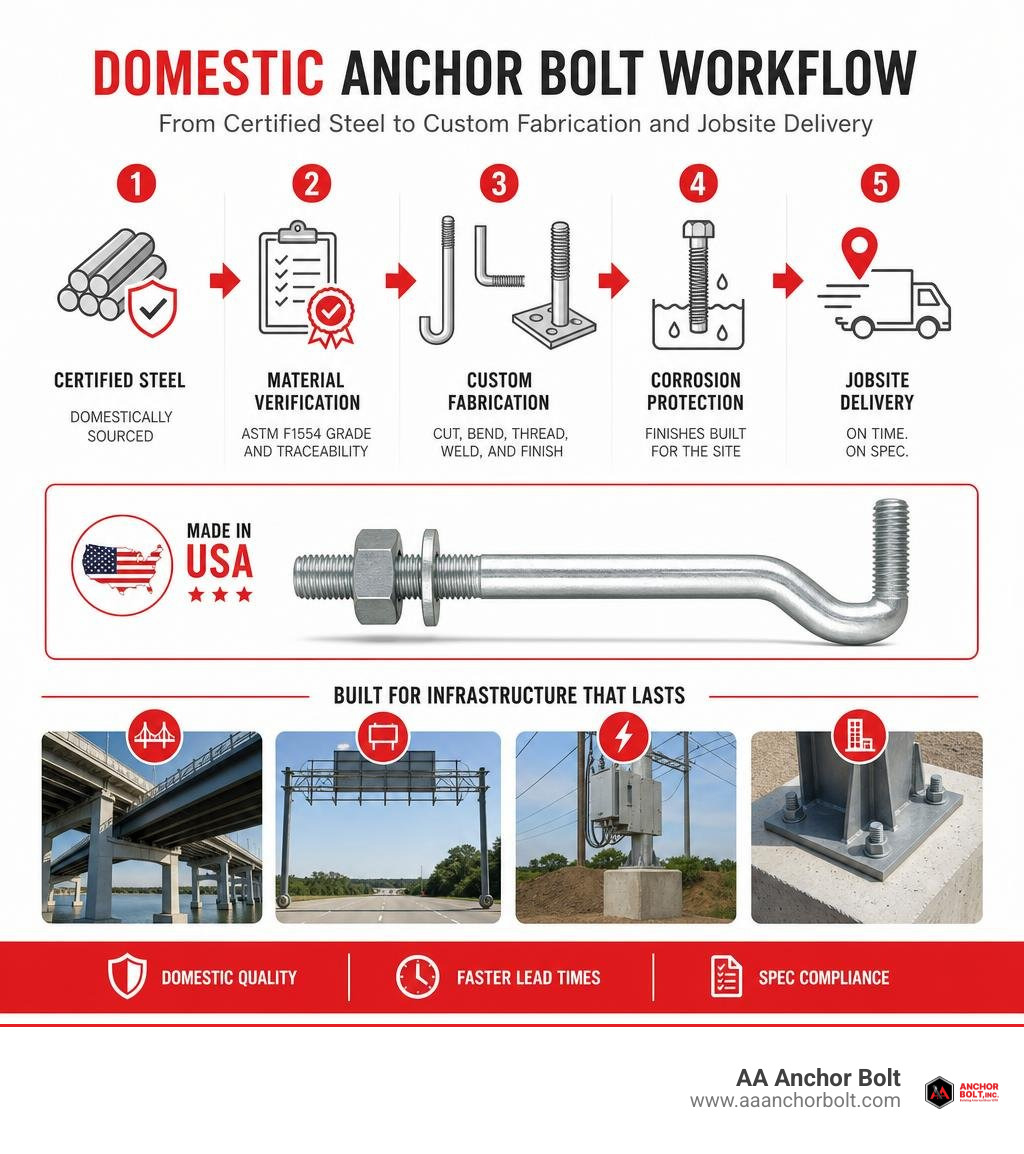
For infrastructure work, source domestic production anchor bolts with documented material traceability, the required ASTM F1554 grade, and corrosion protection suited to the site. Ask for mill test reports, domestic-origin documentation when the project requires it, and fabrication details before production starts. This helps contractors meet DOT and project specifications while avoiding delays caused by mismatched materials or long overseas supply chains.
USA-made anchor bolts are not one-size-fits-all parts. A bridge, sign structure, utility installation, or structural steel foundation may need custom lengths, bends, threads, welded plates, or hot-dip galvanizing. The bolt must also transfer tension, shear, uplift, and vibration loads safely into concrete.
AA Anchor Bolt manufactures custom anchor bolts in ASTM F1554 Grades 36, 55, and 105, with diameters from 1/4 inch through 5 inches. Its domestic steel inventory and custom fabrication capabilities help support fast-moving infrastructure schedules.
I am Pauline Horton, and this guide explains how to specify, source, and install domestic anchor bolts with greater confidence.
Essential domestic production anchor bolts terms:
- construction fastener production Michigan
- anchor bolt production and threading
- threaded rebar for infrastructure projects
Why Infrastructure Specifications Require Domestic Production Anchor Bolts
Infrastructure projects across the United States operate under rigorous regulatory frameworks designed to protect public safety and ensure structural longevity. Whether you are building highway interchanges, energy substations, municipal water plants, or commercial transit hubs, sourcing USA-made fasteners is rarely optional. Federal mandates like the Build America, Buy America Act (BABA) and the Buy American Act require structural steel components to be melted and manufactured domestically.
State Departments of Transportation (DOTs) impose strict requirements on structural hardware. When an inspector audits a bridge foundation or overhead sign truss, they look for verifiable pedigree. Imported fasteners frequently present supply chain bottlenecks, unpredictable lead times, and documentation gaps that can halt an active concrete pour.
Choosing domestic production anchor bolts mitigates these risks entirely. By partnering with a dedicated domestic fabricator, contractors gain direct oversight of their order, transparent tracking, and rapid turnaround times. If you need help identifying a trustworthy domestic partner, check out our An Essential Guide to Finding Reliable Anchor Bolt Manufacturers.
Standards and Traceability for Domestic Production Anchor Bolts
Traceability is the bedrock of infrastructure safety. ASTM F1554 represents the primary standard for steel anchor bolts intended for structural anchorage in concrete foundations. Under this standard, every production heat must be tracked back to its original domestic mill melt.
A complete documentation package includes certified Mill Test Reports (MTRs) detailing:
- Chemical composition (carbon, manganese, phosphorus, sulfur, and silicon content)
- Mechanical properties (tensile strength, yield strength, reduction of area, and elongation percentage)
- Heat lot numbers matched to physical bolt stampings or shipping tags
- Country of origin verification confirming domestic melt and manufacture
To understand why this paperwork is non-negotiable for project engineers, read Certified Strength: Why Anchor Bolt Material Certs Matter. Without authentic MTRs, project engineers and DOT inspectors can reject entire shipments, forcing expensive structural remediation.
Structural Grades: ASTM F1554 Grade 36, 55, and 105
The ASTM F1554 specification covers three distinct strength grades. Selecting the appropriate grade ensures that the anchor assembly can safely resist the design tensile and shear forces while maintaining necessary ductility.
- Grade 36 Anchor Bolts: Manufactured from low-carbon steel, this grade offers an anchor bolt baseline yield strength of 36 ksi. It is weldable and widely used for light structural frames, residential/commercial building columns, and standard utility foundations.
- Grade 55 Anchor Bolts: A moderate-strength carbon or low-alloy steel delivering a 55 ksi yield strength. It is a workhorse grade for transportation sign structures, highway lighting, and precast concrete connections. It can be specified with a “Supplementary Requirement S1” to guarantee weldability when required.
- Grade 105 Anchor Bolts: A heat-treated, quenched-and-tempered alloy steel offering a formidable 105 ksi yield strength. Grade 105 is specified for heavy civil superstructures, bridge anchorages, dynamic machinery foundations, and high-seismic loading applications.
For an in-depth breakdown of these structural ratings, explore our article on Demystifying ASTM F1554 Grades 36, 55 and 105.
| Property / Specification | ASTM F1554 Grade 36 | ASTM F1554 Grade 55 | ASTM F1554 Grade 105 |
|---|---|---|---|
| Minimum Yield Strength (ksi / MPa) | 36 ksi (248 MPa) | 55 ksi (380 MPa) | 105 ksi (724 MPa) |
| Tensile Strength Range (ksi / MPa) | 58–80 ksi (400–550 MPa) | 75–95 ksi (517–655 MPa) | 125–150 ksi (862–1034 MPa) |
| Elongation in 2 in. (50 mm) Min. % | 23% | 21% | 15% |
| Reduction of Area, Min. % | 40% | 30% | 45% |
| Heat Treatment | As-rolled (None) | As-rolled or Normalized | Quenched and Tempered |
| Weldable | Yes (Standard) | Only with S1 Requirement | No (Welding impairs heat treat) |
Cast-In-Place Anchor Configurations and Embedment Design
Anchor bolts are engineered load-transfer mechanisms that secure steel superstructures to concrete foundations. Structural engineers design these connections under the provisions of ACI 318 Chapter 17 (Anchoring to Concrete). The fundamental objective is to prevent concrete breakout, anchor pullout, side-face blowout, or steel tension failure under peak service loads.
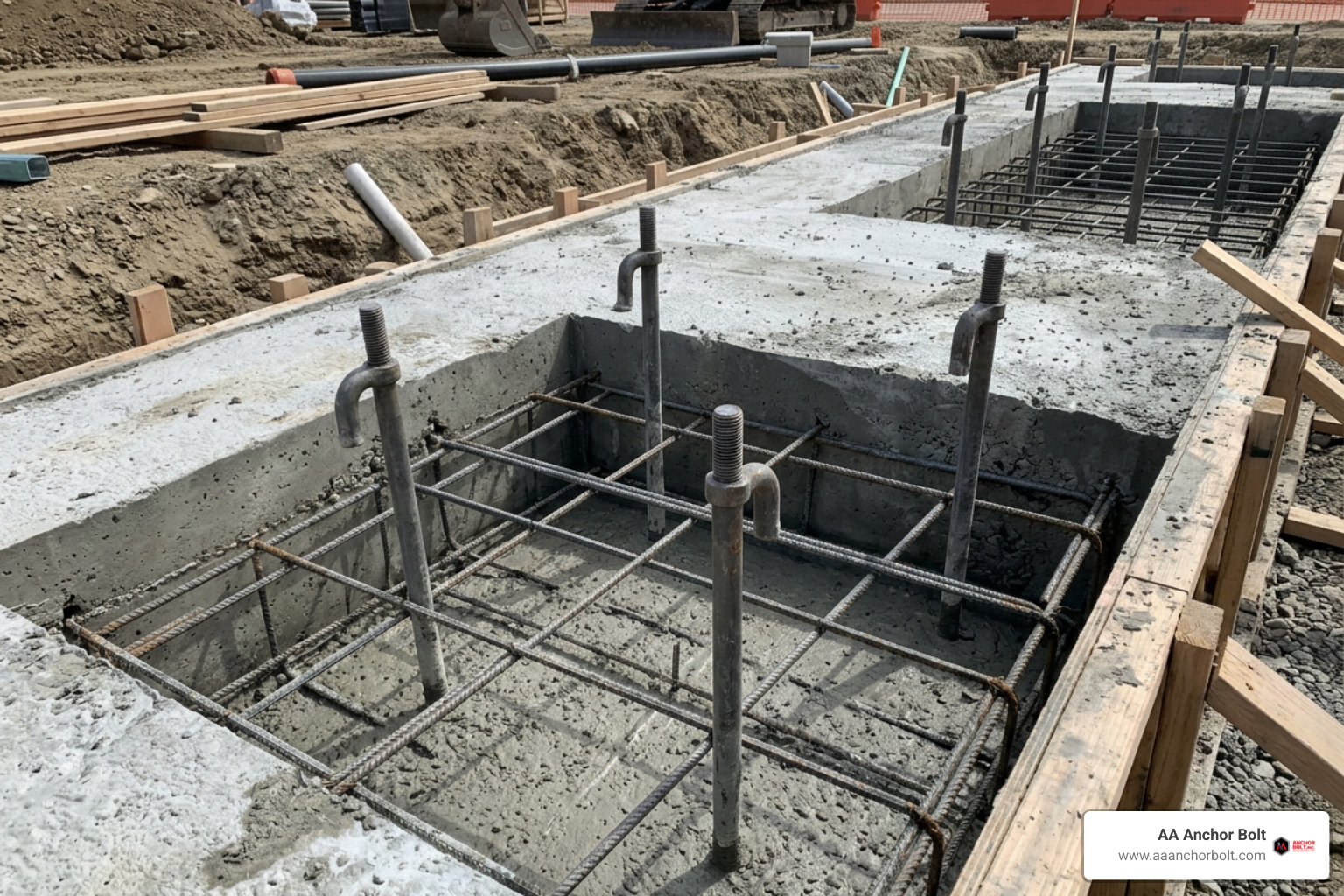
To explore these design mechanics in detail, consult The Complete Guide to F1554 Anchor Bolt Specs.
Cast-in-Place Anchors: L-Bolts, J-Bolts, Headed Bolts, and Swedge Bolts
Cast-in-place fasteners are installed inside reinforcement cages before concrete is poured. This provides superior tensile strength and embedment depth compared to post-installed anchors.
Our core cast-in-place configurations include:
- L-Shaped and J-Bolts: Bent anchor rods where the hooked end creates mechanical interlock against the cured concrete. They are standard hardware for light poles, railing posts, and equipment pads.
- Headed Anchor Bolts: Heavy hex or square-head bolts that transfer massive tensile loads through direct bearing of the bolt head against the concrete.
- Swedge Bolts: Round steel bars featuring precision-machined or cold-formed indentations along their embedment length. Concrete flows into these indentations to develop high pullout resistance. Swedge bolts are standard structural connections for bridge girders and substructure piers.
Review our complete F1554 Anchor Bolt Overview to view detailed geometry and standard sizing options.
Anchor Assemblies: Double-Ended Rods, Welded Plates, and Sleeves
For heavy industrial columns and high-uplift infrastructure, double-ended threaded rods combined with structural anchor plates provide optimal performance. A square or round steel plate is secured to the embedded end using heavy hex nuts or a full-penetration weld. This plate creates a large concrete bearing cone that mobilizes the full tensile capacity of the steel.
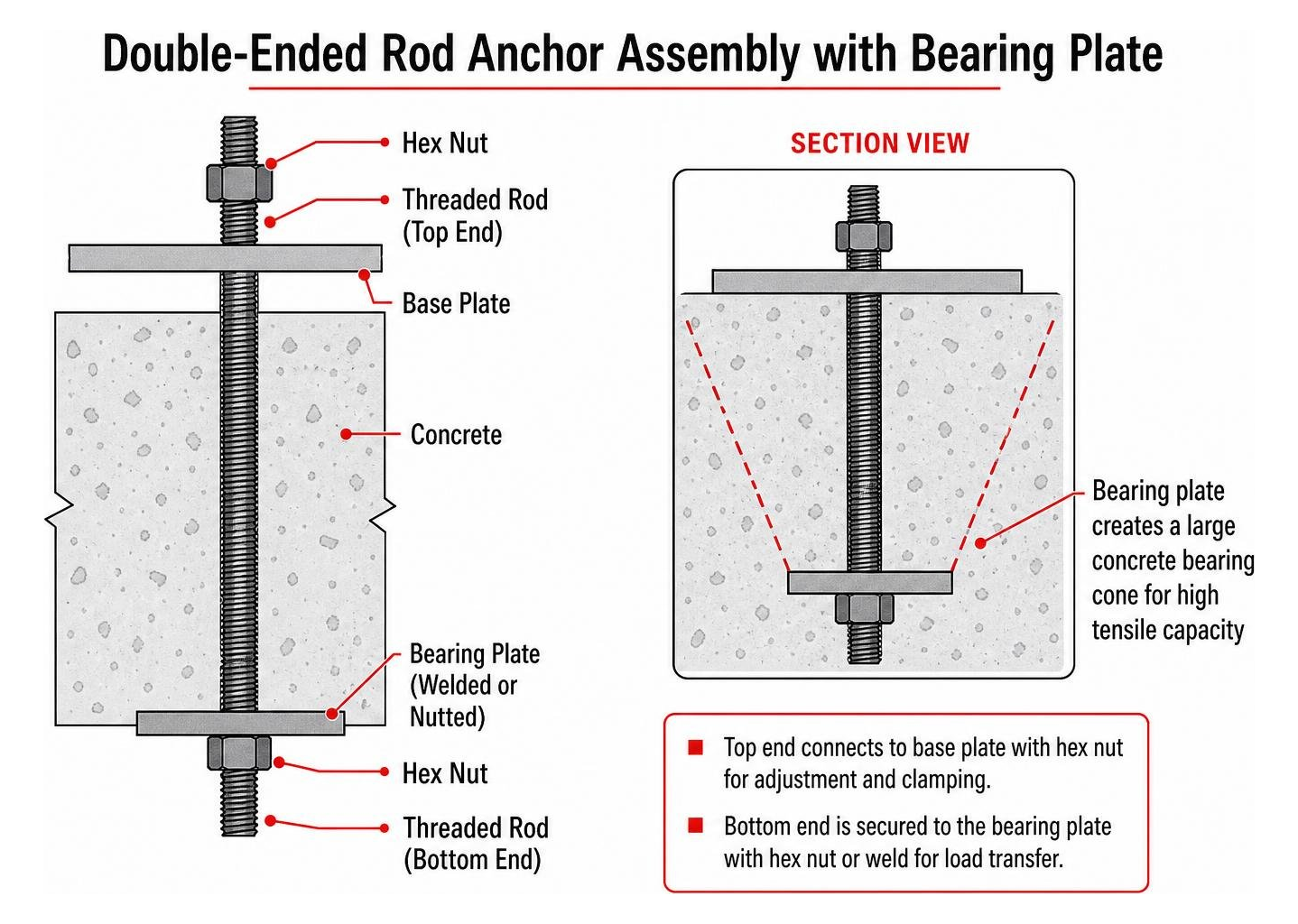
When slight field adjustment is anticipated, anchor rods are often paired with steel pipe sleeves or corrugated grout tubes. The sleeve creates an annular cavity around the top portion of the embedded rod. This allows erectors to nudge the bolt into perfect alignment with the column base plate before filling the sleeve with non-shrink grout.
Material Grades, Protective Coatings, and Corrosion Resistance
Infrastructure components must endure decades of environmental exposure without losing structural capacity. Moisture, deicing salts, coastal spray, and industrial chemicals will rapidly compromise unprotected carbon steel.
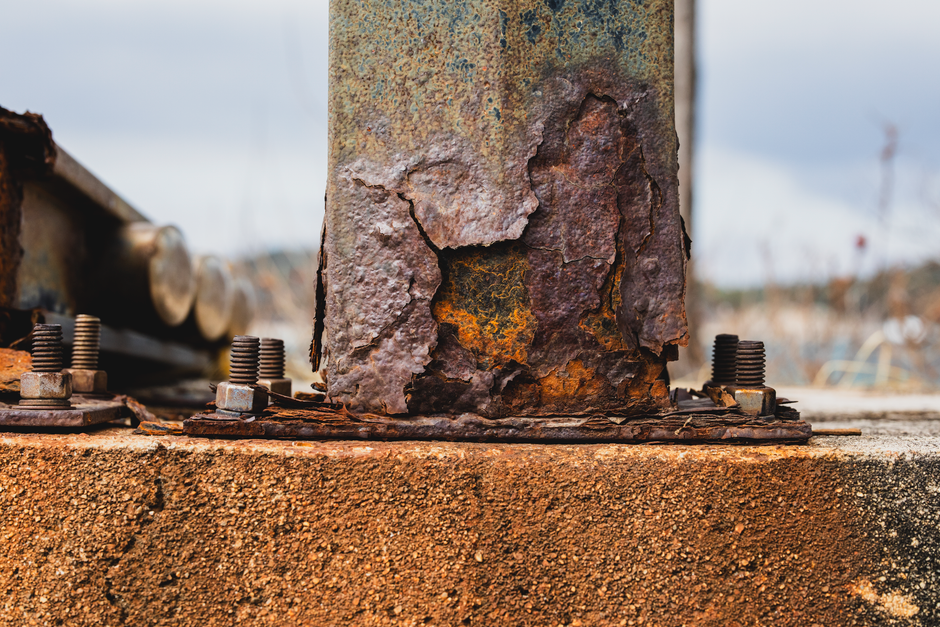
We manufacture our complete line of structural Products in bare carbon steel, hot-dip galvanized carbon steel, and multiple grades of stainless steel to meet any environmental demand.
Hot-Dip Galvanizing Standards for Exterior and Marine Applications
Hot-dip galvanizing (HDG) is the premier corrosion protection system for exterior infrastructure. When clean steel is submerged in molten zinc at approximately 830°F (443°C), it forms a series of metallurgically bonded zinc-iron alloy layers topped by pure zinc.
Key standards and practices for galvanized anchor bolts include:
- ASTM A153 / ASTM F2329: Governing standards specifying zinc coating thickness, adhesion, and finish quality for threaded fasteners.
- Thread Chasing and Cleanliness: After galvanizing, external threads are spun or chased clean of excess zinc while hot. This ensures that mating nuts run smoothly down the threads without galling or binding on the jobsite.
- Cathodic Protection: Zinc serves as a sacrificial anode. Even if the coating is scratched during erection, the surrounding zinc sacrifices itself to protect the underlying structural steel.
HDG anchor bolts are standard requirements for highway sign bridges, transmission towers, bridge parapets, and exterior industrial storage tanks.
Stainless Steel and High-Stress Environmental Protection
Where environmental conditions are too aggressive for galvanized carbon steel, stainless steel fasteners provide long-term corrosion resistance.
- Type 304 Stainless Steel: Excellent corrosion resistance in general outdoor, freshwater, and architectural applications.
- Type 316 Stainless Steel: Contains 2% to 3% molybdenum, providing superior defense against chloride pitting and crevice corrosion. It is widely specified for marine piers, coastal highway bridges, chemical manufacturing plants, and wastewater treatment aeration basins.
Load Distribution, Dynamic Vibration, and Heavy Machinery Anchoring
Industrial manufacturing facilities house heavy, high-speed rotating and reciprocating equipment—such as CNC stamping presses, industrial compressors, forging hammers, turbines, and dynamic pumps. These machines generate substantial cyclic shear, uplift, and continuous vibration.
If anchored with undersized or generic fasteners, machinery will slowly vibrate loose, lose precision leveling, and “walk” across the facility floor. This leads to bearing wear, shaft misalignment, broken tooling, and catastrophic structural damage.
To explore our full scope of machining and anchoring support, visit our Services overview.
Engineering Base Plates, Precision Templates, and Non-Shrink Grout
Anchoring heavy equipment requires a cohesive engineering assembly:
- Steel Anchor Templates: Reusable rigid steel templates hold anchor bolt clusters in exact Cartesian coordinates during the concrete pour. This eliminates alignment errors that could prevent heavy base plates from setting cleanly over the studs.
- Leveling Nuts and Shims: Heavy hex leveling nuts beneath the base plate allow millwrights to adjust elevation and level the machine to thousandths of an inch.
- High-Strength Non-Shrink Grout: Once leveled, high-flow non-shrink cementitious or epoxy grout is pumped beneath the base plate. The grout provides 100% surface contact, distributing static equipment weight evenly across the concrete footing while dampening vibration.
- Calibrated Torque Documentation: Anchor bolts must be tightened with calibrated torque wrenches or hydraulic tensioners to pre-load the steel studs. Proper pre-load prevents cyclic load reversals from loosening the nuts under operational shock.
Mitigating Installation Misalignment and Edge Distance Challenges
Field installation errors can compromise structural capacity. Two common challenges on the jobsite are inadequate edge distance and bolt misalignment.
- Edge Distance Requirements: Concrete breakout strength drops sharply if an anchor is placed too close to the edge of a foundation pier or slab. ACI 318 Chapter 17 defines strict minimum edge distances based on bolt diameter and embedment depth.
- Base Plate Slotting and Thick Washers: If an anchor rod shifts slightly during a concrete pour, torching the base plate hole in the field can damage structural capacity. Using oversized base plate holes paired with heavy-gauge ASTM F436 structural washers—or custom welded plate washers punched on an ironworker—restores full structural bearing without violating code.
In-House Fabrication and Custom Machining Capabilities
Standard commodity fasteners rarely satisfy complex infrastructure prints. Heavy civil projects require custom embedment lengths, extended thread runs, specialty bends, and welded anchor plates engineered to tight tolerances.
Learn more about our technical engineering data by visiting our Resources portal.
Custom Fabrication Advantages of Domestic Production Anchor Bolts
AA Anchor Bolt maintains end-to-end production control at our Northville, Michigan manufacturing facility. By eliminating third-party processing intermediaries, we deliver reliable quality and rapid turnaround times for infrastructure contractors nationwide. Read more about our regional manufacturing heritage in The Best Michigan Fastener and Anchor Bolt Manufacturers.
Our in-house capabilities include:
- Comprehensive Size Range: Threading and forming anchor bolts from 1/4″ to 5″ in diameter.
- Heavy Bar Bending: Custom cold and hot bending of J-bolts, L-bolts, U-bolts, and hook bolts up to 3″ in diameter.
- High-Capacity Threading: Both cut threading and thread rolling capabilities to match project specifications and bar diameters.
- 140-Ton Ironworker: Precision hole punching up to 3″ diameter in heavy structural steel plate.
- Plate Shearing: In-house plate shearing up to 3/4″ thickness by 8 feet in width and 1″ by 18″.
- Heavy Stud Welding: 1600-amp stud welding for concrete embeds, deformed bar anchors, and headed studs up to 7/8″ diameter.
- Raw Material Inventory: Maintaining nearly one million pounds of domestic carbon, alloy, and stainless steel on hand, ready for immediate fabrication.
Frequently Asked Questions About USA Made Anchor Bolts
What certifications are required for domestic anchor bolts on DOT projects?
DOT projects require signed and certified Mill Test Reports (MTRs) representing the specific melt heat lot used to manufacture the bolts. The MTR must confirm that the raw steel was melted and manufactured in the United States in compliance with Buy America and BABA standards. The package must also include plating/galvanizing certifications confirming compliance with ASTM A153/F2329 and dimensional inspection sheets.
When should ASTM F1554 Grade 105 be specified over Grade 36 or Grade 55?
ASTM F1554 Grade 105 should be specified when high design tensile and shear loads exceed the physical capacity of standard carbon steels within available foundation dimensions. It is commonly selected for heavy structural building columns, tall highway sign gantries, bridge abutments, wind turbine foundations, and structures located in high-risk seismic zones (Seismic Design Categories C through F).
How do cut threads compare to rolled threads in custom anchor bolt manufacturing?
Rolled threads are formed by cold-forming steel bar between reciprocating dies, displacing the grain flow of the metal without removing material. This burnishes the surface and increases thread yield strength. Cut threads are produced by physically machining steel away from the bar using cutting dies. While rolled threads are efficient for high-volume standard diameters, cut threading offers exceptional versatility for custom, large-diameter structural bolts (over 2″ diameter), specialty thread pitches, and smaller production runs. Both methods deliver full structural performance under ASTM F1554 when executed to standard pitch diameters.
Conclusion
Infrastructure reliability begins where structural steel meets reinforced concrete. Specifying and sourcing domestic production anchor bolts ensures your project complies with BABA mandates, meets stringent DOT engineering requirements, and resists severe static, dynamic, and environmental loads.
Since 1979, AA Anchor Bolt has partnered with general contractors, structural fabricators, and civil engineering teams across the United States. Backed by nearly a million pounds of on-site domestic steel inventory and full in-house bending, shearing, punching, and threading capabilities, we eliminate costly supply chain bottlenecks and keep your critical pours on schedule.
To review our complete equipment line and fabrication capacities, visit our Manufacturing Capabilities page or contact our Northville, Michigan team today for a rapid quote on your next infrastructure project.