The Best Michigan Fastener and Anchor Bolt Manufacturers
Michigan Fastener Manufacturers for Faster Infrastructure Builds
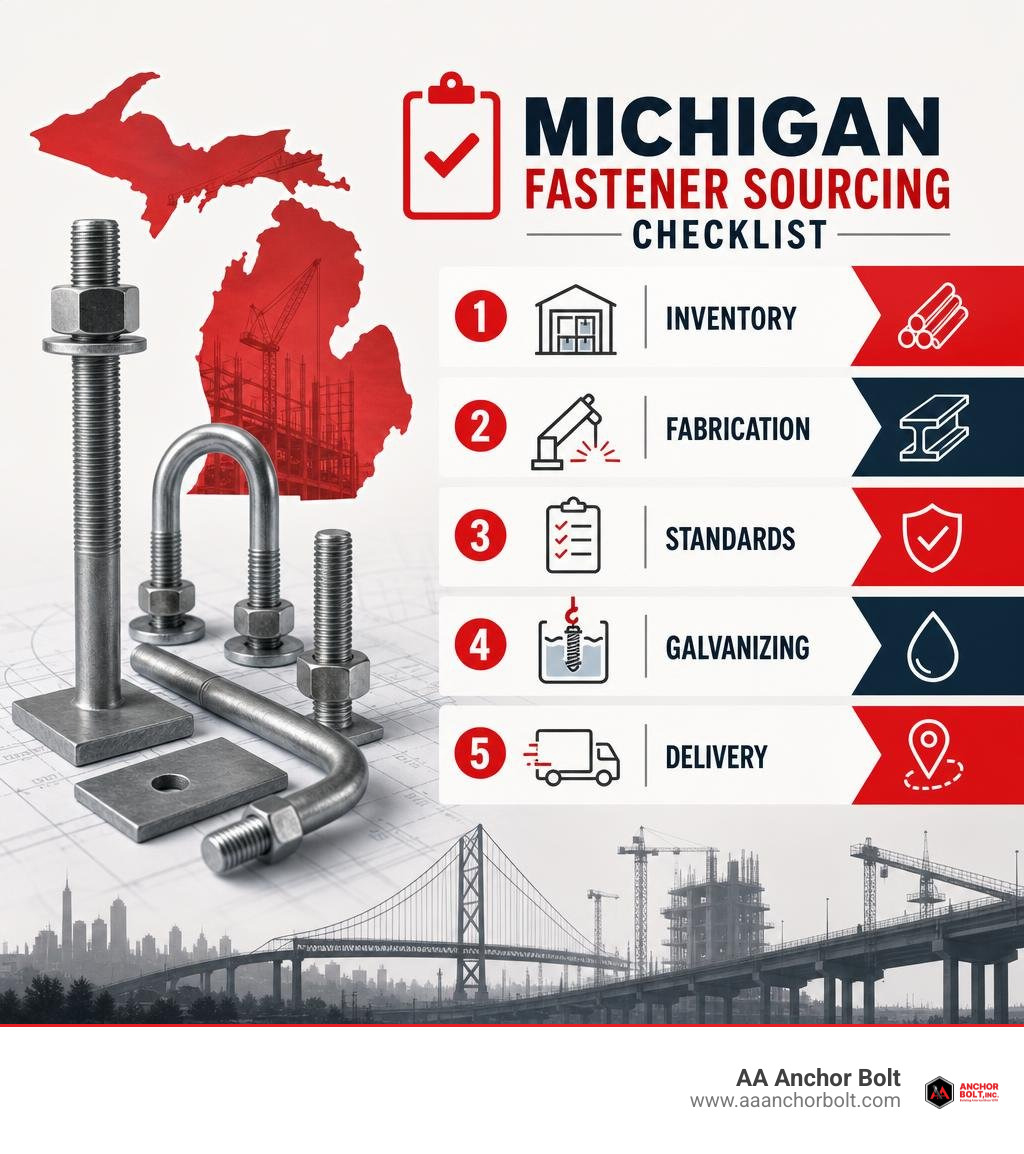
For contractors sourcing construction fastener production Michigan capabilities, the best fit is usually a manufacturer that can make custom anchor bolts, threaded rod, embeds, and plates quickly – while keeping steel inventory and fabrication work close to the job site.
Look for suppliers that can provide:
- Custom J-bolts, L-bolts, U-bolts, anchor rods, and embed plates
- ASTM F1554 material options for structural concrete foundations
- Rolled or cut threads, bending, plate fabrication, and welding
- Hot-dip galvanized products for exposed infrastructure work
- Certifications and documentation required for DOT and commercial projects
Michigan’s fastener sector serves far more than building foundations. Local plants support infrastructure, automotive, agriculture, and the growing EV supply chain. New manufacturing investment is expanding regional capacity, while established fabricators help contractors avoid long overseas lead times by working from substantial domestic steel inventory.
For a Midwest contractor facing a tight pour date, the practical advantage is simple: choose a Michigan supplier that can confirm material availability, fabricate to the drawing, and coordinate corrosion protection without adding unnecessary supply-chain steps.
I am Pauline Horton, and this guide compares the Michigan manufacturers and capabilities that matter most when your project needs dependable structural fasteners fast.
Simple construction fastener production Michigan glossary:
- Anchor Bolt Production and Threading
- Threaded Rebar for Commercial Projects
- Threaded Rebar for Infrastructure Projects
Introduction
As we move through August 2026, the Great Lakes industrial corridor is experiencing an extraordinary manufacturing resurgence. Infrastructure demands, civil expansions, and major commercial developments are pushing project schedules to their limits. When general contractors, civil engineers, and steel erectors break ground on expansive commercial developments or public works, foundational security sits squarely on the strength of structural anchoring systems.
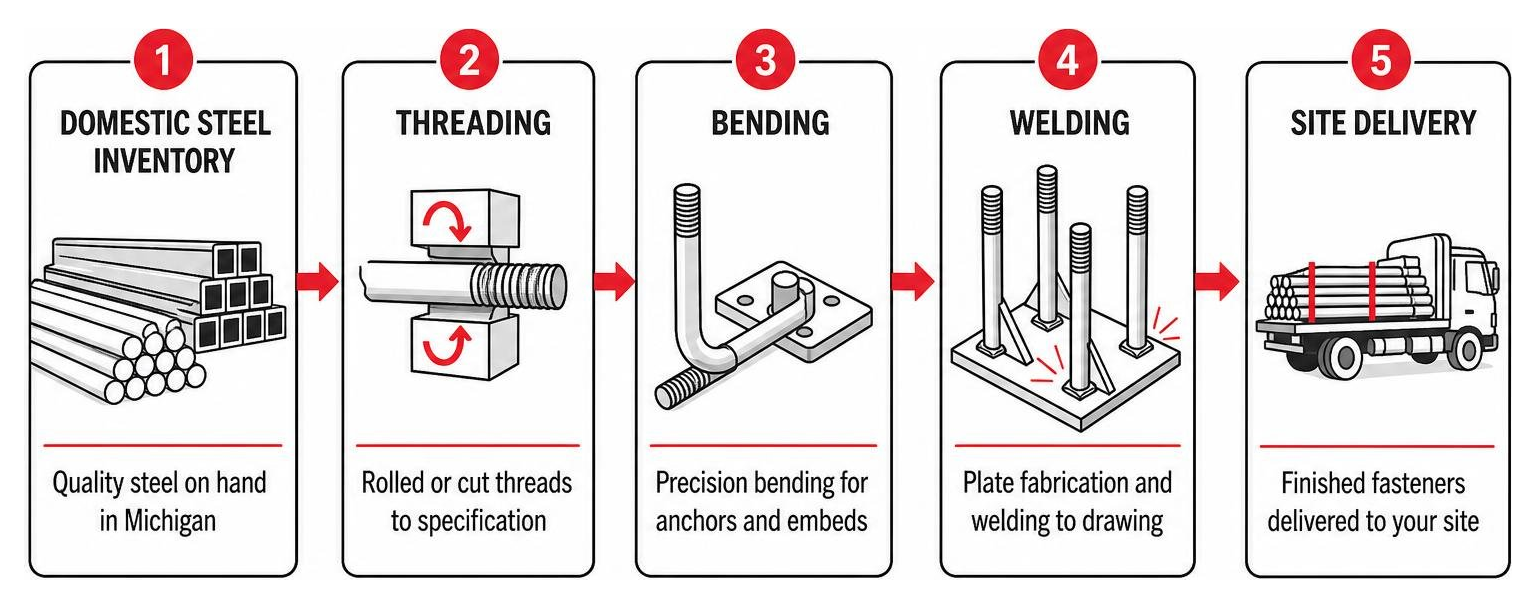
Meeting these project milestones requires responsive regional supply chain localization. Waiting weeks—or even months—for overseas freight or fragmented broker networks simply does not work when foundation crews are standing by with concrete trucks queued up. By keeping domestic steel sourcing, heavy threading, plate fabrication, and finishing close to home, regional builders eliminate transit bottlenecks and gain direct oversight of their engineering specifications.
Structural Demands and Fabrication Capabilities for Civil Infrastructure
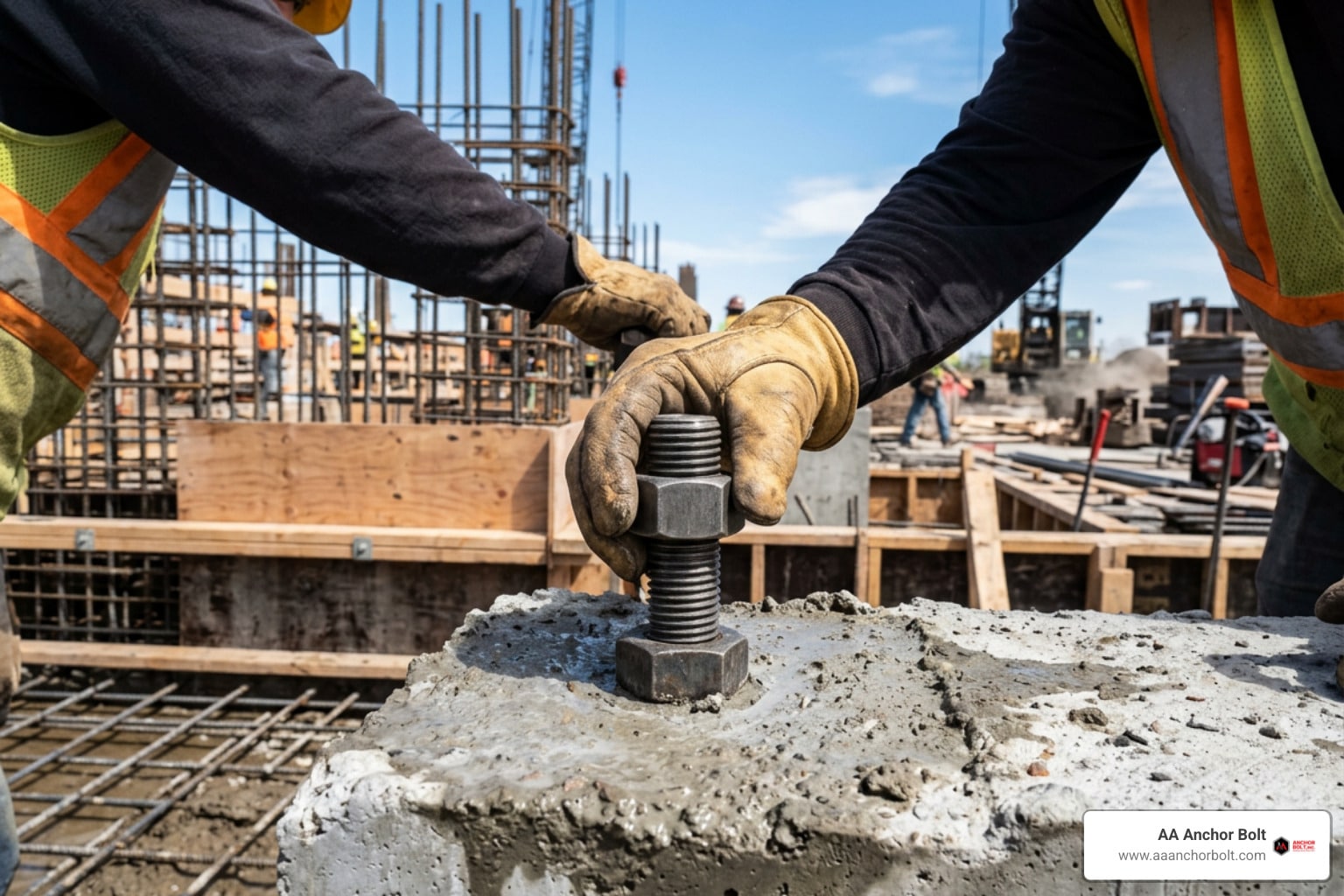
Civil infrastructure projects impose uncompromising physical demands on structural fasteners. Whether anchoring highway bridge supports, high-voltage utility substations, precast tilt-up walls, or overhead crane rails, fasteners must resist dynamic shear loads, cyclic vibrations, wind-induced uplift, and seismic shifts. Navigating these requirements starts with a thorough understanding of heavy foundation engineering, as detailed in the concrete fastener guide for heavy duty anchoring.
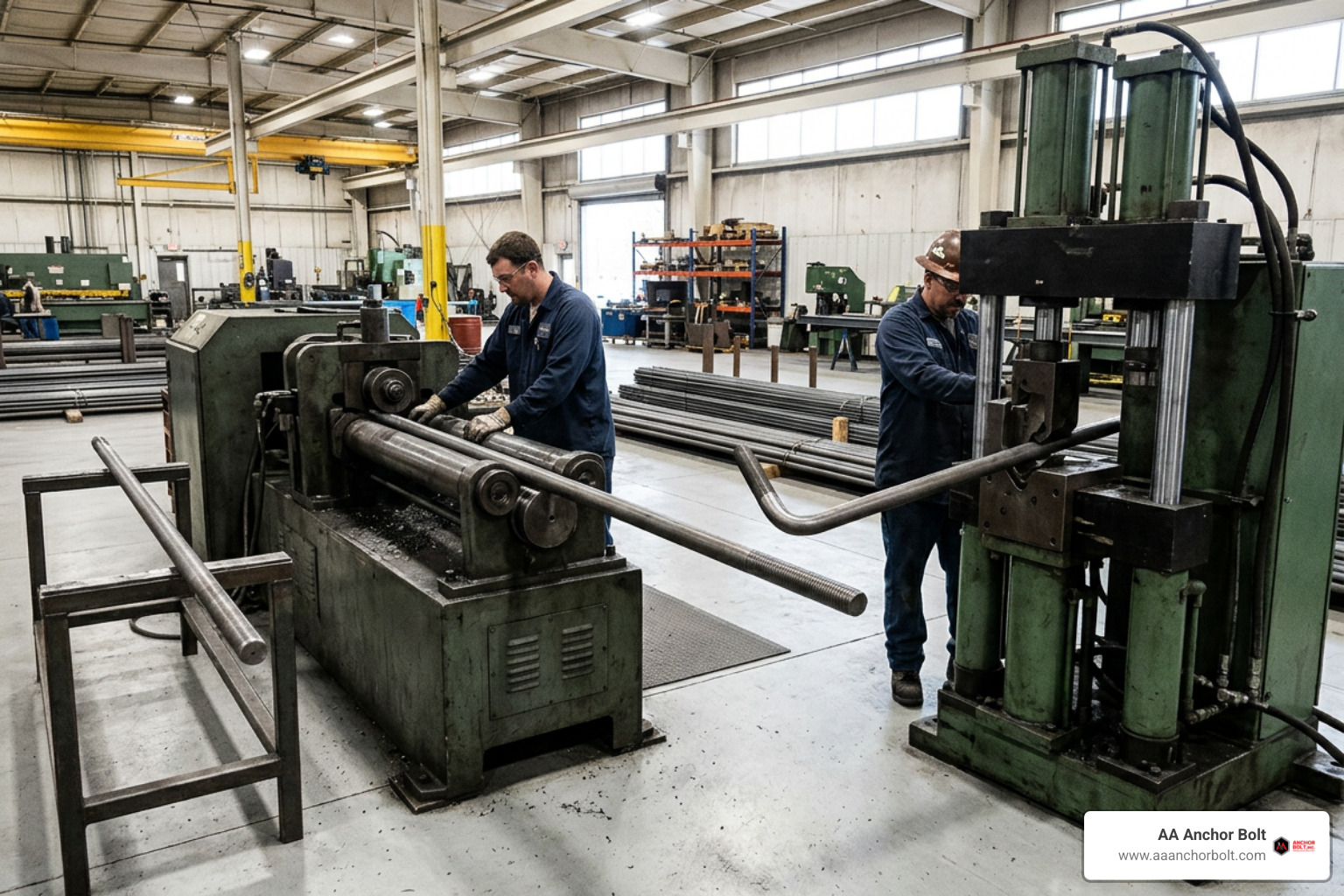
To meet these exacting criteria, a modern manufacturing plant must support diverse fabrication processes under one roof:
- Cold Forging and Cold Forming: Cold forging rearranges the steel’s crystalline grain structure to follow the contours of the part, increasing tensile strength and yield performance without generating excess scrap metal.
- Cut Threading vs. Rolled Threading: Cut threading mechanically carves away material using specialized chasers, making it ideal for large diameters up to 5 inches, custom pitches, or low-volume runs. Rolled threading displaces metal under immense pressure between hardened dies, forming smooth, work-hardened thread profiles with continuous grain flow that dramatically enhances fatigue resistance.
- Heavy Plate Shearing and Punching: Producing custom embeds and leveling plates requires industrial-grade machinery, such as plate shears capable of slicing through 3/4-inch steel plate at 8-foot spans and 140-ton ironworkers that punch clean holes up to 3 inches in diameter.
- Stud Welding: Integrating heavy anchoring studs up to 7/8 inches in diameter onto embed assemblies requires dedicated high-amperage stud welding units (up to 1600 amps) to ensure full-penetration fusion capable of surviving massive tensile loads.
- Rebar Threading: Precision end-threading on deformed reinforcing steel bar allows mechanical butt-splicing and structural anchoring without compromising core tensile integrity.
Evaluating Quality Standards in Construction Fastener Production Michigan Projects
Engineering specifications leave no room for guesswork. When evaluating regional industrial bolt suppliers, project managers must verify compliance with strict American Society for Testing and Materials (ASTM) specifications, as well as Department of Transportation (DOT) standards.
The primary standard governing cast-in-place structural foundation anchors is ASTM F1554, which encompasses three distinct grades:
| ASTM F1554 Grade | Minimum Yield Strength (ksi) | Minimum Tensile Strength (ksi) | Weldability | Primary Structural Applications |
|---|---|---|---|---|
| Grade 36 | 36 ksi | 58–80 ksi | Excellent (mild carbon steel) | General commercial base plates, light poles, standard foundation embeds, and welded assemblies. |
| Grade 55 | 55 ksi | 75–95 ksi | Moderate (requires S1 weldability spec) | Precast concrete anchoring, heavy structural steel frames, and highway signage structures. |
| Grade 105 | 105 ksi | 125–150 ksi | Not recommended (heat-treated alloy) | High-load civil infrastructure, seismic tie-downs, bridge abutments, and wind turbine foundation rings. |
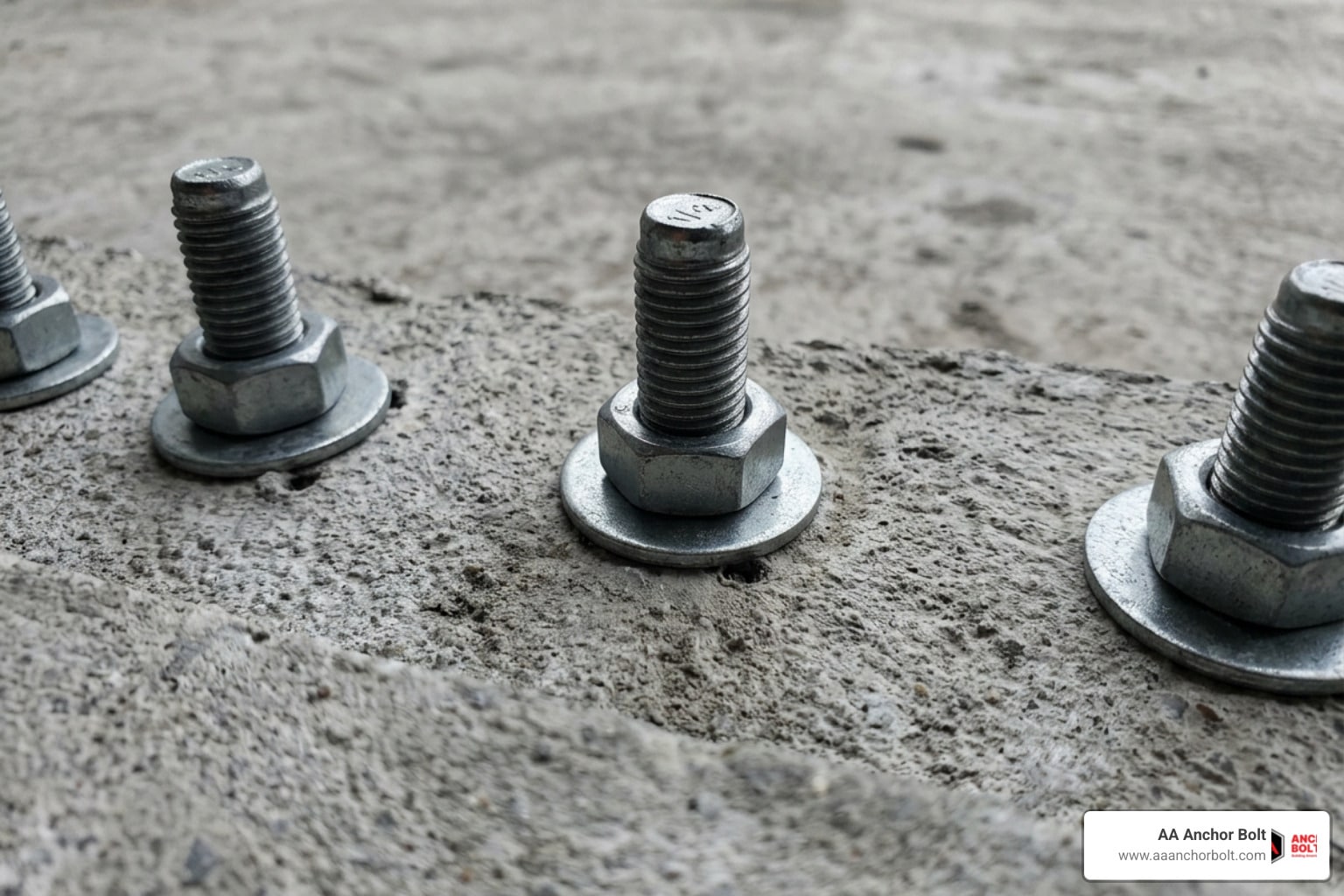
Beyond raw tensile ratings, regional projects frequently mandate hot-dip galvanizing per ASTM A153/A153M Class C. Immersing thoroughly cleaned steel into molten zinc creates a metallurgical series of zinc-iron alloy layers, providing cathodic protection that prevents subterranean and atmospheric corrosion across outdoor highway, utility, and marine environments.
Key Drivers Shaping Construction Fastener Production Michigan Facilities
Michigan’s industrial landscape is benefiting from historic capital investment and regional economic development initiatives. Supported by organizations like the Michigan Economic Development Corporation (MEDC) and regional economic partnerships, major multi-million dollar investments are accelerating industrial output across the state. This includes large-scale private manufacturing investments, such as a recent $77 million industrial commitment slated to create 200 advanced manufacturing jobs.
These capital projects do more than expand regional payrolls; they fortify the critical supply chain supporting electric vehicle (EV) battery plants, gigafactories, automated distribution hubs, and agricultural processing facilities. Building these colossal manufacturing spaces requires thousands of tons of structural steel anchored to concrete pad footings with precision-fabricated bolts.
For procurement managers vetting partners, our essential guide to finding reliable anchor bolt manufacturers walks through the verification steps needed to guarantee material traceability, certified mill test reports (CMTRs), and steady delivery schedules.
Future Automation Trends in Construction Fastener Production Michigan Plants
Modern fastener facilities are adopting advanced automation to meet tight tolerances, shorten lead times, and eliminate defects. High-speed multi-spindle screw machines, automated bar feeders, and robotic transfer arms run high-volume component batches with microscopic repeatability.
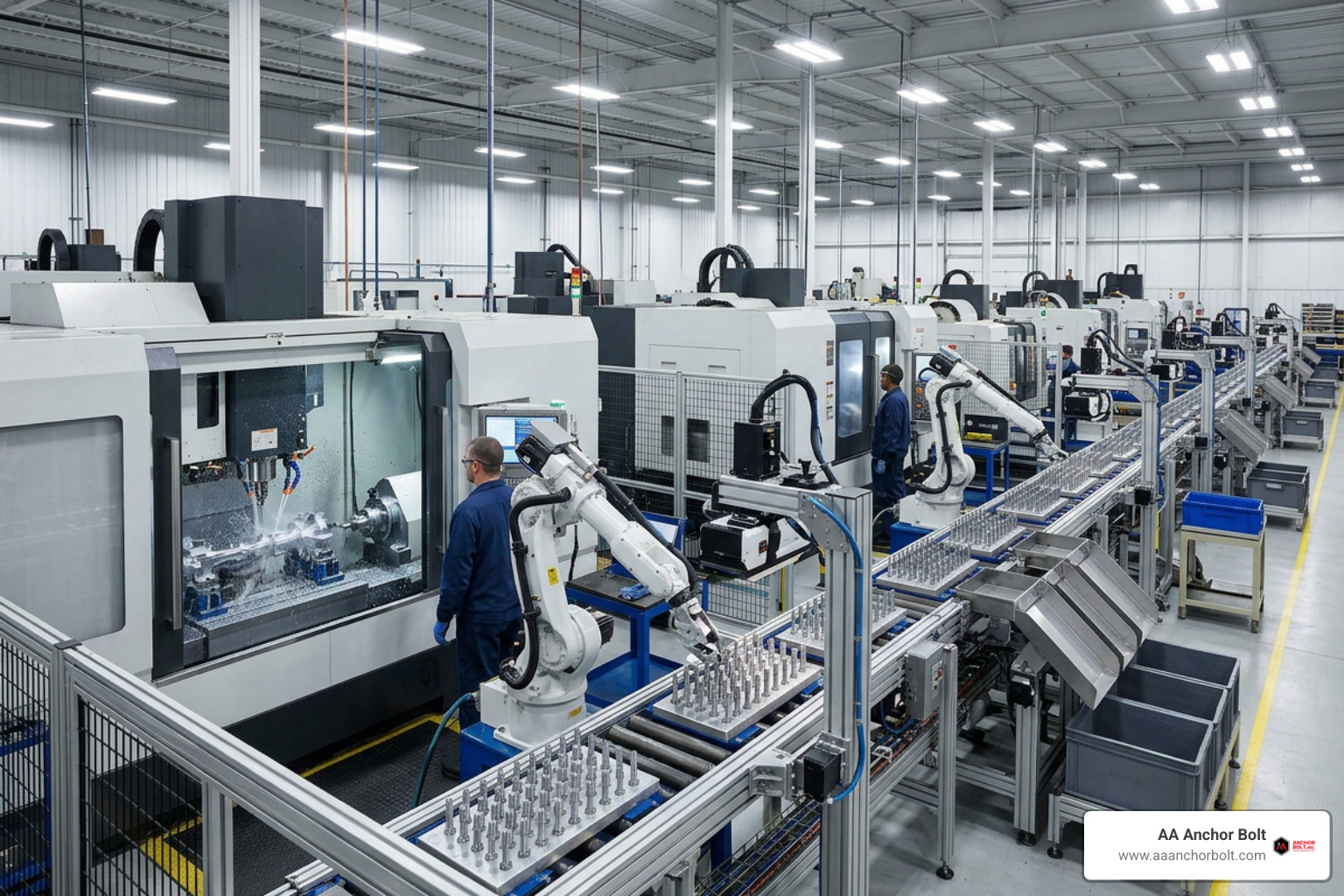
Integrated quality assurance relies heavily on Statistical Process Control (SPC) paired with automated optical sorting systems. High-resolution cameras and laser measurement systems inspect parts at high speeds, verifying thread pitch, major diameter, shank straightness, and head concentricity before parts are boxed.
Furthermore, combining raw material annealing, multi-spindle turning, automated secondary threading, and controlled heat treatment allows facilities to deliver parts that seamlessly satisfy both commercial building codes and Tier-level industrial standards.
Sourcing Custom Fastener Solutions for Complex Heavy Civil Builds
Every heavy civil construction project presents unique site challenges. Irregular soil conditions, tight rebar cages, and specialized equipment footprints frequently demand non-standard geometries that cannot be sourced from standard fastener distributors.
When an unexpected site condition arises, we supply fully customized configurations tailored to exact engineer drawings:
- Custom J-Bolts and L-Bent Anchor Rods: Engineered for cast-in-place concrete footings, bent anchors provide mechanical interlock within foundation slabs. We handle custom bending of raw steel bars up to 3 inches in diameter.
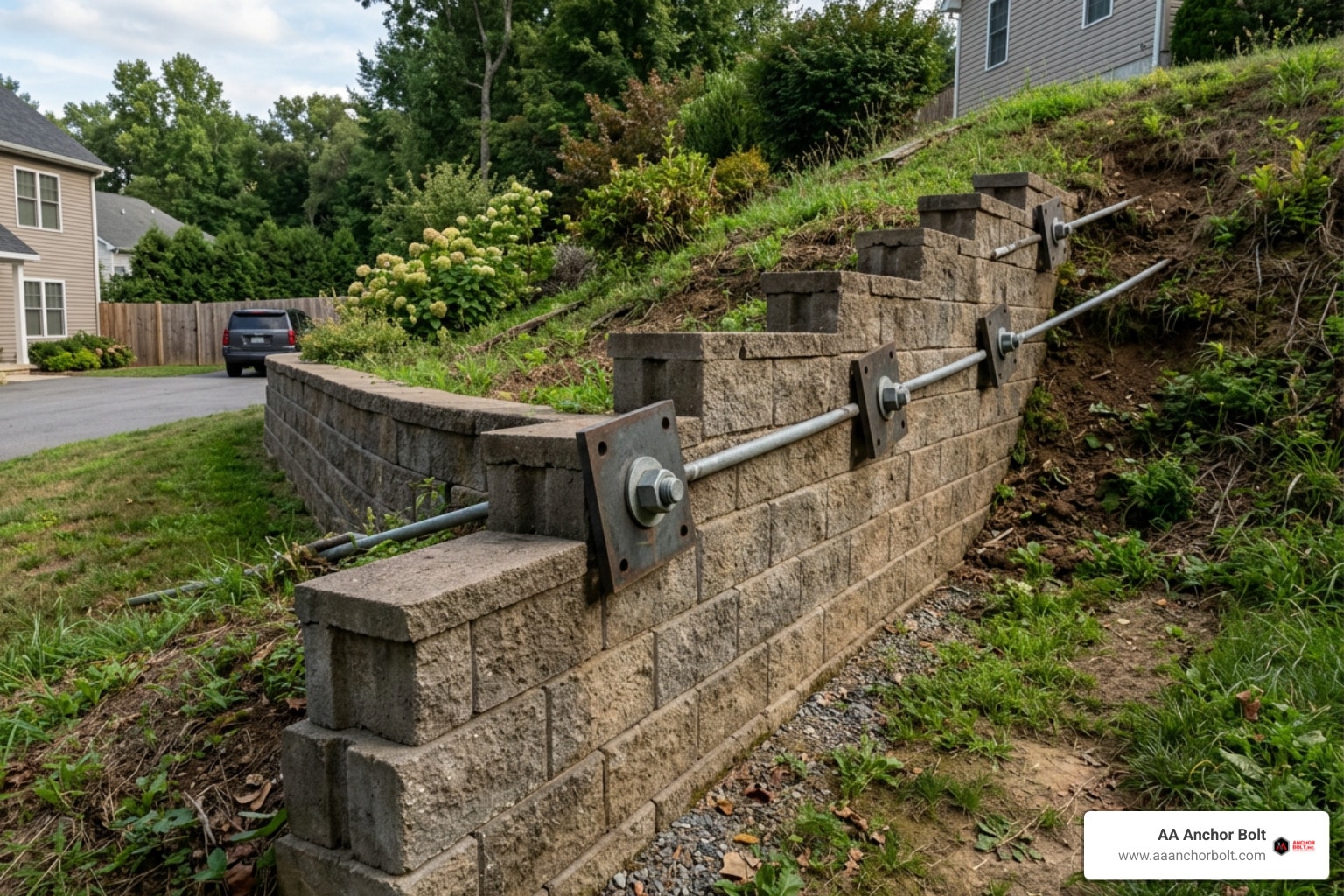
- Square and Round U-Bolts: Fabricated for piping support, bridge conduits, utility poles, and heavy structural framing.
- Fabricated Embed Plates and Leveling Assemblies: Heavy plates sheared, drilled, or punched with custom hole patterns—ranging from 1/4″ x 6″ x 6″ up to 1/4″ x 26″ x 26″—integrated with pre-welded studs or structural reinforcing bars.
We maintain a complete lineup of turnkey custom steel fabrication services and a comprehensive inventory of heavy structural fastener products ready for rapid deployment to job sites across the Midwest.
Frequently Asked Questions About Michigan Fastener Manufacturing
What certifications should civil contractors require for domestic anchor bolts?
Civil contractors and structural engineers should require full material traceability through Certified Mill Test Reports (CMTRs) confirming chemical composition, heat numbers, tensile strength, yield strength, and elongation according to ASTM standards (such as ASTM F1554 Grade 36, 55, or 105). For federally funded or state Department of Transportation projects, documentation verifying compliance with Buy America and Build America, Buy America (BABA) provisions is also required.
How do cut threads compare to rolled threads in structural anchor bolts?
Cut threads are produced by physically slicing steel away from a solid bar, allowing fabricators to produce custom diameters, non-standard thread pitches, and large sizes up to 5 inches. Rolled threads are created by cold-forming the steel between hardened dies, displacing the metal without removing material. This work-hardens the steel and creates a continuous grain flow along the root of the thread, offering superior fatigue resistance for dynamic or high-vibration applications.
Why is significant in-house raw steel inventory critical for project timelines?
Maintaining heavy raw steel inventory on-site shields contractors from global supply chain disruptions, port congestion, and mill lead times. When a fabricator maintains hundreds of thousands of pounds of round bar in various carbon and alloy steel grades, they can start shearing, threading, and bending the moment project drawings are approved. This enables same-day or next-day turnarounds for emergency job-site modifications, avoiding costly foundation pour delays.
Conclusion
The strength of any commercial structure or infrastructure asset relies entirely on the anchoring systems embedded deep within the foundation. At AA Anchor Bolt, we have proudly operated as a family-owned domestic manufacturer since 1979, bringing over 80 years of combined sales staff and machining experience to every project we support.
By keeping nearly one million pounds of raw steel on hand at our Northville, Michigan facility, we provide general contractors, steel fabricators, and civil engineers with unmatched turnaround speeds, domestic quality control, and custom engineering support. Whether you require standard ASTM F1554 foundation rods, complex embed plates, or large-diameter custom bent fasteners, explore our in-house manufacturing capabilities today and let our team keep your next build on schedule.