Lock Down Your Next Project with the Right Concrete Block Bolts
Choose Concrete Block Anchors That Match the Block
The right anchor bolts for concrete block depend on where the fastener lands. Use screw anchors, sleeve anchors, lag shields, or double-expansion anchors in solid areas of the block when the manufacturer approves that application. For hollow cores and higher loads, use an epoxy system with a screen tube and threaded rod, or through-bolt the wall with plate washers when both sides are reachable.
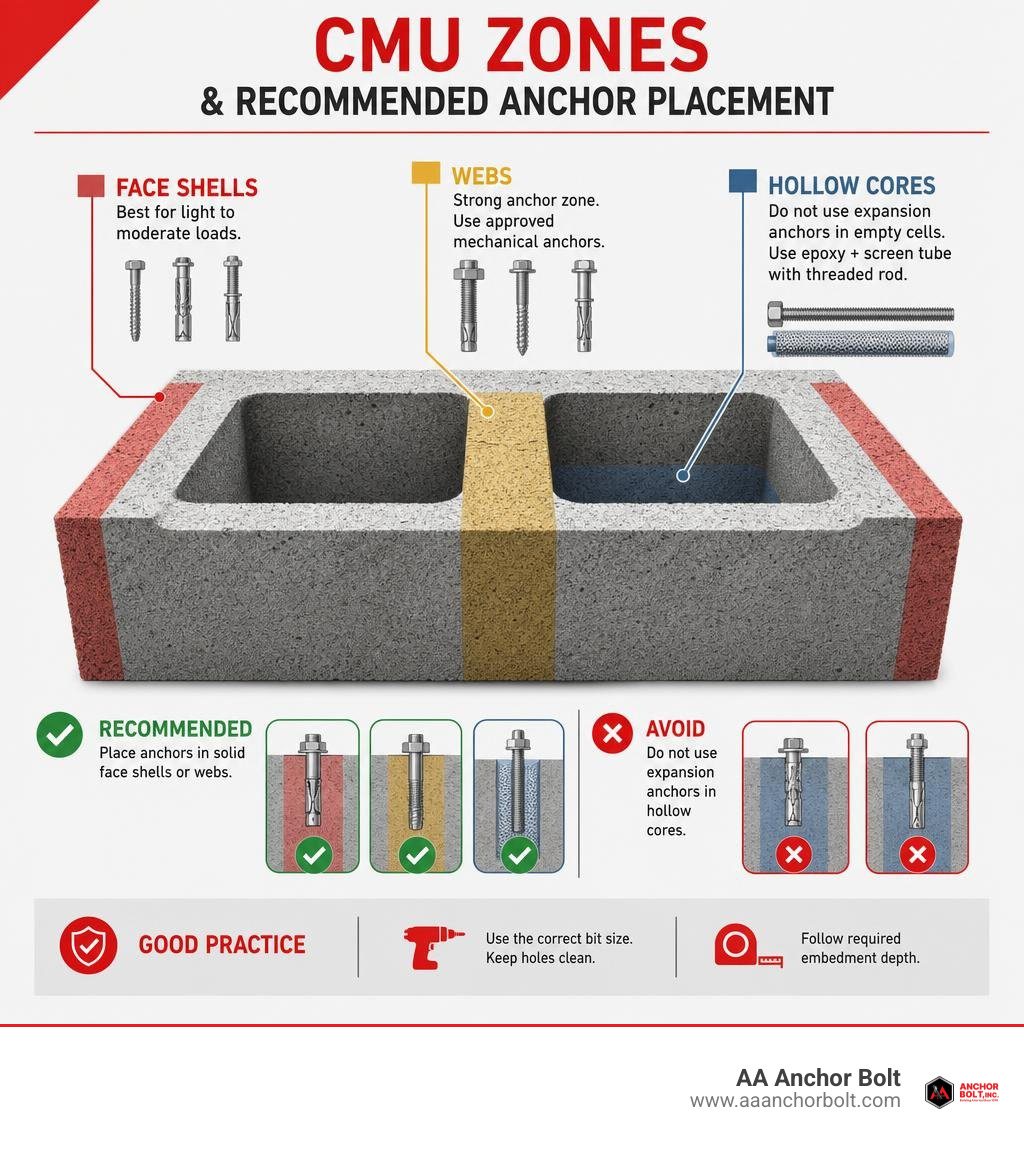
Avoid wedge anchors and drop-in anchors in hollow cinder block. Their expansion force can crack the thin block face or fail inside an empty cell.
Concrete block is not solid poured concrete. Its face shells, webs, hollow cells, mortar joints, and grout-filled cores can all deliver very different holding strength. A clean, correctly sized hole and the right embedment depth matter just as much as the bolt itself.
I am Pauline Horton, and this guide will help you select, install, and protect concrete block fasteners for dependable field performance.
Fastening Mechanics: Solid Concrete vs. Hollow Concrete Block
Fastening into solid, poured concrete allows a mechanical fastener to engage homogeneous aggregate across its entire embedment depth. In contrast, standard Concrete Masonry Units (CMU)—often called cinder blocks—present a non-uniform structure consisting of outer face shells, interior webs, and open air voids.
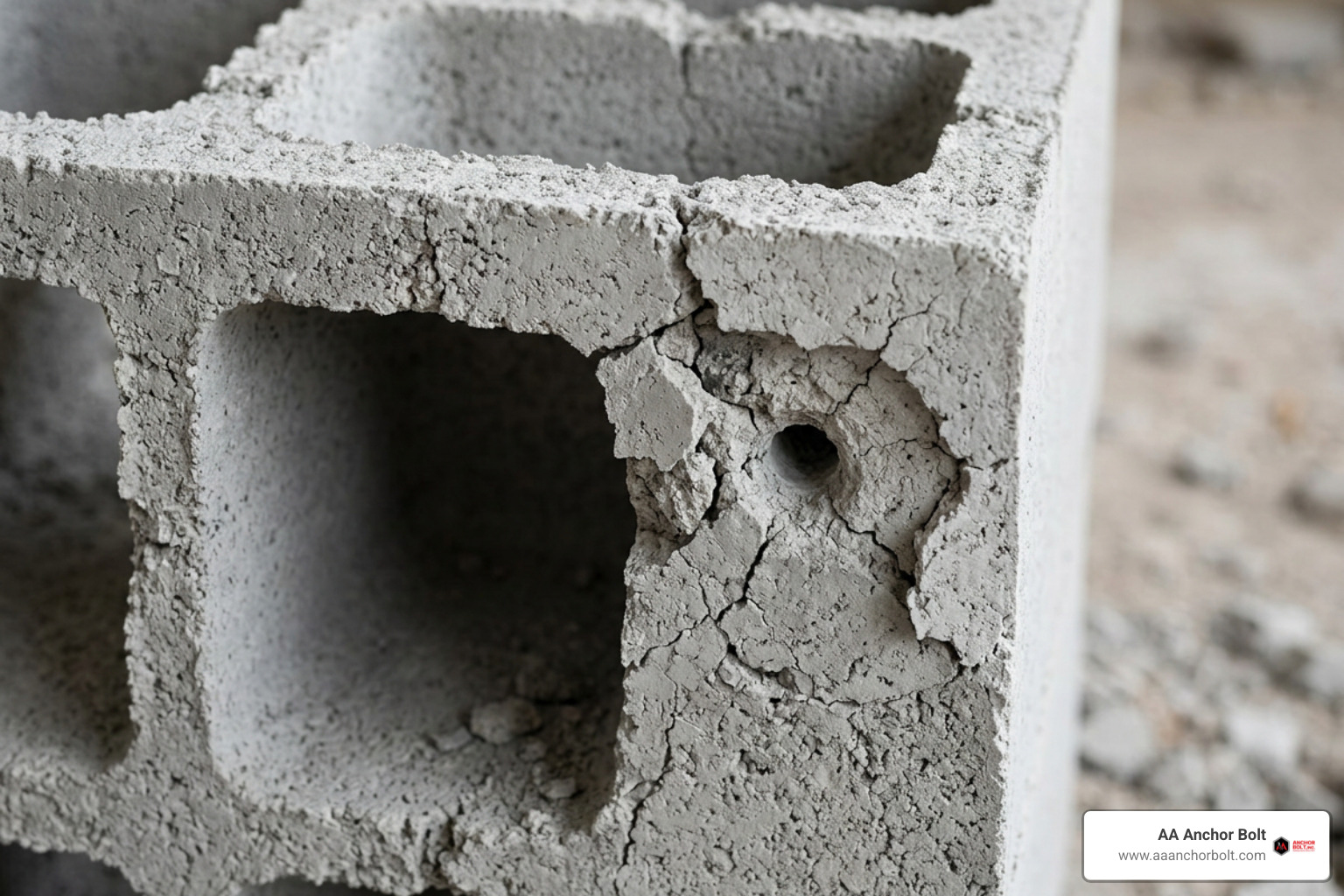
When you drive or expand a fastener into masonry, the base material’s density directly dictates structural performance. Poured concrete commonly exhibits compressive strengths ranging from 3,000 to 5,000+ PSI throughout the entire slab. Hollow CMU, however, relies on relatively thin exterior walls (typically 1-1/4 to 1-1/2 inches thick for standard blocks). Because the core is empty, anchors cannot develop deep embedment friction unless installed into a solid web or a grout-filled cell. To see how these differences shape fastener selection across major construction projects, check out How to Choose the Right Concrete & Masonry Anchors – Lowe’s for an overview of everyday applications.
CMU Fastening Zones: Face Shell, Void, and Mortar Joint
Navigating a cinder block wall requires knowing where your drill bit lands:
- The Face Shell: The outer perimeter wall of the block. Standard mechanical anchors like self-tapping concrete screws or sleeve anchors rely solely on this 1-1/4″ to 1-1/2″ wall thickness for purchase.
- The Hollow Core: The internal air pocket. Fasteners that penetrate beyond the face shell sit unsupported in this void unless paired with toggles, chemical screen tubes, or through-bolts.
- The Web: The solid partition connecting the face shells. Anchoring here provides solid masonry purchase, but precision drilling is required to avoid edge blowouts along the interior partition.
- Mortar Joints: The bonding material between blocks. Mortar is softer, more porous, and far more variable in compressive strength than the CMU itself. Fasteners set into horizontal bed joints or vertical head joints show reduced holding power and should be avoided for primary structural connections.
When high-load attachments are required on existing hollow walls and both sides of the assembly are accessible, through-bolting offers unmatched consistency. Drilling clean through the block and securing a threaded rod with structural plate washers distributes clamping pressure across the inner and outer face shells simultaneously.
Why Wedge Anchors and Drop-In Anchors Fail in Cinder Block
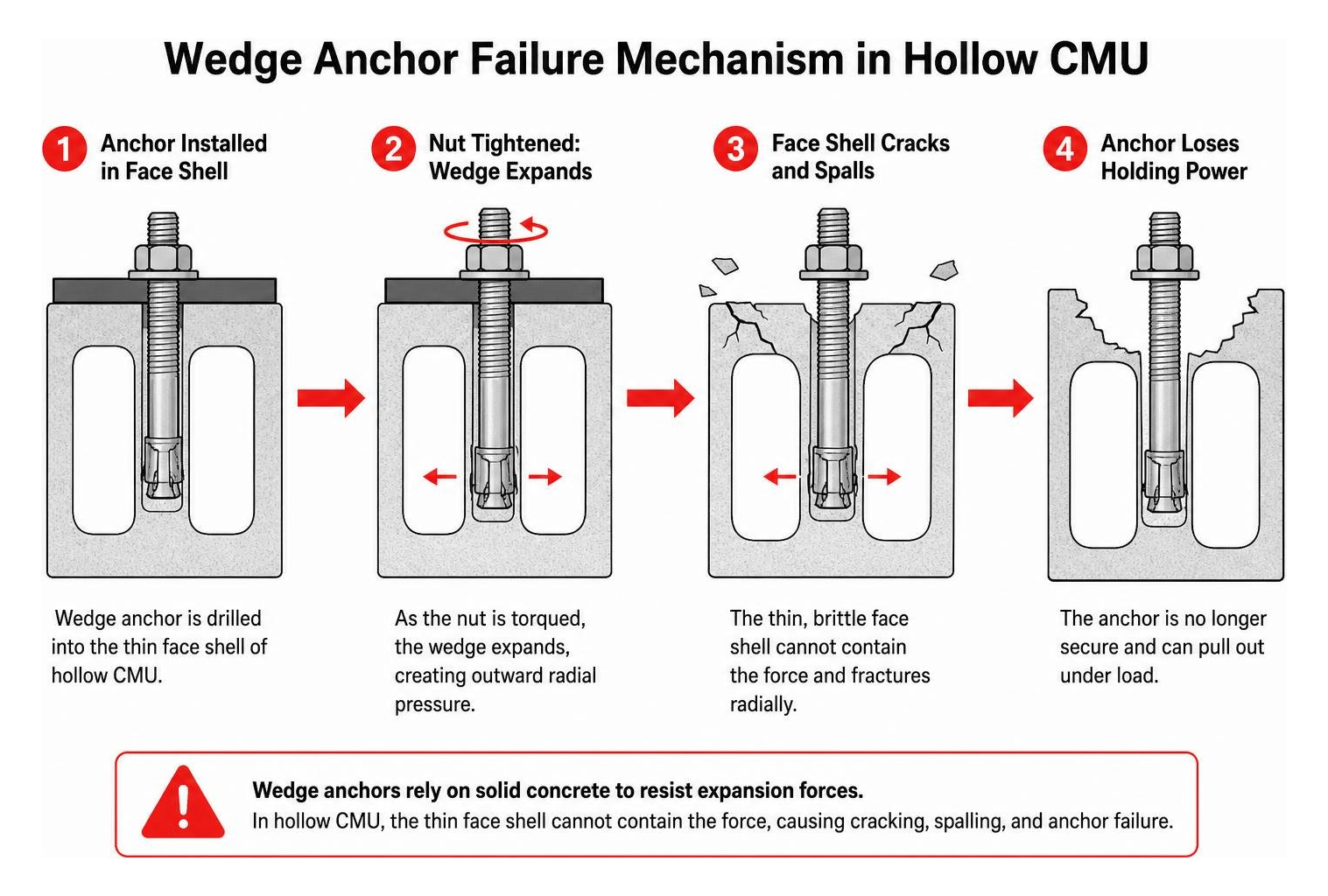
Wedge anchors and drop-in anchors are designed exclusively for solid poured concrete. A wedge anchor creates immense, localized outward expansion pressure via a small metal clip driven outward as the nut is torqued. In solid concrete, the surrounding mass easily contains this radial stress.
In hollow concrete block, this concentrated outward force causes immediate structural failure. The brittle face shell fractures, causing radial cracking and blowout. If the expansion collar sits inside a hollow cell, it expands into empty air without gripping anything. Drop-in anchors suffer the exact same fate: they require a solid, unyielding hole bottom to drive the internal expansion plug home. Installing either type into hollow CMU risks catastrophic fastener pullout.
Selecting the Right Anchor Bolts for Concrete Block
Matching the fastener to the masonry condition prevents structural failure, jobsite delays, and costly rework. Reviewing The Concrete Fastener Guide for Heavy Duty Anchoring can provide comprehensive insights into selecting heavy-duty hardware suited to challenging substrates.
Heavy-Duty Anchor Bolts for Concrete Block Cores
For major structural loads—such as securing structural ledgers, roof trusses, equipment pads, or seismic hold-downs—the standard practice is embedding heavy-duty anchors directly into solid, grout-filled CMU cells.
When blocks are fully grouted with coarse masonry grout and reinforced with rebar, you can place cast-in-place anchors or post-install heavy-duty studs. For structural building code applications, using specified F1554 Anchor Bolt hardware ensures compliance with strict tensile and yield requirements across Grades 36, 55, and 105. Learn more about their fabrication in our guide on Anchor Bolt Threading Machines and How They Work, or explore foundational steel criteria in The Complete Guide to F1554 Anchor Bolt Specs and Demystifying ASTM F1554 Grades 36, 55, and 105.
Post-Installed Anchor Bolts for Concrete Block Surfaces
When working on finished, un-grouted masonry walls, post-installed mechanical anchors provide practical holding power:
- High-Performance Concrete Screw Anchors: One-piece, heavy-duty screws (such as Screw-Bolt+ designs) tap their own matching internal threads into the masonry. Because they distribute load along the full length of the engaged thread rather than generating radial expansion pressure, they allow for closer edge spacing.
- Sleeve Anchors: A versatile light-to-medium-duty option. Tightening the nut draws a conical mandrel into an external split sleeve, expanding the sleeve against the full depth of the hole.
- Double Expansion Anchors: Superior to single expansion shields in hollow or softer masonry. They feature two expanding cones that push outward along the entire body, distributing holding friction over a larger surface area to prevent face-shell cracking.
- Lag Shields & Machine Screw Anchors: Ideal for medium fixtures. Lag shields expand as a lag screw is turned inside them, available in 1/4″ to 3/4″ diameters. Machine screw anchors utilize a threaded cone setting piece driven into a lead sleeve using a manual setting tool.
- Hammer Drive Anchors: Light-duty fasteners (typically 3/16″ and 1/4″ diameters) featuring a mushroom head that drives home quickly to pin sheet metal, termination bars, and electrical boxes to block surfaces.
Step-by-Step Installation and Chemical Anchoring Systems
Proper installation directly determines anchor performance. Even the highest-grade domestic steel bolt will fail prematurely if drilled incorrectly or set into a dusty hole.
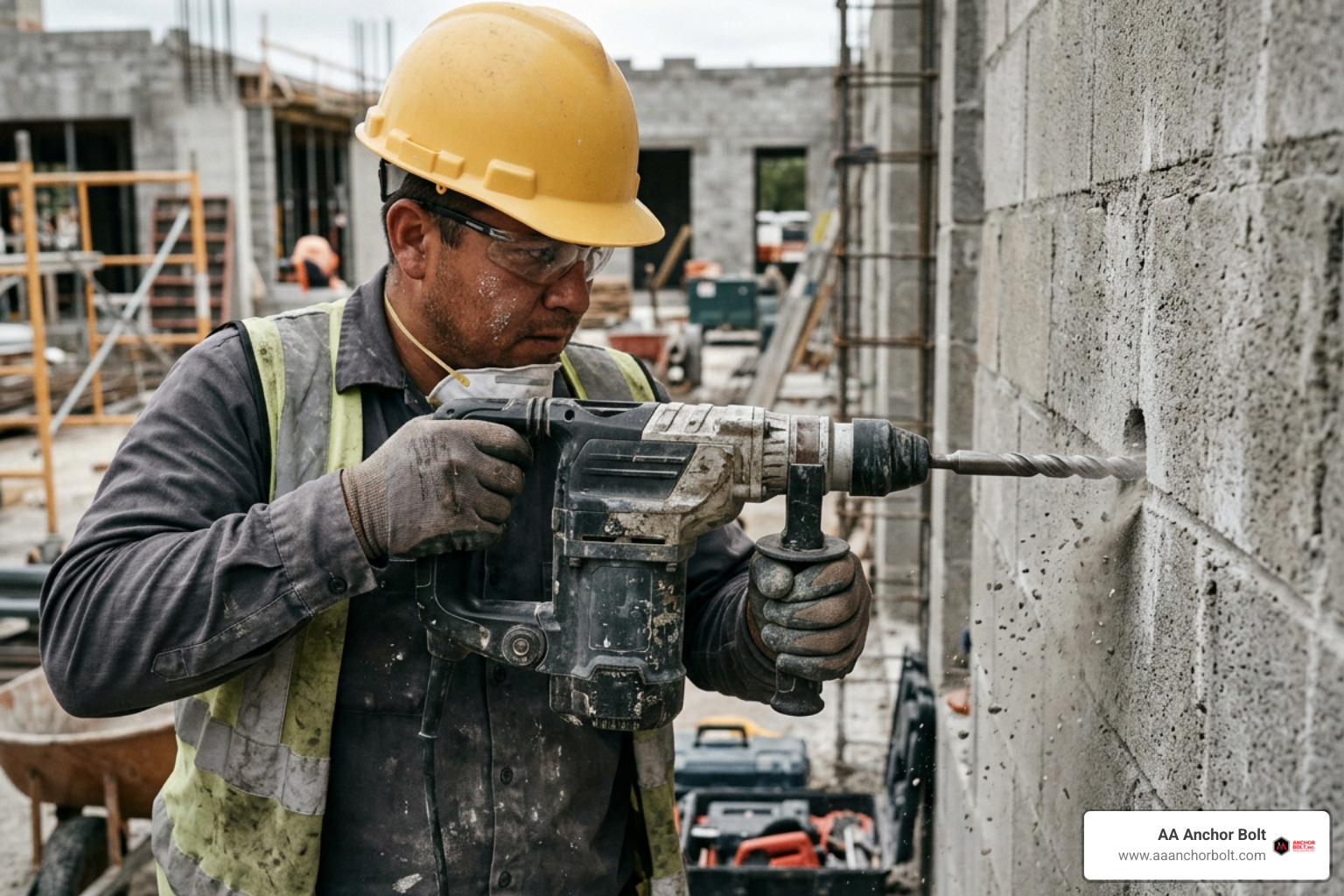
- Mark and Drill: Set your rotary hammer drill to hammer mode for solid webs/grout, or rotation-only mode if the face shell is brittle. Use an ANSI Standard B212.15 carbide-tipped masonry bit. Drill 1/4″ to 1/2″ deeper than the required fastener embedment depth to account for un-cleared dust.
- Clean the Hole Thoroughly: Compressed air, a wire masonry brush, and a vacuum must be used in sequence. Leftover pulverized masonry acts as a dry lubricant, drastically reducing friction and resin adhesion.
- Insert and Set: Insert the mechanical fastener through the fixture into the hole. For screw anchors, drive with an impact wrench until the integrated washer head sits flush. For sleeve anchors, tighten the hex nut to the specified torque. For proper nut pairing on critical connections, refer to our walkthrough on How to Choose the Right Anchor Bolt Nuts for Your Next Project.
Chemical Epoxy Systems and Screen Mesh Tubes
When you need high shear and tensile performance in hollow cinder block, chemical anchoring systems with screen mesh tubes are the industry gold standard.
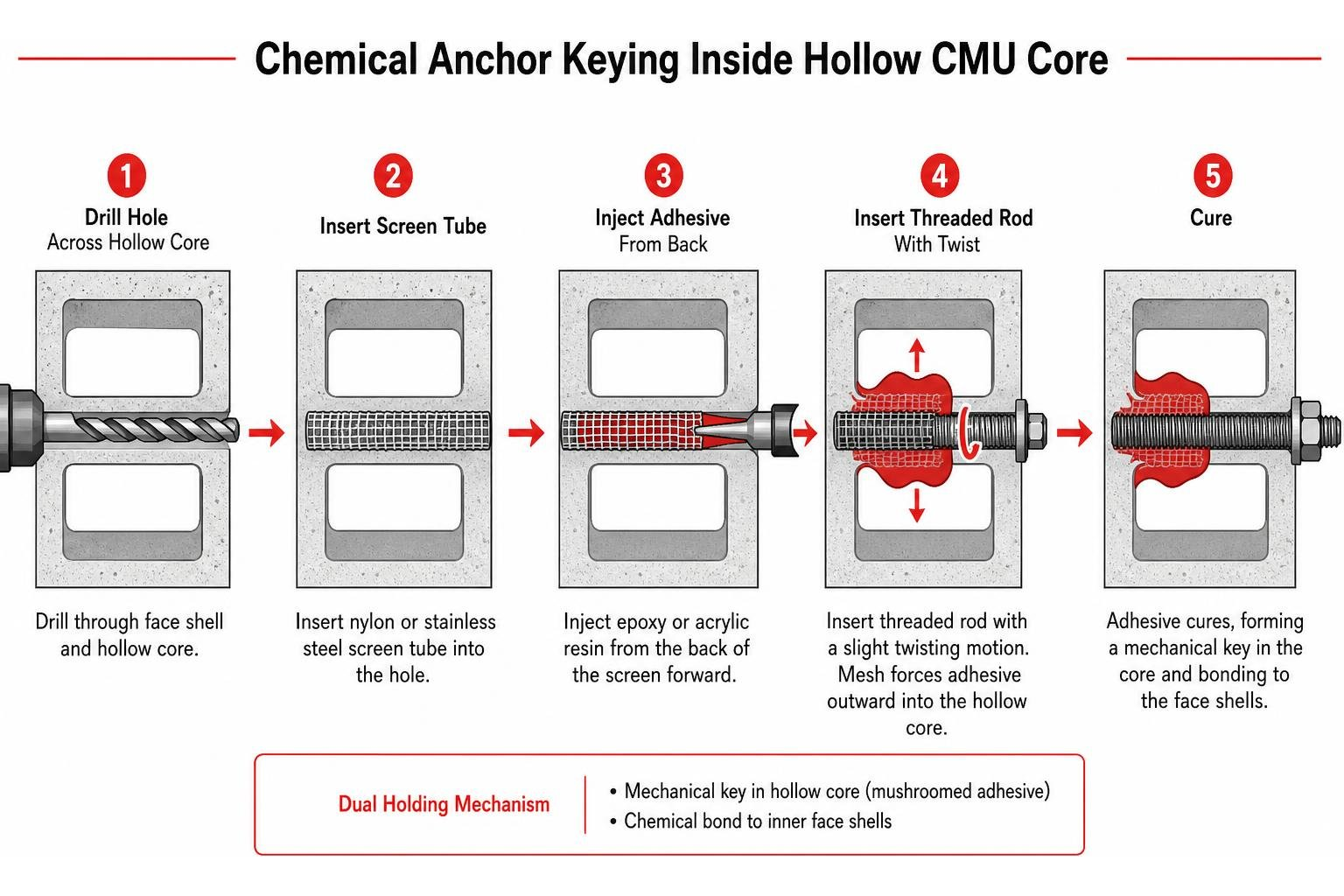
A nylon or stainless steel screen tube is inserted into the drilled hole across the hollow void. Structural adhesive (epoxy or acrylic resin) is injected from the back of the screen forward. As a threaded rod is inserted with a slight twisting motion, the mesh forces adhesive outward into the hollow core, creating a mushroomed mechanical key upon curing while simultaneously bonding to the inner face shell. This dual holding mechanism—chemical adhesion plus mechanical keying—resists cyclic vibration and heavy dynamic loads.
Proper Drilling Techniques to Avoid Internal Spalling
When a standard hammer drill bit punches through the back of a hollow block’s face shell, the high-frequency percussion can blow out a cone-shaped chunk of masonry on the unsupported inside wall. This is known as internal spalling.
Internal spalling cuts the effective structural thickness of a 1-1/4″ face shell down to 3/4″ or less, undermining the holding power of mechanical anchors. To prevent internal blowout:
- Use sharp, high-grade ANSI carbide drill bits.
- Reduce forward pressure on the hammer drill as you near the back of the face shell.
- Switch to rotation-only drilling when working on delicate or historic CMU walls.
- Maintain proper edge distances: keep mechanical anchors at least 2 to 3 inches away from unsupported block corners and open edges.
Load Capacities, Safety Factors, and Corrosion Protection
Structural calculations in masonry distinguish between Ultimate Load Capacity (the point of mechanical or base-material failure in laboratory testing) and Allowable Working Load (the safe operational capacity for engineering design).
In masonry and concrete anchoring, the standard engineering baseline applies a safety factor of 4:1 (the 25% rule). Allowable working loads should never exceed 25% of the ultimate rated capacity.
| Anchor Type & Diameter | Base Material & Placement | Ultimate Tension (lbs) | Allowable Tension (lbs) | Ultimate Shear (lbs) | Allowable Shear (lbs) |
|---|---|---|---|---|---|
| 1/4″ Concrete Screw | Solid Concrete (4,000 PSI) | ~1,540 | 385 | ~1,920 | 480 |
| 1/4″ Screw-Bolt+ | Grout-Filled CMU (Face Shell, 1-5/8″ emb.) | 1,260 | 315 | 1,600 | 400 |
| 1/4″ Screw-Bolt+ | Grout-Filled CMU (Top of Wall, 2-1/2″ emb.) | 1,640 | 410 | 740 | 185 |
| 1/2″ Concrete Screw | Solid Concrete (4,000 PSI) | 2,260 | 565 | 1,590 | 398 |
| 1/2″ Sleeve Anchor | Solid Concrete (4,000 PSI) | 8,460 | 2,115 | 10,040 | 2,510 |
| 1/2″ Wedge Anchor* | Solid Concrete (4,000 PSI) | 25,210 | 6,303 | 36,040 | 9,010 |
| 3/4″ Screw-Bolt+ | Solid Concrete (4,000 PSI) | 7,640 | 1,910 | 14,700 | 3,675 |
| 3/4″ Screw-Bolt+ | Grout-Filled CMU (Face Shell, 4″ emb.) | 4,600 | 1,150 | 11,200 | 2,800 |
| 3/4″ Screw-Bolt+ | Grout-Filled CMU (Top of Wall, 6-1/4″ emb.) | 4,860 | 1,215 | 1,040 | 260 |
*Note: Wedge anchors are listed strictly for solid concrete baseline comparisons; they must never be used in hollow or un-grouted concrete block. Additional technical loading parameters are outlined in technical engineering guides like the manufacturer data sheets in Volume 2 .
Calculating Tension Pullout and Shear Loads in CMU
When sizing fasteners, evaluate both loading directions:
- Tension (Pullout): The force attempting to pull the anchor axially straight out of the wall. In CMU, tension capacity is constrained by the face shell thickness and concrete thread-tapping engagement.
- Shear: The downward or lateral force applied perpendicular to the fastener axis.
Notice how placement affects capacity: installing into the top of a grout-filled block wall provides strong tension resistance due to deep embedment, but lower edge shear resistance (e.g., 260 lbs allowable shear for a 3/4″ screw bolt at the top vs. 2,800 lbs in the face). When multiple anchors are installed near one another, apply standard reduction factors if center-to-center spacing drops below the critical distance specified by the manufacturer (typically 12 anchor diameters).
Environmental Durability and Protective Coatings
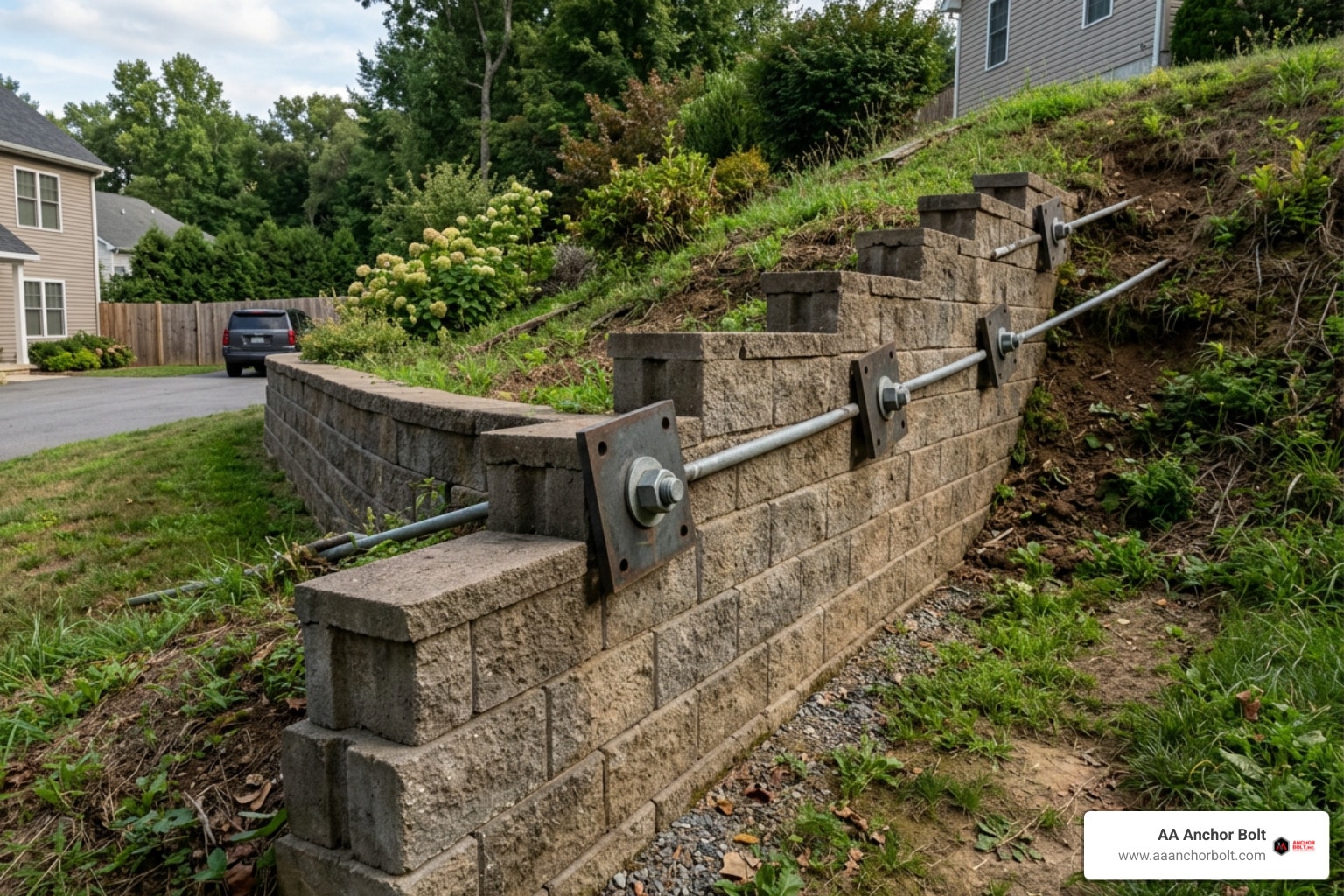
Corrosion resistance is just as critical as mechanical strength, particularly for exterior retaining walls, basement foundations, or industrial environments:
- Zinc Plating (ASTM B633): Provides standard indoor rust protection for dry environments.
- Hot-Dip Galvanizing (HDG): Delivers a thick metallurgical zinc bond that withstands severe weather. Read How to Choose and Use Hot Dipped Galvanized Anchor Bolts to select the right grade for wet or outdoor exposures.
- Mechanical Galvanizing (ASTM B695 Class 55): An ideal uniform coating for threaded fasteners, eliminating thread binding while ensuring exterior protection.
- 304 & 316 Stainless Steel: The premium choice for chemical exposure, marine environments, and food-grade facilities where galvanic corrosion cannot be tolerated.
For projects with strict structural or governmental compliance, review Certified Strength: Why Anchor Bolt Material Certs Matter for Your Next Order to verify traceability. Discover what goes into selecting domestic suppliers in An Essential Guide to Finding Reliable Anchor Bolt Manufacturers.
Frequently Asked Questions About Masonry Fasteners
Can you use wedge anchors in hollow cinder block?
No. Wedge anchors rely on high radial expansion force against dense, solid concrete. In hollow cinder block, tightening a wedge anchor will either crack the thin, brittle face shell or expand harmlessly into the hollow core cavity, leading to sudden fastener failure. Use sleeve anchors, double-expansion shields, screw anchors, or chemical screen tubes instead.
What is the safe working load limit for concrete block fasteners?
The safe working load is 25% of the ultimate tested failure capacity (a 4:1 safety factor). Because CMU blocks vary in density, web thickness, and aggregate composition, keeping operating tension and shear loads below one-quarter of the ultimate capacity prevents catastrophic substrate pullout.
When should screen tubes be used with epoxy anchors?
Screen mesh tubes must always be used when chemically anchoring into hollow-core or ungrouted CMU. Without a screen tube, injected epoxy flows freely into the bottom of the hollow cell cavity, wasting material and preventing the fastener from establishing a solid connection. The mesh retains the adhesive and creates a secure mechanical key against the interior face shell.
Conclusion
Securing attachments to concrete masonry units requires matching your fastener directly to the wall’s internal structure. While hollow face shells call for sleeve anchors, self-tapping screw bolts, or chemical screen tubes, heavy structural connections demand fully grouted cores paired with cast-in-place or post-installed anchor hardware.
At AA Anchor Bolt, we manufacture domestic structural anchor bolts, custom J-bolts, tie rods, and specialty fasteners at our facility in Michigan. Backed by nearly a million pounds of prime domestic steel and end-to-end production control, we provide contractors, fabricators, and engineers across the USA with rapid turnarounds and fully certified materials. Explore our full line of custom structural Products, or read our deep-dive on heavy-duty concrete screw anchors to equip your next masonry project with dependable holding power.