Securing the Connection: A Roundup of the Best Anchor Bolt Catalogs
Why Every Contractor Needs the Right Anchor Bolt Catalog Before Breaking Ground
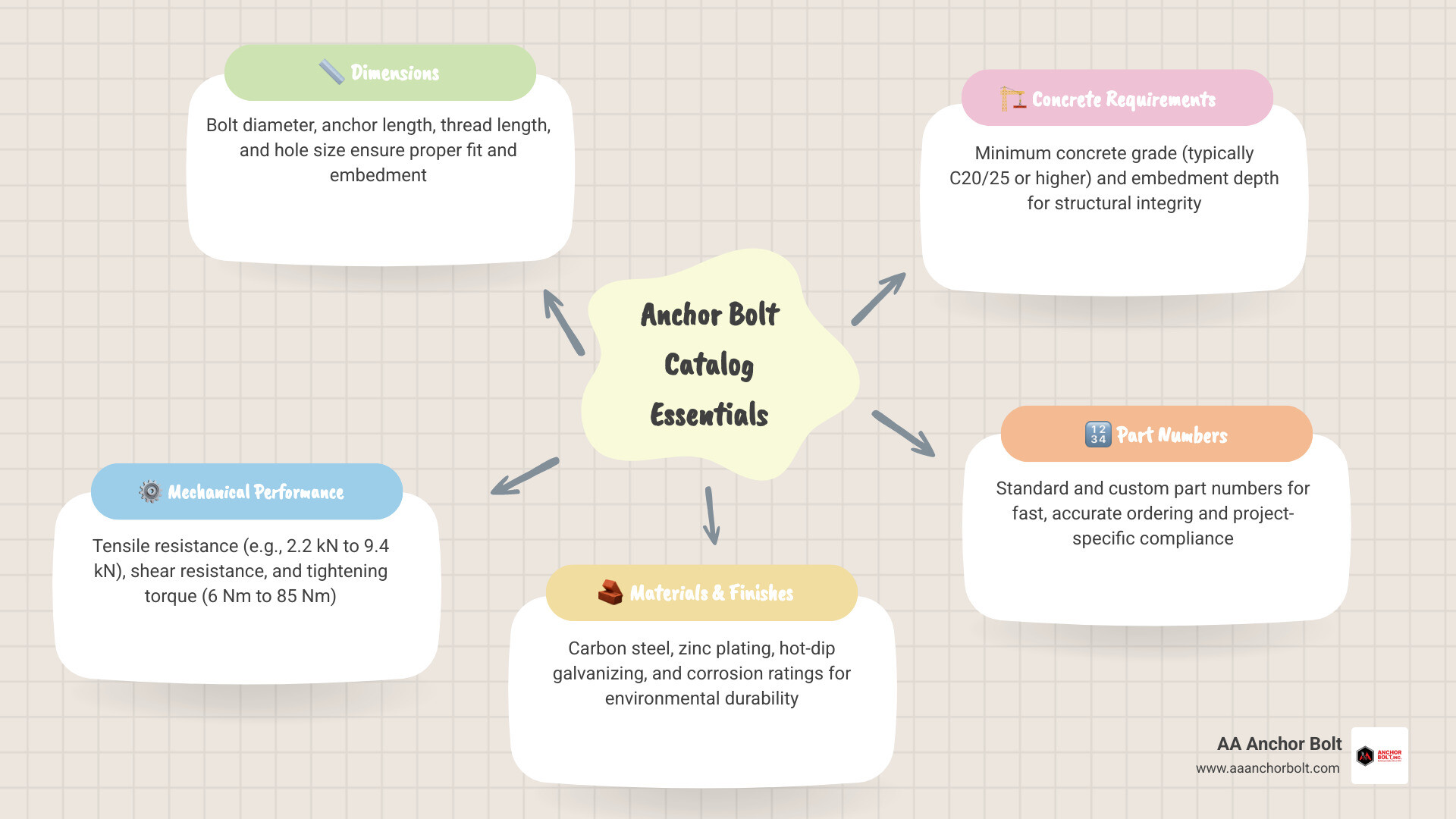
An anchor bolt catalog is your go-to reference for selecting the right fastener size, material, and load capacity for concrete anchoring projects. Here’s a quick look at what the best catalogs cover:
- Dimensions — bolt diameter, anchor length, thread length, and hole size
- Mechanical performance — tensile resistance, shear resistance, and tightening torque
- Materials and finishes — carbon steel, zinc plating, hot-dip galvanizing, and corrosion ratings
- Concrete requirements — minimum concrete grade (typically C20/25 or higher)
- Part numbers — for fast, accurate ordering
When you’re securing heavy fixtures or machinery to concrete, guessing isn’t an option. The wrong anchor size, the wrong torque, or the wrong finish can mean a failed connection — or worse, a failed structure.
A good catalog gives you exact numbers. For example, a 6 mm anchor may only handle 2.2 kN in tension, while a 16 mm anchor can take up to 9.4 kN. Tightening torque scales just as sharply — from 6 Nm all the way up to 85 Nm. Those details matter on a tight deadline.
But not all catalogs are created equal. Some cover only standard off-the-shelf sizes. Others include custom configurations, domestic steel grades, and project-specific compliance data — which is exactly what Midwest infrastructure contractors often need.
I’m Pauline Horton, and in this roundup I’ll walk you through the best anchor bolt catalogs available in 2026 so you can find the right specs fast and keep your project on schedule.
Key terms for anchor bolt catalog:
Deciphering the Anchor Bolt Catalog: Key Specifications and Dimensions
When we open up a professional mechanical anchor bolt catalog, the sheer volume of dimensional data can look like a foreign language. However, understanding these structural parameters is the difference between a rock-solid foundation and a catastrophic failure.
To get a clear picture of what we are working with, let’s break down the primary dimensions you will encounter in any reputable catalog:
- Bolt/Anchor Diameter: This is the nominal width of the anchor body (typically ranging from 6 mm to 16 mm for light-to-medium duty throughbolts, and up to 4 inches for heavy-duty cast-in-place structural bolts).
- Overall Anchor Length: The total length of the bolt from end to end. In standard throughbolt catalogs, lengths typically vary from 50 mm for shallow installations to 220 mm for deep structural anchoring.
- Thread Length: The portion of the bolt that is threaded to accept the nut and washer. Having sufficient thread length ensures you can accommodate different fixture thicknesses.
- Fixture Thickness (Maximum/Minimum): The thickness of the material or bracket you are securing to the concrete. The catalog will specify the maximum fixture thickness a given bolt length can safely clamp down.
- Hole Size (Drill Bit Diameter): The exact diameter of the hole that must be drilled into the concrete. For torque-controlled expansion throughbolts, the drill bit diameter matches the nominal anchor size (e.g., a 12 mm anchor requires a 12 mm hole).
For a deep dive into how these dimensions translate to heavy-duty structural applications, you can read The Complete Guide to F1554 Anchor Bolt Specs and consult The Concrete Fastener Guide for Heavy Duty Anchoring.
The Installation Process: Why Precision Matters
One of the most common topic gaps in standard catalogs is a clear explanation of how to actually install these fasteners. If you don’t install the bolt correctly, the cataloged load limits mean absolutely nothing.
Here is the proper sequence we recommend for installing torque-controlled throughbolts:
- Drill: Use a rotary hammer drill to make a hole. Always match the drill bit diameter to the specified anchor hole size.
- Clean: Thoroughly blow out the dust and debris from the hole. Leftover concrete dust acts like tiny ball bearings, preventing the expansion clip from gripping the concrete walls.
- Hammer: Tap the throughbolt through the fixture and into the hole using a hammer until the washer is flush against the fixture.
- Torque: Use a calibrated torque wrench to tighten the nut to the recommended tightening torque specified in the catalog. This expands the expansion clip against the concrete.
Mechanical Performance: Load Capacities and Tensile Strengths
An anchor bolt is only as good as the loads it can safely carry. When we look at mechanical performance, we focus on two primary forces: tensile strength (the force pulling the bolt straight out of the concrete) and shear resistance (the side-to-side sliding force pushing against the side of the bolt).
These capacities are heavily dependent on the anchor’s diameter and embedment depth. Let’s look at the mechanical performance metrics for standard torque-controlled zinc-plated throughbolts in uncracked concrete (minimum grade C20/25):
| Anchor Size (Hole Dia.) | Min. Hole Depth | Rec. Tensile Resistance | Rec. Shear Resistance | Recommended Tightening Torque |
|---|---|---|---|---|
| 6 mm | 34 mm | 2.2 kN | 2.4 kN | 6 Nm |
| 8 mm | 43 mm | 3.0 kN | 4.2 kN | 15 Nm |
| 10 mm | 48 mm | 5.3 kN | 7.2 kN | 28 Nm |
| 12 mm | 59 mm | 6.3 kN | 10.1 kN | 50 Nm |
| 16 mm | 85 mm | 9.4 kN | 14.3 kN | 85 Nm |
Note: For complete technical drawings and precise part-number listings, you can view the official manufacturer Datasheet.
These throughbolts require a minimum concrete strength class of C20/25 to safely achieve their rated tensile and shear resistance. If you are installing them in weaker concrete, or close to edges and neighboring anchors, you must apply spacing reduction factors to prevent the concrete from cracking or blowing out.
Understanding Design Strengths in an Anchor Bolt Catalog
When reviewing structural catalogs, understand the difference between yield strength (the point at which the steel permanently deforms) and tensile strength (the point at which the bolt actually breaks). Selecting the proper steel grade prevents structural deformation under high loads.
Equally important is matching your bolts with compatible nuts. A heavy-duty high-strength anchor bolt paired with a weak, low-carbon nut is a recipe for stripped threads and sudden joint failure. To ensure your hardware is fully compatible, check out our guide on How to Choose the Right Anchor Bolt Nuts for Your Next Project.
Materials, Finishes, and Corrosion Resistance
No matter how strong your anchor bolt is on paper, it won’t do much good if rust eats it away within a couple of years. Selecting the right material and finish is critical to ensuring long-term structural integrity.
Most anchor bolt catalogs offer a few standard options for corrosion protection:
- Zinc Plating with Yellow Passivation: This standard industrial finish features a minimum coating thickness of 5 micrometers (µm). It is highly cost-effective and provides basic protection for dry, indoor environments. However, it is not suitable for outdoor or high-moisture applications.
- Hot-Dip Galvanizing (HDG): This process applies a much thicker layer of protective zinc. Because it forms a metallurgical bond with the steel, HDG is the industry standard for outdoor construction, infrastructure, and heavy-duty industrial applications.
- Stainless Steel: Offering the highest level of corrosion resistance, stainless steel is ideal for marine environments or chemical processing plants, though it comes at a higher price point.
To understand why hot-dip galvanizing is so effective, read Why Hot Dipped Galvanized Bolts Are Your Best Defense Against Rust and learn How to Choose and Use Hot Dipped Galvanized Anchor Bolts.
Selecting Materials from a Heavy-Duty Anchor Bolt Catalog
For structural and highway projects, standard metric throughbolts often aren’t enough. Engineers typically specify the ASTM F1554 standard, which is the premier specification for structural anchor bolts designed to cast directly into concrete foundations.
To help you navigate these specifications, we have put together an in-depth resource: Demystifying ASTM F1554 Grades 36, 55 and 105.
Here is a quick breakdown of the three primary grades you will find in our catalog:
- Grade 36: Made from low-carbon steel, this grade offers a minimum yield strength of 36 ksi. It is highly weldable and is the most common choice for light structural columns, sign poles, and traffic signals.
- Grade 55: A high-strength, low-alloy steel with a minimum yield strength of 55 ksi. It can be ordered with a special weldability requirement (S1) and is widely used in highway infrastructure and heavy industrial framing.
- Grade 105: A heat-treated, quenched, and tempered alloy steel boasting a minimum yield strength of 105 ksi. This is the heavy hitter of the anchor bolt world, designed for massive structures, wind turbines, and high-load industrial machinery.
Frequently Asked Questions about Anchor Bolt Catalogs
What concrete embedment depth is required for structural anchor bolts?
Embedment depth is the distance from the concrete surface to the deepest point of the anchor bolt. The required depth depends on several factors, including the bolt diameter, the structural load requirements, and the compressive strength of the concrete.
For standard mechanical throughbolts, the minimum hole depth scales with size—ranging from 34 mm for a small 6 mm anchor up to 85 mm for a heavy-duty 16 mm anchor. For massive cast-in-place ASTM F1554 structural bolts, embedment depth is calculated by structural engineers to ensure the steel will yield before the concrete cone breaks or pulls out.
How do custom-manufactured anchor bolts compare to standard off-the-shelf options?
Standard off-the-shelf anchor bolts are convenient for quick, lightweight projects, but they often fall short on large-scale infrastructure or heavy industrial jobs.
At AA Anchor Bolt, we manufacture custom anchor bolts right here in Northville, Michigan. Because we maintain nearly a million pounds of in-house domestic steel, we can offer incredibly fast turnarounds on custom lengths, diameters, and thread configurations. Choosing custom-manufactured bolts ensures full domestic compliance (Buy America/Buy American Act) and exact structural alignment with your engineering drawings.
What are the standard configurations and dimensions for ASTM F1554 anchor bolts?
ASTM F1554 anchor bolts are typically available in three main configurations:
- Bent Bolts (L-Bolts): Featuring a 90-degree hook at the bottom to resist pullout.
- Headed Bolts: Featuring a forged heavy hex or square head at the bottom embedded in the concrete.
- Thread-Each-End Rods: Straight rods threaded on both ends, utilizing an anchor plate and nut at the embedded end to secure the assembly.
These configurations are available in standard diameters ranging from 1/2″ all the way up to 4″ to accommodate everything from light commercial buildings to massive bridge abutments.
Conclusion
Whether you are securing a simple steel bracket to a concrete wall with an M12 throughbolt or anchoring a multi-story structural steel column to a heavy foundation, having the right anchor bolt catalog is the first step toward a safe, successful build.
At AA Anchor Bolt, we don’t just supply standard fasteners; we manufacture high-quality, domestic F1554 Anchor Bolt assemblies tailored to your project’s exact load and environmental requirements. From our family-owned facility in Michigan, we control the entire production process to deliver the fast turnaround times your schedule demands.
Ready to find the perfect anchor bolts for your next project? Browse our full range of Products and technical Resources, or Contact our engineering team today to get a custom quote.