Certified Strength: Why Anchor Bolt Material Certs Matter for Your Next Order
Essential Requirements for Anchor Bolt Material Certs
When it comes to structural integrity on heavy highway and bridge projects, paper trail quality matters just as much as steel quality. Anchor bolt material certs act as the birth certificate for every piece of structural hardware on your jobsite. Without proper verification, even high-grade steel is treated as non-compliant scrap by project engineers and state inspectors.
Key Elements of a Compliant Mill Test Report (MTR)
The backbone of any documentation package is the Mill Test Report (MTR). This document traces raw material from the original steel mill melt down to the finished threaded rod. To pass strict state transportation agency reviews and conform to The Complete Guide to F1554 Anchor Bolt Specs, an MTR must contain specific, unalterable data points:
- Heat Number Traceability: Every MTR must match the exact heat number stamped on the physical product or bundle tags.
- Chemical Composition: Chemical analysis detailing percentages of carbon, manganese, phosphorus, sulfur, and silicon to ensure weldability and ductileness.
- Mechanical Properties: Actual lab-tested yield strength, ultimate tensile strength, elongation percentage, and reduction of area.
- Explicit Standards Statement: An unambiguous declaration stating full compliance with ASTM F1554 (or AASHTO equivalents) including the specific grade.
- Authorized Representative Signature: A legally binding signature from the fabricator’s or mill’s quality assurance representative.
- Review Verification: Initialed proof that the fabricator reviewed and verified the mill values prior to shipping.
Buy America Compliance and Galvanizer Certification
Infrastructure projects funded by federal and state grants mandate strict domestic production oversight. Under Buy America rules (such as Iowa DOT Matls IM 107, Group 1), anchor bolt material certs must explicitly certify that all melting and manufacturing processes for bolts, nuts, and washers occurred 100% within the United States.
Furthermore, protective coatings require their own distinct paper trail. When corrosion protection is specified, you must review the galvanizer’s certificate alongside the mill certs. As discussed in Why Hot-Dipped Galvanized Bolts Are Your Best Defense Against Rust, hot-dip galvanized anchor bolts must meet ASTM F2329 or mechanical zinc plating under ASTM B695 Class 50, Type 1. The galvanizing cert must verify coating thickness, confirm process compliance, and note whether a chromate conversion treatment was applied.
Comparing US State Specifications and European Assessment Standards
Understanding regulatory compliance requires recognizing that different jurisdictions assess performance and origin through different frameworks. US transportation agencies like the Iowa Department of Transportation enforce material traceability via Instructional Memorandums (IM), while European projects follow European Assessment Documents (EAD) issued by the European Organisation for Technical Assessment (EOTA).
| Feature / Standard | Iowa DOT (Matls IM 453.08) | European Standard (EAD 330924-01-0601) |
|---|---|---|
| Primary Material Specs | ASTM F1554 (Grade 36, 55, 105) | EN 1992-1-1 / EN ISO standards ($f_{uk} \le 1000\text{ N/mm}^2$) |
| Origin Traceability | Buy America (100% US Melt & Manufacture) | European Technical Assessment (ETA) framework |
| Visual Grade Marking | End color-coding (Blue, Yellow, Red) | Manufacturer mark & anchor head designation |
| Coating Standards | ASTM F2329 / ASTM B695 Class 50 | EN ISO 10684 ($\ge 50\mu\text{m}$ hot-dip galvanizing) |
| Design Working Life | Project design life (standard US infrastructure) | Formally assessed 50-year working life baseline |
| Physical Verification | 1 sample per project/size (or 1 per source/year) | 5% fractile mechanical confirmation testing |
ASTM F1554 Material Grades, Color-Coding, and Swedge Bolts
Under ASTM F1554 guidelines, structural anchor bolts are divided into three primary mechanical yield strength grades:
- F1554 Anchor Bolt Grade 36: Low-carbon steel with a 36 ksi minimum yield strength.
- F1554 Anchor Bolt Grade 55: High-strength, low-alloy steel yielding 55 ksi (weldable version).
- F1554 Anchor Bolt Grade 105: Heat-treated alloy steel delivering 105 ksi minimum yield strength.
For detailed breakdown on these material properties, read our deep-dive on Demystifying ASTM F1554 Grades 36, 55, and 105.
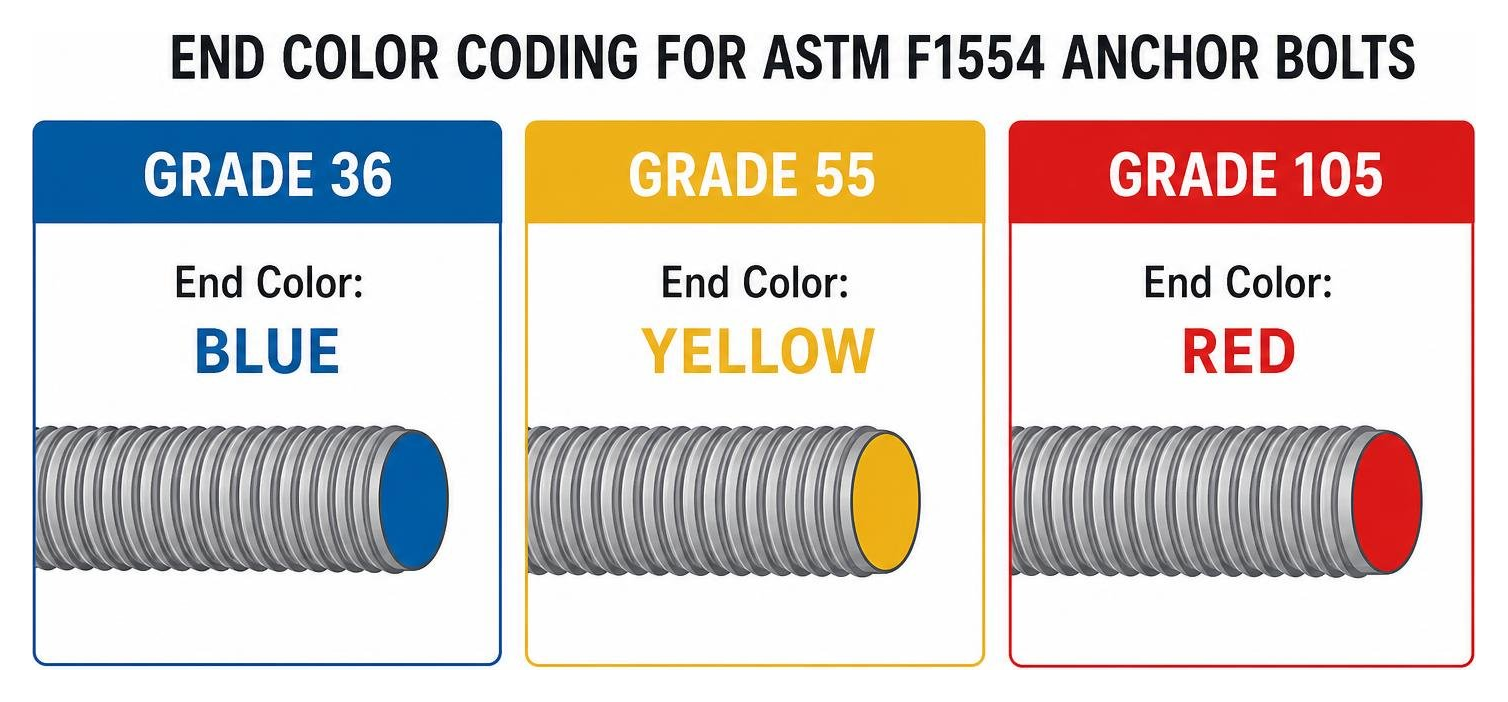
To avoid mix-ups on busy jobsites, state DOTs like Iowa in Matls IM 453.08, Revised 10/16/18 enforce strict end color-coding:
- Blue = Grade 36
- Yellow = Grade 55
- Red = Grade 105
For bridge bearings and structural expansion joints, swedge anchor bolts are frequently required. Rather than cutting material away, swedge indentations must be created through cold metal displacement in four staggered rows. Regulations mandate indentation depths between 1/8 inch and 3/16 inch, widths of 1/4 inch to 1/2 inch, and spacing between 2.0 and 3.0 inches with a rounded bottom radius of at least 1/4 inch. Sharp V-shaped cut grooves are strictly prohibited because they create structural stress risers.
High-Strength Fastener Certifications vs Anchor Bolt Material Certs
Contractors often confuse standard structural anchor bolt documentation with high-strength structural bolt certifications covered under guidelines like Iowa’s Matls IM 453.06B, revised 4/21/20. The procedures differ significantly in sampling protocols and testing criteria.
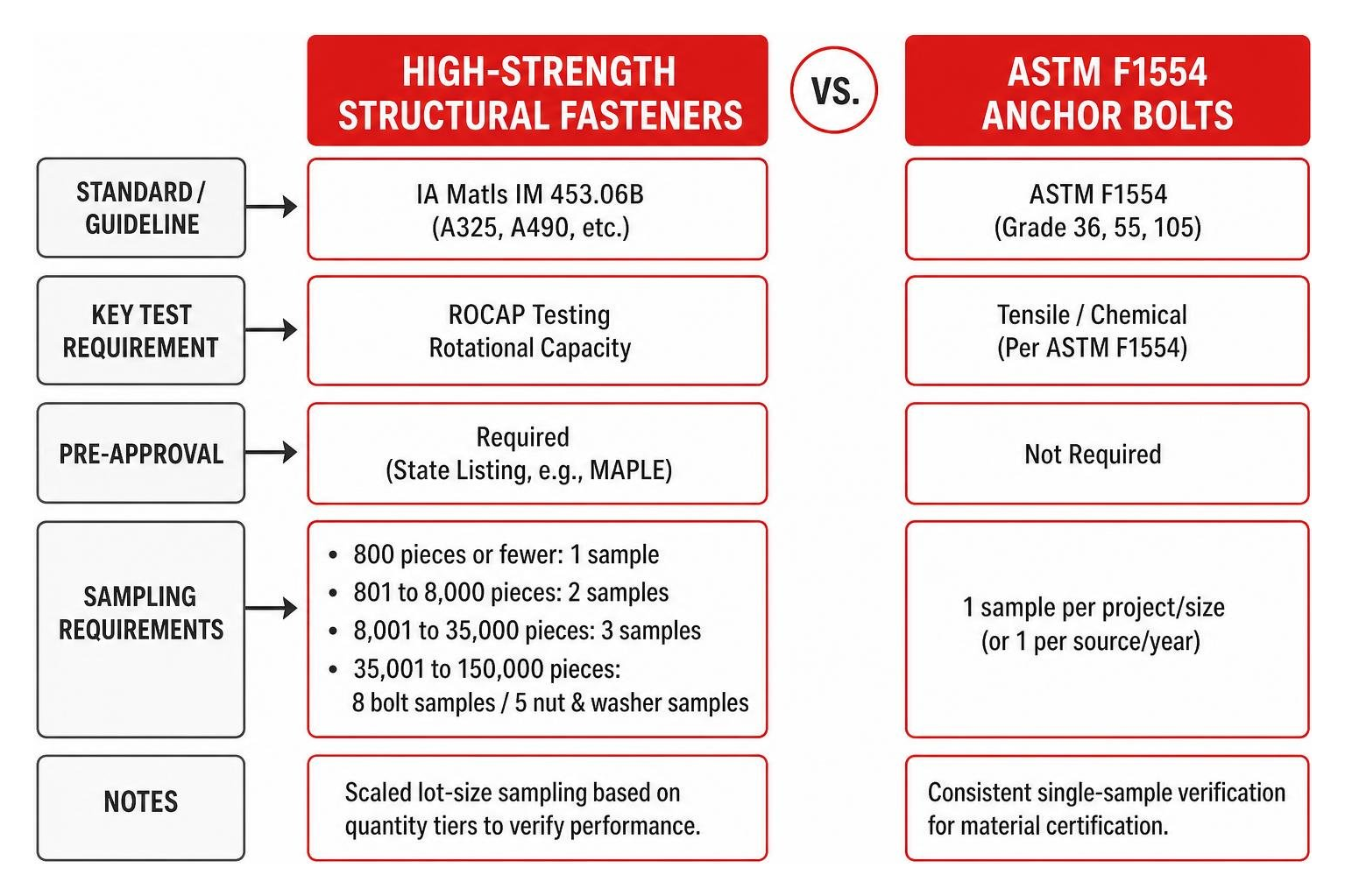
High-strength bolts (like ASTM F3125 Grade A325 or A490) require rotational capacity (ROCAP) testing to prevent thread stripping during installation, mandatory pre-approval on state listings (such as MAPLE), and scaled lot-size sampling:
- 800 pieces or fewer: 1 sample required
- 801 to 8,000 pieces: 2 samples required
- 8,001 to 35,000 pieces: 3 samples required
- 35,001 to 150,000 pieces: 8 bolt samples / 5 nut & washer samples
- Over 150,000 pieces: 13 bolt samples
Conversely, standard anchor bolts under IM 453.08 operate on a simpler verification frequency: one physical sample (bolt, nut, and washer assembly) per project per size, or one sample per source per size per calendar year for pre-approved fabricators. Non-high-strength standard fasteners or small lot purchases under 100 assemblies can often be accepted directly via certified MTRs without destructive field sampling.
Cast-In Anchor Performance Criteria Under EAD 330924-01-0601
When reviewing European engineering submittals governed by EAD 330924-01-0601, the evaluation shifts from pure material property verification to holistic, performance-based calculations. As outlined in The Concrete Fastener Guide for Heavy-Duty Anchoring, European standards evaluate structural cast-in anchor performance based on a assumed 50-year working life baseline.
Under the EAD framework, cast-in anchors (Type 1 single headed bars or Type 2 welded assemblies) are evaluated across concrete strength classes ranging from C20/25 up to C90/105. Mechanical resistance is verified by mathematical formulas confirmed through 5% fractile lab testing:
- Steel Tension Resistance: Determined using the stressed cross-sectional area and nominal tensile strength ($f_{uk} \le 1000\text{ N/mm}^2$).
- Cracked Concrete Pull-Out Resistance: Calculated as $7.5 \cdot f_{ck} \cdot \frac{\sum A_h}{1000}\text{ kN}$.
- Uncracked Concrete Pull-Out Resistance: Calculated as $10.5 \cdot f_{ck} \cdot \frac{\sum A_h}{1000}\text{ kN}$.
The anchor head diameter ratio ($d_h / d$) must be at least 1.6, with head inclination angles kept between 0° and 30° to prevent premature concrete breakout failure.
Fabricator Approval, Quality Control, and Verification Testing
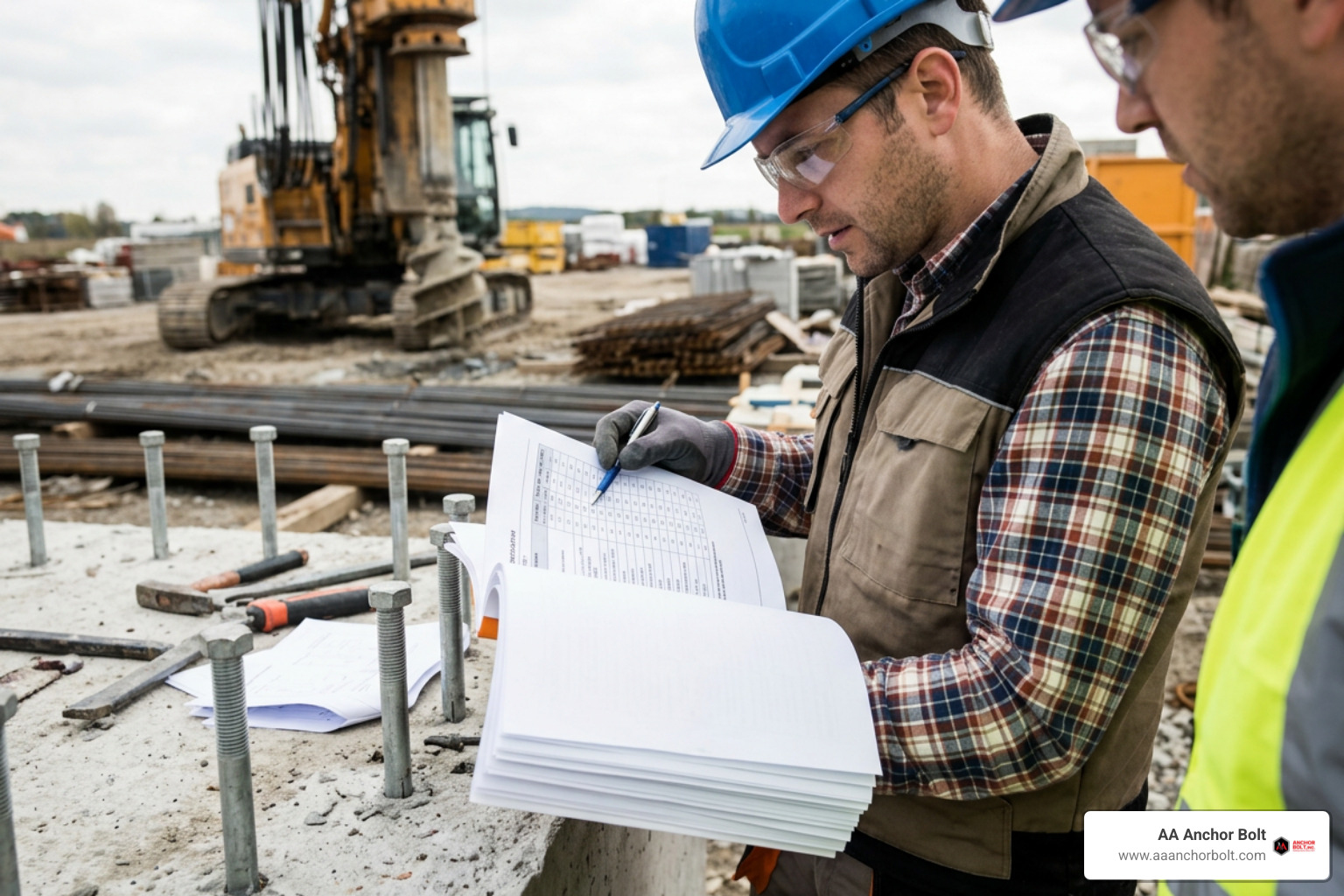
Obtaining fully compliant anchor bolt material certs starts long before steel arrives on site. It begins with the manufacturing facility’s internal quality control procedures.
Facility Registration and Quality Control Plan Submission
To supply state DOT projects, manufacturers must submit detailed plant information and a written Quality Control Plan to the state Central Construction and Materials Office. Once approved, the facility is placed on state enterprise tracking systems (such as the MAPLE database).
Every shipment originating from an approved fabricator must include an itemized identification list, invoice, or bill of lading detailing:
- Project design and contract numbers
- Exact physical dimensions (diameter, length, thread length)
- Specified material grade and heat numbers
- Full traceability back to the original steel melt source
Verification Sampling and Testing Protocols
Paperwork alone doesn’t guarantee structural acceptance; physical field samples validate what the MTR claims. Materials inspectors collect test samples at a minimum frequency of one sample per project per size.
When preparing anchor bolts for field sampling, remember the guidelines from How to Choose and Use Hot-Dipped Galvanized Anchor Bolts:
- Complete Assemblies: A sample set must include the anchor bolt, heavy hex nut, and hardened washer from the same heat lot.
- Destructive Tensile Testing: Lab technicians pull the bolt to destruction to verify yield strength, ultimate tensile strength, and elongation.
- Galvanizing & Fit Verification: Inspectors verify zinc coating thickness and check for over-tapping limits on nuts to ensure threads aren’t over-chased or weakened during galvanizing clean-up.
Avoiding Common Pitfalls in Fastener Documentation

A single paperwork error can cause project engineers to reject a shipment, creating unnecessary construction downtime. Avoiding documentation mistakes requires careful cross-checking before submittals go out.
How to Spot Non-Compliant Anchor Bolt Material Certs
By utilizing resources like Securing the Connection: A Roundup of the Best Anchor Bolt Catalogs, contractors can spot missing documentation elements early. Watch out for these common non-compliance red flags:
- Heat Number Mismatches: Paper MTR heat numbers that don’t match the physical tags on the bolt bundles.
- Missing Domestic Declarations: Certification packages lacking an explicit Buy America clause confirming domestic steel melt and fabrication.
- Unsigned MTR Copies: Submitting raw, uncertified mill test sheets that lack an authorized technical representative’s signature or fabricator review initials.
- Incorrect Swedge Geometry: Swedge anchor bolts with sharp V-grooves or improper indentation depth (must be 1/8 to 3/16 inch deep with a 1/4-inch minimum radius).
- Excessive Zinc Accumulation: Hot-dip galvanized threads that prevent full hand-engagement of nuts due to improper spinning or zinc pooling.
Frequently Asked Questions About Anchor Bolt Material Certs
What mandatory information must appear on an Iowa DOT anchor bolt MTR?
An anchor bolt MTR submitted for Iowa DOT projects must include chemical heat analysis, physical/mechanical test properties (yield, tensile, elongation), ASTM designation and grade (e.g., F1554 Grade 55), fabricator technical representative signature, fabricator verification initials, and an explicit Buy America domestic origin statement confirming US melt and manufacture.
How do high-strength fastener certs differ from standard anchor bolt certs?
High-strength structural fastener certs (IM 453.06B) require rotational capacity (ROCAP) test results, mandatory manufacturer listing on the MAPLE pre-approved system, and lot-size dependent verification sampling (up to 13 samples for large lots). Standard anchor bolt certs (IM 453.08) focus on ASTM F1554 grade compliance, Buy America traceability, and simple project/size verification sampling.
What visual marking and color-coding rules apply to ASTM F1554 anchor bolts?
Under state specifications like Iowa DOT IM 453.08, the embedded end of each ASTM F1554 anchor bolt must be color-coded to visually verify its grade on site: Blue for Grade 36, Yellow for Grade 55, and Red for Grade 105. Permanently stamped manufacturer marks and grade identifiers on the exposed end are also standard requirement under ASTM F1554.
Conclusion
Navigating the complexities of anchor bolt material certs doesn’t have to be a headache. Whether you are building highway sign trusses, bridge substructures, or heavy industrial facilities, having 100% compliant, fully traceable documentation is essential for keeping your project moving forward without costly inspector delays.
At AA Anchor Bolt, we take the guesswork out of fastener certification. Operating out of our Michigan facility with nearly a million pounds of in-house raw steel, we maintain complete domestic manufacturing control over our custom anchor bolts. Every shipment of our F1554 Anchor Bolts comes with fully verified, compliant MTRs, Buy America certifications, and complete heat traceability.
Need reliable, fast-turnaround anchor bolts with rock-solid certification packages for your next build? Contact AA Anchor Bolt today to request a quote and secure the strength your project deserves!