The Ultimate Guide to Buying Threaded Rod
Choose the Right Threaded Rod Before It Becomes a Jobsite Delay
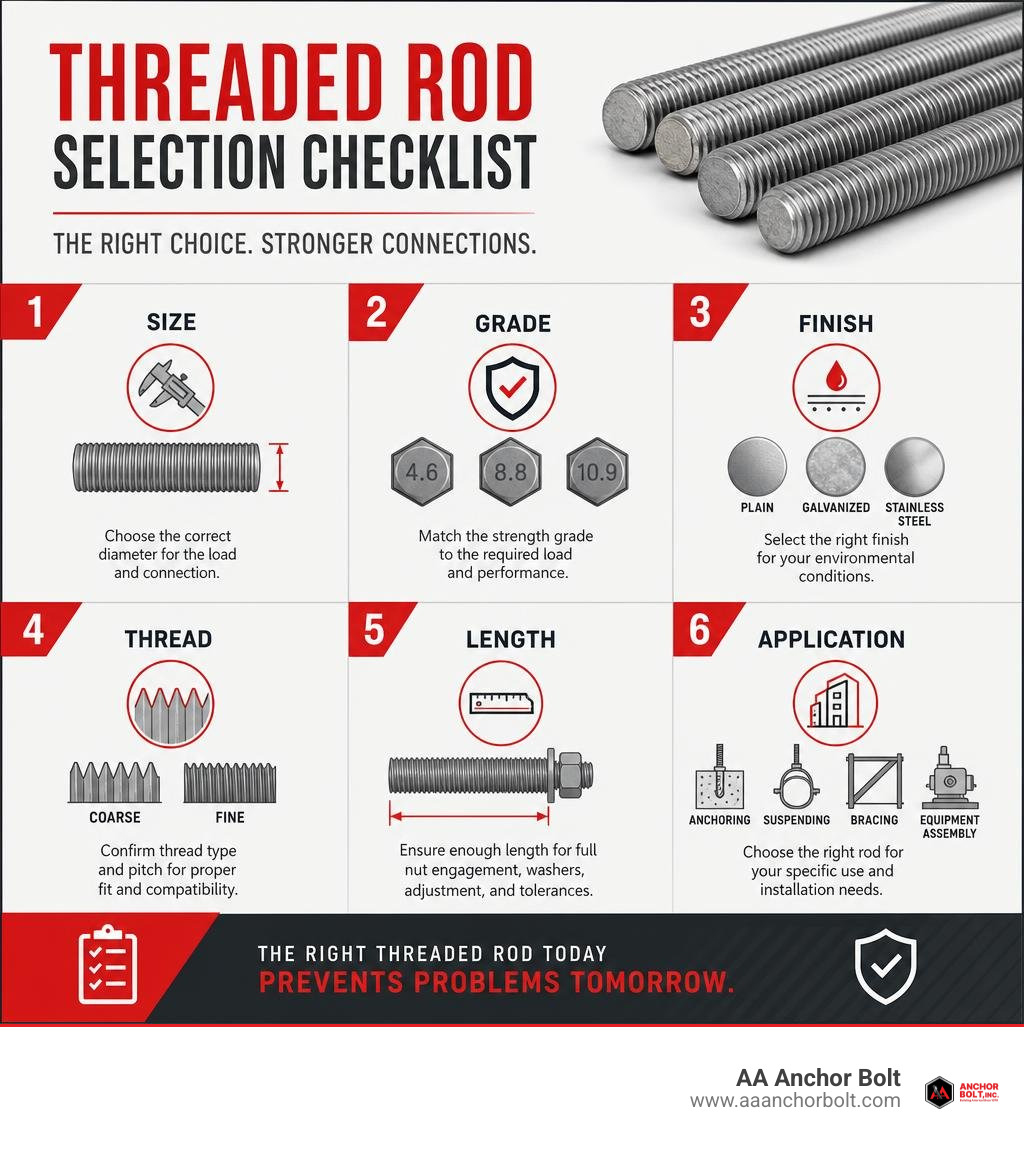
A threaded rod is a headless steel bar with threads along all or part of its length. Also called all-thread, all-thread rod, or a stud, it connects, supports, or anchors parts under tension. For a fast, reliable purchase, match the rod’s diameter, thread standard, strength class, finish, and length to the engineered connection and site conditions.
For infrastructure work, that usually means confirming:
- Load and required strength grade, such as 4.6, 8.8, or 10.9
- Corrosion exposure and whether plain, galvanized, or stainless steel is needed
- Thread compatibility with the specified nuts, couplers, and embedded hardware
- Enough length for full nut engagement, washers, adjustment, and installation tolerance
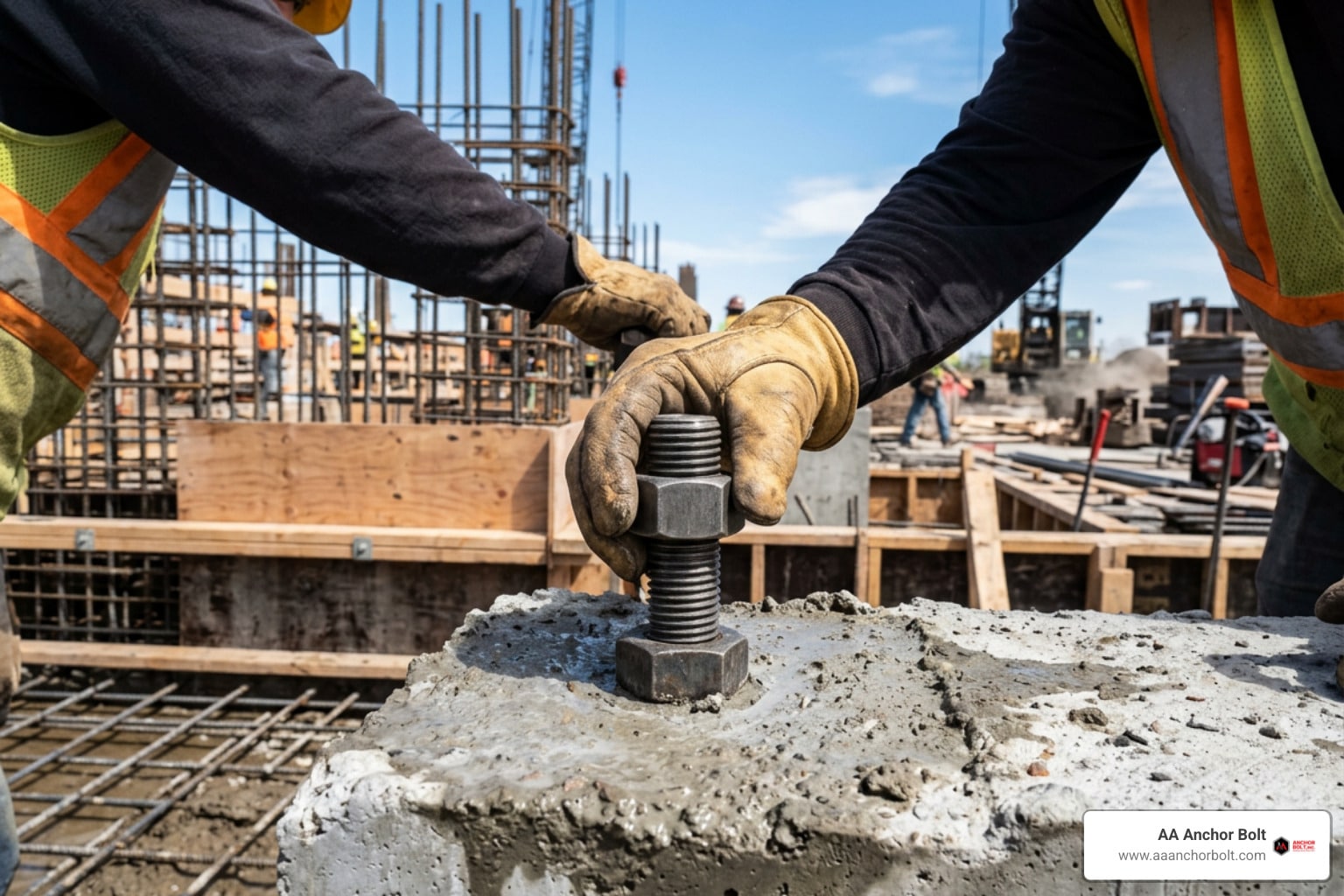
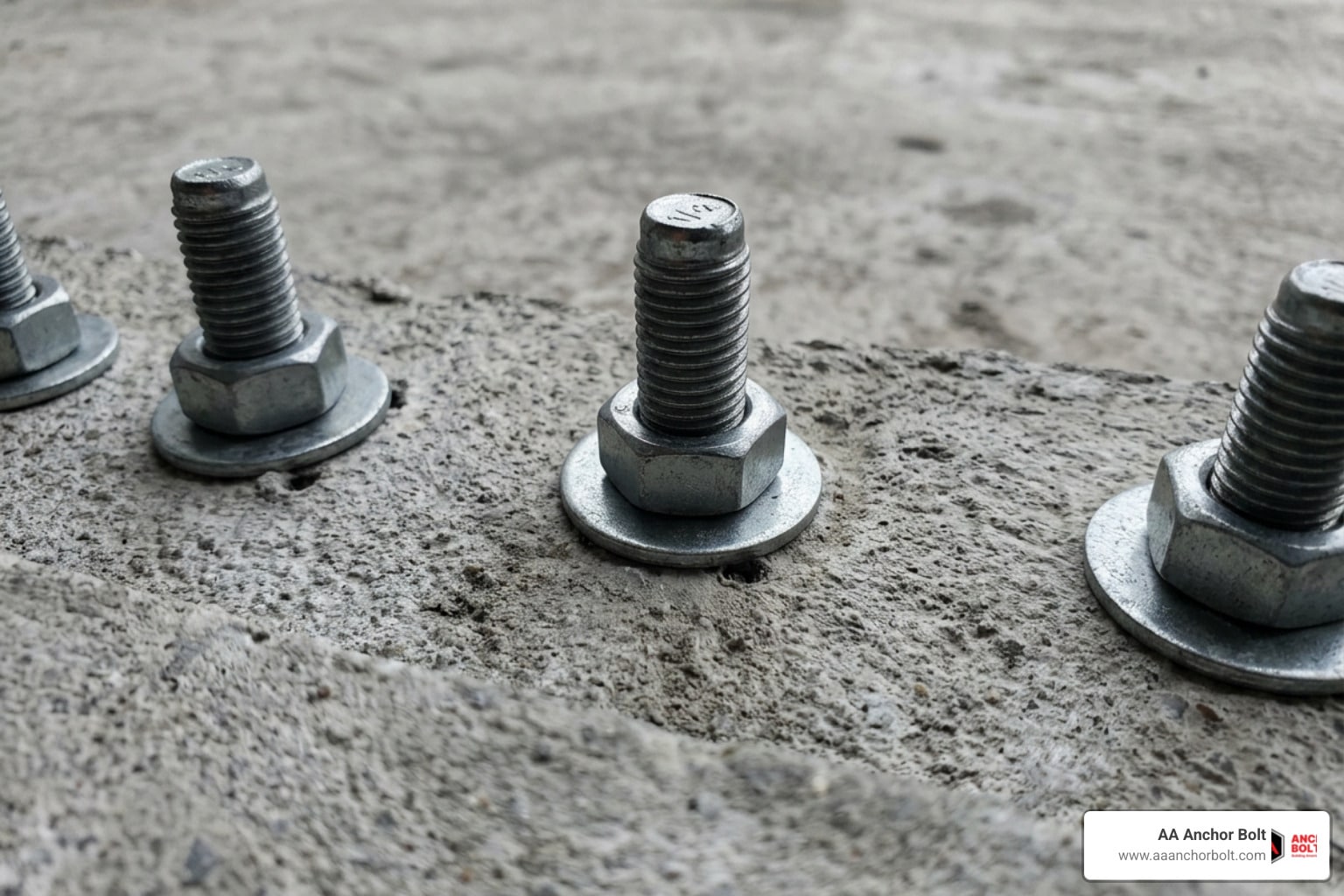
Threaded rod is a simple part with a big role. It can anchor steel to concrete, suspend pipe and HVAC systems, brace structural components, or assemble equipment and fixtures. The wrong material, pitch, or grade can create field-fit problems, rework, and schedule risk.
I am Pauline Horton, and this guide will help you specify and buy threaded rod with fewer surprises on the job.
What Is a Threaded Rod? Types, Profiles, and Configurations
At its simplest, a Threaded rod is a solid, cylindrical metal shaft that features continuous external helical ridges. Often called all-thread rod (ATR), continuously threaded rod, or simply stud bar, this fastener is engineered primarily for direct tension and clamping loads.
Unlike conventional hex bolts or cap screws, a threaded rod has no forged head. This headless design gives it immense versatility on the jobsite: you can thread a nut onto either end, torque it into a pre-tapped blind hole, or couple multiple bars together to span long structural distances. In everyday field operations, threaded rods serve two primary functions depending on their geometry:
- Fastening and Clamping: Securing structural joints, anchoring framework to concrete foundations, or hanging overhead utilities.
- Motion Transmission: Transforming rotational torque into precise linear movement (as seen in lead screws and specialized drive rods).
Threaded Rod Types and Stud Variations
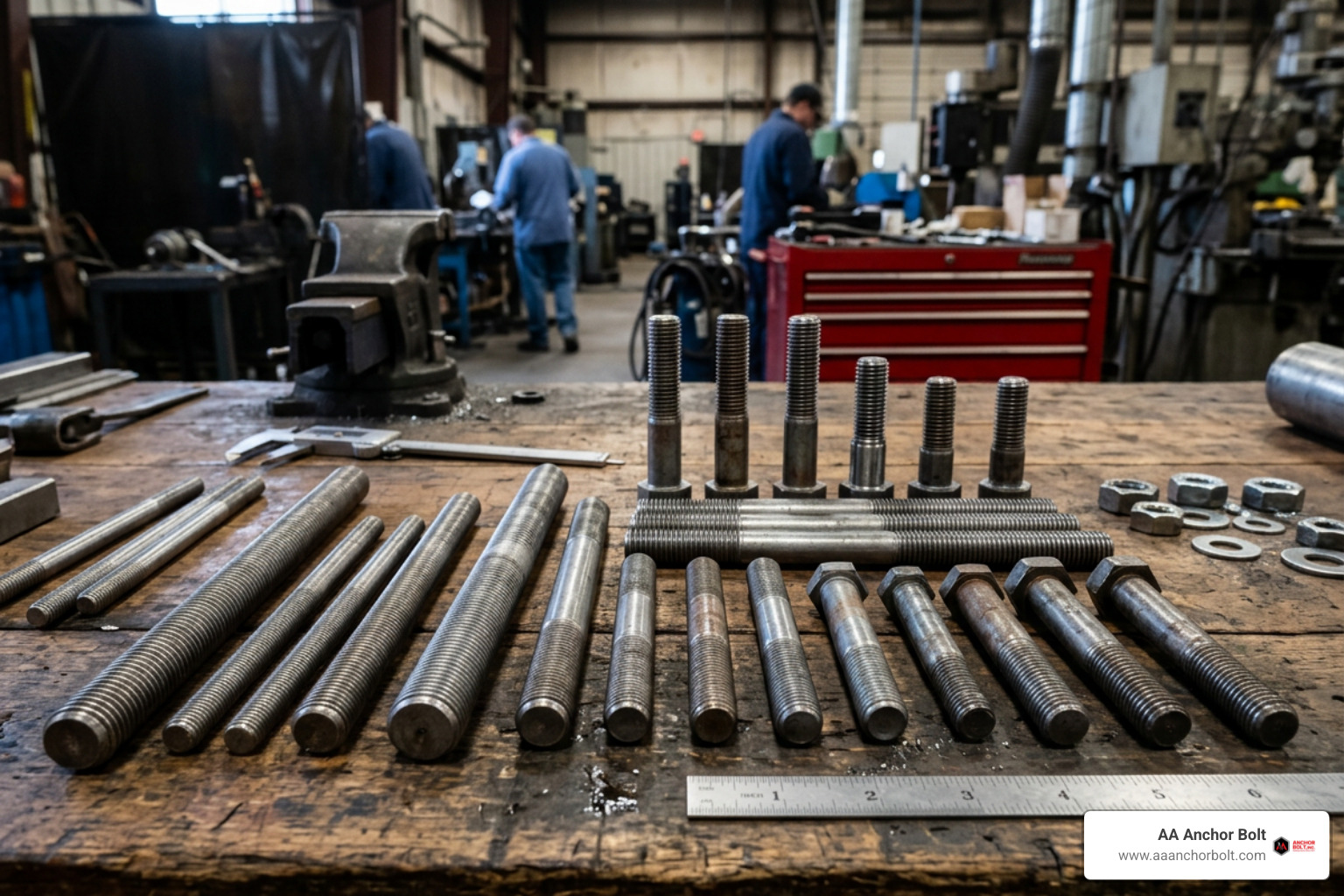
While a continuous bar of all-thread is the most recognized configuration, engineering specifications frequently require specialized stud variants:
- Fully Threaded Rods: Threaded continuously from tip to tip. These offer total adjustability and can be cut down to any custom length on-site.
- Double-End Studs: Threaded on both ends with a smooth, unthreaded shank in the middle. Both threaded ends typically have equal lengths designed to accept standard nuts.
- Tap-End Studs: Feature threads on both ends separated by a plain shank, but the “tap end” is intentionally shorter and designed to thread securely into a tapped blind hole, leaving the longer threaded end exposed for structural fastening.
- Flange Studs: Fully threaded studs engineered with specific chamfered ends, widely used in ASME pipe flange assemblies.
- Undercut (Reduced Shank) vs. Full-Bodied Studs: A full-bodied stud maintains a shank diameter equal to the major diameter of the thread (common in cut-thread manufacturing). An undercut or rolled stud features a shank diameter equal to the thread’s pitch diameter. This “waisted” profile distributes dynamic stress along the shank rather than concentrating fatigue in the thread roots.
When planning structural tiebacks or anchor arrays, selecting the right overall length and engagement depth is critical. For practical sizing considerations, see The Practical Sizing Guide for 12-Inch All Thread Rods to understand standard dimensioning practices.
Thread Profiles: Metric, Trapezoidal, and High Helix
Not all threads are shaped the same. The profile determines whether a rod locks firmly in place or drives motion smoothly:
- ISO Metric (DIN 13-1) and UNC/UNF (ANSI/ASME): Standard 60-degree triangular thread profiles used for structural fastening. The sharp flank angle creates substantial friction under torque, making standard metric and unified national coarse (UNC) threads inherently self-locking so assemblies do not vibrate loose. Metric diameters typically span from M3 up to M50+ with standard pitches between 0.5 mm and 1.5 mm on smaller sizes.
- Trapezoidal Threads (DIN 103 / ACME): Characterized by a 30-degree (metric) or 29-degree (ACME) trapezoidal flank angle. These robust profiles are engineered for heavy-duty power transmission, jack screws, and heavy clamping rigs. Standard trapezoidal rods range from 6 mm to 50 mm outer diameters with pitches between 1.5 mm and 8 mm.
- High-Helix (Steep) Threads: Specialized drive profiles such as dryspin® threaded rod designs feature steep thread pitches (from 2.4 mm up to 100 mm pitch on 4 mm to 20 mm diameters) and flat flank angles. These are not self-locking; they are designed specifically for high-speed linear motion, low wear, and whisper-quiet operation in mechanical automation.
Materials and Manufacturing: Rolled vs. Cut Threads
Selecting the right raw material and manufacturing method directly determines whether your connection withstands environmental corrosion and cyclic fatigue over decades.
Material Selection
- Mild Carbon Steel (e.g., C15, ASTM A36): Cost-effective and highly ductile, ideal for everyday indoor framing, hanging MEP racks, and light anchoring.
- Medium Carbon & Alloy Steels (e.g., 4140, Grade B7): Heat-treated steels that deliver the extreme yield and tensile strengths demanded by structural bridge joints, heavy equipment foundations, and pressure vessels.
- 304 (A2) Stainless Steel: The industry standard for general outdoor installations, wet manufacturing plants, and architectural framing, offering solid corrosion resistance.
- 316 (A4) Marine-Grade Stainless Steel: Formulated with molybdenum for exceptional resistance to chlorides, making it mandatory for coastal infrastructure, chemical plants, and wastewater facilities.
- Hot-Dip Galvanized Steel: Carbon steel coated in molten zinc for heavy-duty exterior corrosion protection in municipal and utility applications.
- Aluminum (EN AW 6082) & Brass: Specialized non-magnetic, lightweight, or spark-resistant materials used in electrical installations and custom machinery.
Rolled Threads vs. Cut Threads
How the external threads are produced on the bar stock fundamentally changes the mechanical performance of the finished fastener:
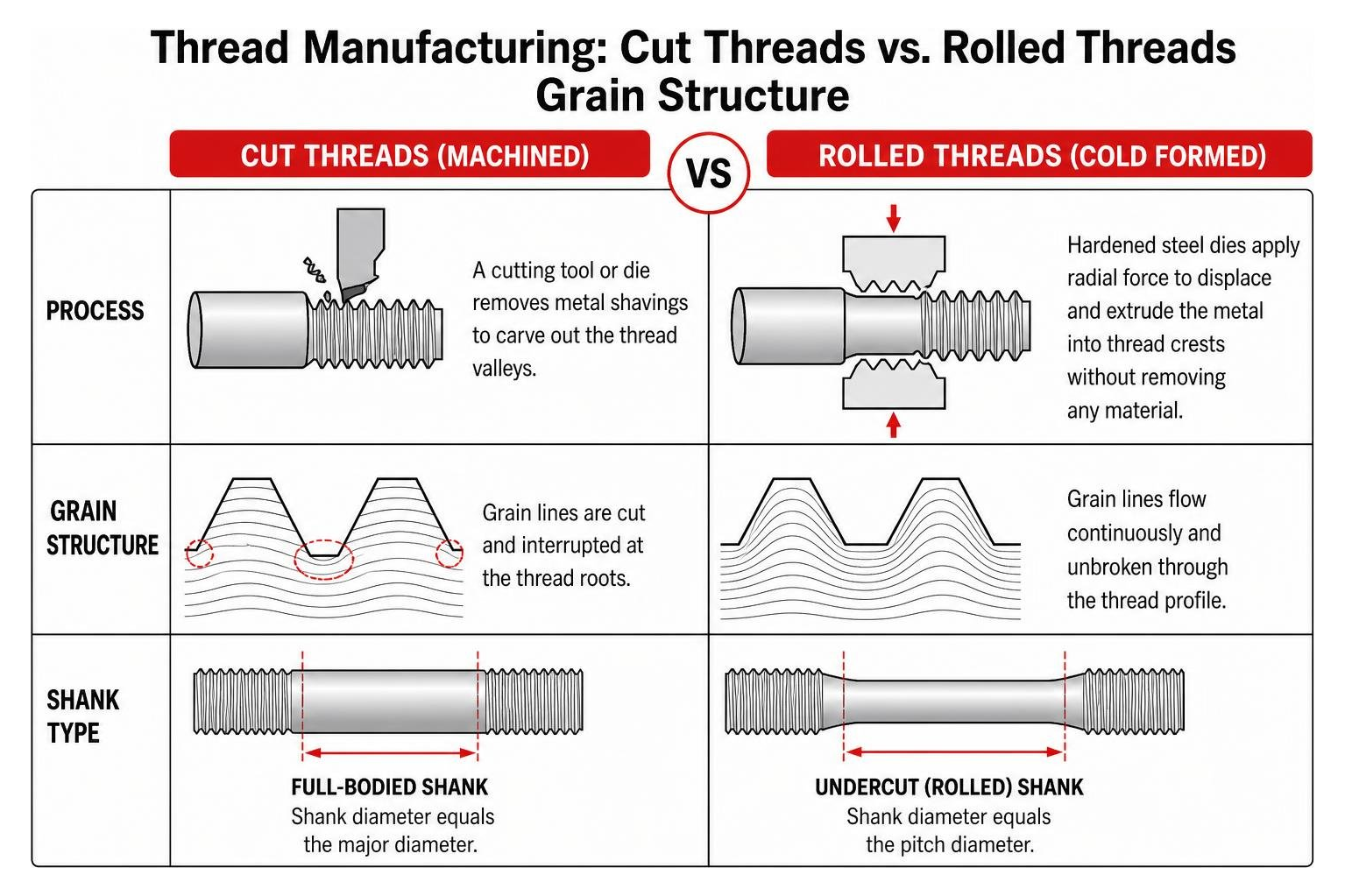
- Cut Threads (Machined): A cutting tool or die physically removes metal shavings to carve out the thread valleys. This process interrupts and severs the natural grain lines of the steel bar stock. Cut threads result in full-bodied shanks, but the cut root radius can introduce microscopic tool marks and stress concentrations that reduce fatigue life.
- Rolled Threads (Cold Formed): Hardened steel dies apply massive radial force to displace and extrude the metal into thread crests without removing any material. Cold rolling compresses the steel, burnishing the surface to a smooth finish and causing the grain flow lines to curve unbroken through the thread profile.
Understanding the mechanics of cold-forming equipment is vital for quality assurance; review our guide on Anchor Bolt Threading Machines and How They Work to see how precision rolling dies work under production loads.
| Feature | Rolled Threads | Cut (Machined) Threads |
|---|---|---|
| Grain Flow | Continuous, contoured along thread profile | Severed and interrupted by cutting tool |
| Tensile & Shear Strength | Higher (work-hardened by cold forming) | Baseline raw material strength |
| Surface Finish | Burnished, smooth, low friction | Machined finish, minor micro-abrasions |
| Fatigue Life | Significantly higher dynamic fatigue life | Lower resistance to cyclic stress |
| Production Speed | Extremely fast for high-volume runs | Slower, ideal for small custom jobs |
| Shank Geometry | Undercut (pitch diameter shank) | Full-bodied (major diameter shank) |
Strength Classes, Color Codes, and Engineering Calculations
Structural engineers must verify that a threaded rod can support calculated dead, live, and seismic loads without yielding.
Metric ISO Strength Classes
Metric threaded rods are classified under ISO standards using a two-number designation (e.g., 4.6, 8.8, 10.9):
- Class 4.6: Low-carbon steel. The first digit (4) indicates a nominal ultimate tensile strength ($Fu$) of $400\text{ N/mm}^2$ (or MPa). The second digit (.6) indicates that the yield strength ($Fy$) is 60% of the tensile strength: $400 \times 0.6 = 240\text{ N/mm}^2$.
- Class 8.8: Medium-carbon quenched and tempered steel. Tensile strength is $800\text{ N/mm}^2$, and yield strength is $800 \times 0.8 = 640\text{ N/mm}^2$.
- Class 10.9: High-strength alloy steel. Tensile strength reaches $1000\text{ N/mm}^2$, with a yield strength of $1000 \times 0.9 = 900\text{ N/mm}^2$.
Metric Rod Color-Coding System
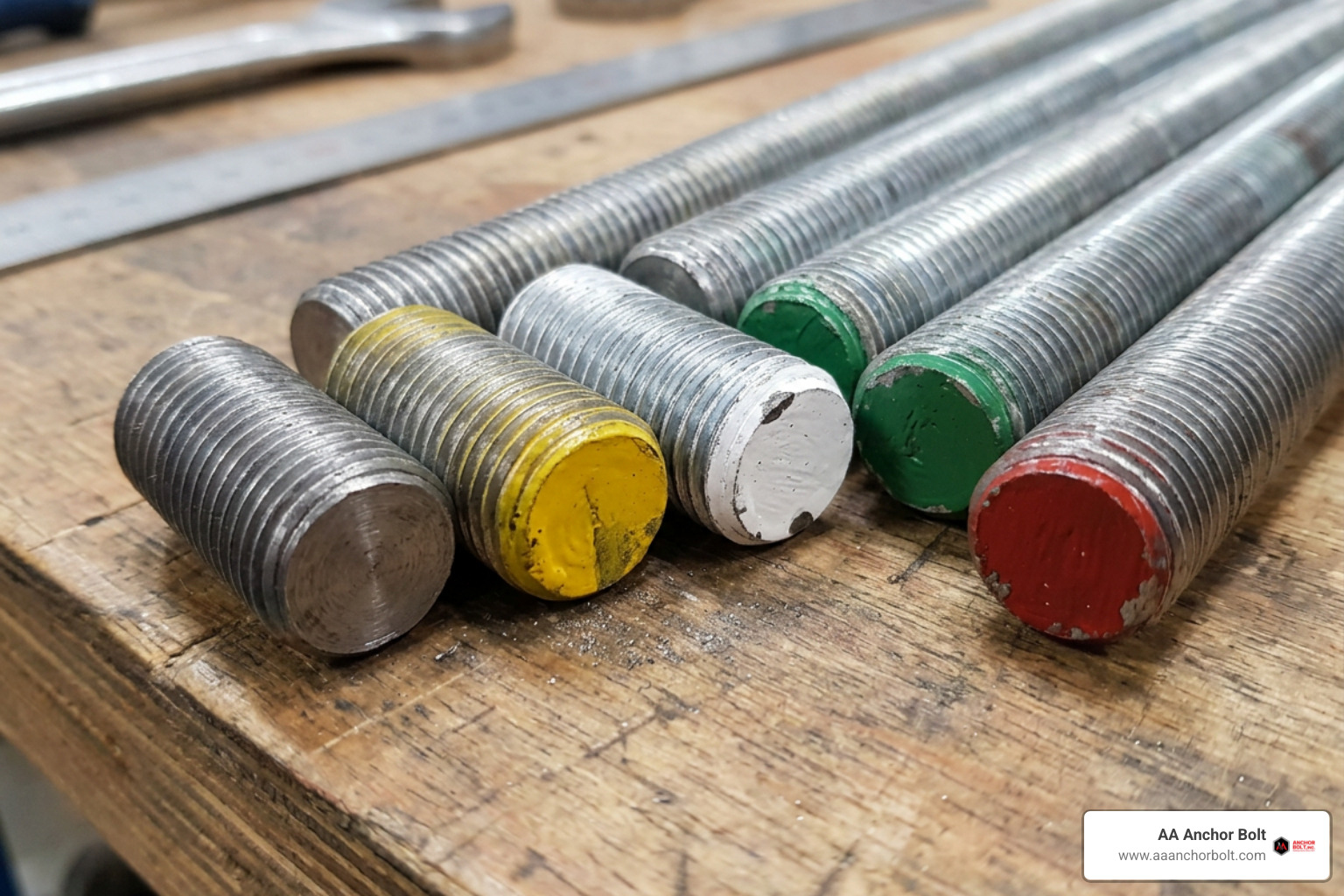
Because an installed, fully threaded rod has no bolt head stamped with grade markings, the industry uses standard color-coded paint on the cut rod ends to prevent dangerous jobsite mix-ups:
- Unmarked / Plain End: Standard Class 4.6 mild carbon steel
- Yellow: Class 8.8 high-strength steel
- White: Class 10.9 structural alloy steel
- Green: A2 (AISI 304) commercial stainless steel
- Red: A4 (AISI 316) marine-grade stainless steel
Allowable Tensile Capacity Calculations (AISC Standards)
To calculate the allowable tensile load ($P$) of a threaded connection under American Institute of Steel Construction (AISC) provisions, the formula depends on whether the rod is full-bodied or undercut:
1. Non-Undercut (Full-Bodied / Cut Thread) Rods
For standard threaded bars where the thread valleys represent the minimum cross-sectional area:
$$P = \frac{0.33 \cdot F_u \cdot \pi \cdot d^2}{4}$$
Where:
- $P$ = Allowable tensile force
- $F_u$ = Specified minimum ultimate tensile strength of the steel
- $d$ = Nominal outside (major) diameter of the rod
2. Undercut (Rolled Shank) Rods
For rods where the smooth unthreaded shank equals the pitch or root diameter:
$$P = \frac{0.60 \cdot Fy \cdot \pi \cdot ds^2}{4}$$
Where:
- $P$ = Allowable tensile force
- $F_y$ = Specified minimum yield strength of the steel
- $d_s$ = Measured diameter of the undercut shank
Primary Applications and Industry Best Practices
Threaded rods are the workhorses of commercial construction, heavy civil works, mechanical contracting, and industrial machinery.
Heavy Construction & Infrastructure
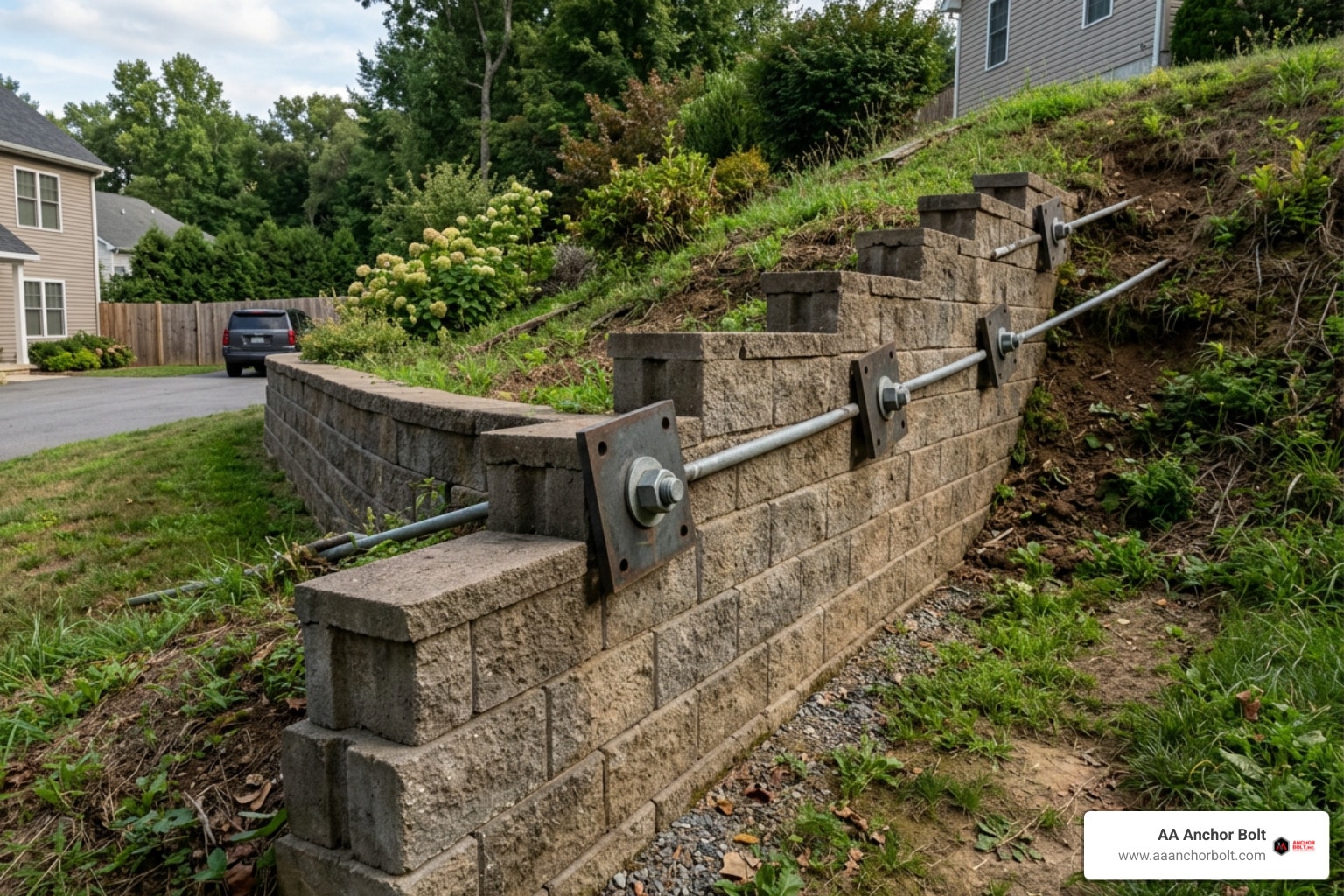
In concrete construction, long threaded rods serve as anchor foundations for structural steel columns, light poles, highway overhead signage, and bridge abutments. Civil engineering projects frequently combine threaded rods with modified reinforcing bars for deep foundation tiebacks. For an in-depth structural overview, explore The Civil Engineer’s Guide to Threaded Rebar and Infrastructure.
MEP & HVAC Mechanical Suspension
Mechanical and electrical trades use millions of feet of all-thread annually. Suspended from concrete ceilings using drop-in anchors or steel beam clamps, threaded rods support trapeze channel systems, cable trays, heavy fire-protection piping, and industrial HVAC ductwork.
Industrial Machinery & Precast Tensioning
In heavy machinery, double-end studs hold engine cylinder heads and pump casings securely against dynamic internal pressures. In precast concrete production, tensioned threaded bars pull structural forms tight to prevent blowouts during high-volume concrete pours.
Critical Selection Best Practices
- Thread Pitch Matching: Ensure mating nuts, couplers, and tapped holes match the rod’s exact standard (coarse UNC vs. fine UNF vs. ISO Metric). Coarse threads are preferred on construction jobsites because they assemble rapidly and resist damage from handling grit.
- Nut Engagement Rule: Always ensure the thread engagement length inside the nut equals at least 1.0 times the nominal diameter for steel-to-steel connections, and 1.5 times the diameter when threading into softer metals like aluminum or cast iron.
- Corrosion Compatibility: Never pair bare carbon steel nuts with stainless steel threaded rods in damp environments, as this triggers rapid galvanic corrosion. Match like-materials or isolate with non-conductive washers.
How to Select the Right Threaded Rod for Your Application
To choose the right threaded rod configuration for your project:
- Calculate Maximum Applied Loads: Determine the peak tension, shear, and cyclic dynamic fatigue the rod must endure. Match these loads against AISC allowable capacities using Class 4.6, 8.8, 10.9, or high-strength ASTM alloys.
- Evaluate the Operating Environment: For indoor dry spaces, plain carbon steel or zinc-plated steel is sufficient. For outdoor municipal installations, specify hot-dip galvanizing. For chemical, coastal, or submerged settings, demand 304 or 316 stainless steel.
- Determine Thread Direction: Right-hand threads are standard for 99% of construction fasteners. Left-hand threads are reserved for counter-rotational equipment, turnbuckle tensioners, and specialized safety fittings.
- Select Diameter and Length: Confirm the clearance hole sizes and account for washer thickness, nut height, building tolerances, and embedment depth.
- Verify Mill Test Certifications: For critical infrastructure, ensure your supplier provides full domestic traceability and certified material test reports (MTRs). For high-load rebar-to-steel adaptations, review our technical insights on Industrial Rebar Threading Solutions for Maximum Tensile Strength.
Frequently Asked Questions about Threaded Rods
What is the difference between an all-thread rod and a stud bolt?
An all-thread rod is a continuously threaded, headless bar typically sold in standard bulk lengths (such as 3-foot, 6-foot, 10-foot, or 12-foot bars) that can be field-cut to length. A stud bolt is a precision-cut fastener manufactured for a specific engineering joint—such as a double-end stud for engine heads or an ASME B16.5 flange stud with chamfered ends designed specifically for piping systems.
How do I identify the strength grade of a metric threaded rod?
Look at the end face of the rod. Metric fasteners use the standardized ISO color-dip system:
- Plain / Unpainted: Class 4.6 mild steel ($400\text{ MPa}$ tensile)
- Yellow: Class 8.8 high-strength steel ($800\text{ MPa}$ tensile)
- White: Class 10.9 structural alloy steel ($1000\text{ MPa}$ tensile)
- Green: A2 (304) stainless steel
- Red: A4 (316) marine stainless steel
When should rolled threads be specified over cut threads?
Rolled threads should always be specified for fatigue-critical, cyclic-load, or high-vibration applications such as bridge supports, structural tension rods, and heavy rotating machinery. The cold-rolling process burnishes the thread root, prevents micro-cracks, and maintains continuous internal steel grain alignment, delivering substantially higher dynamic fatigue resistance than cut threads.
Conclusion
Choosing the correct threaded rod is the foundation of structural safety, mechanical reliability, and jobsite efficiency. From selecting between rolled and cut threads to calculating AISC tensile capacities and verifying ISO strength color codes, matching your fastener specs to real-world engineering loads prevents costly project delays and structural failures.
At AA Anchor Bolt, we manufacture custom anchor bolts, continuously threaded rods, and specialty structural fasteners right here in Michigan. With nearly a million pounds of prime domestic steel in stock, in-house roll-threading machinery, and full manufacturing control, we deliver the fast turnarounds and certified quality your infrastructure projects demand. Explore our comprehensive catalog of custom threaded rod and anchor bolt products or contact our engineering support team today to quote your next job.