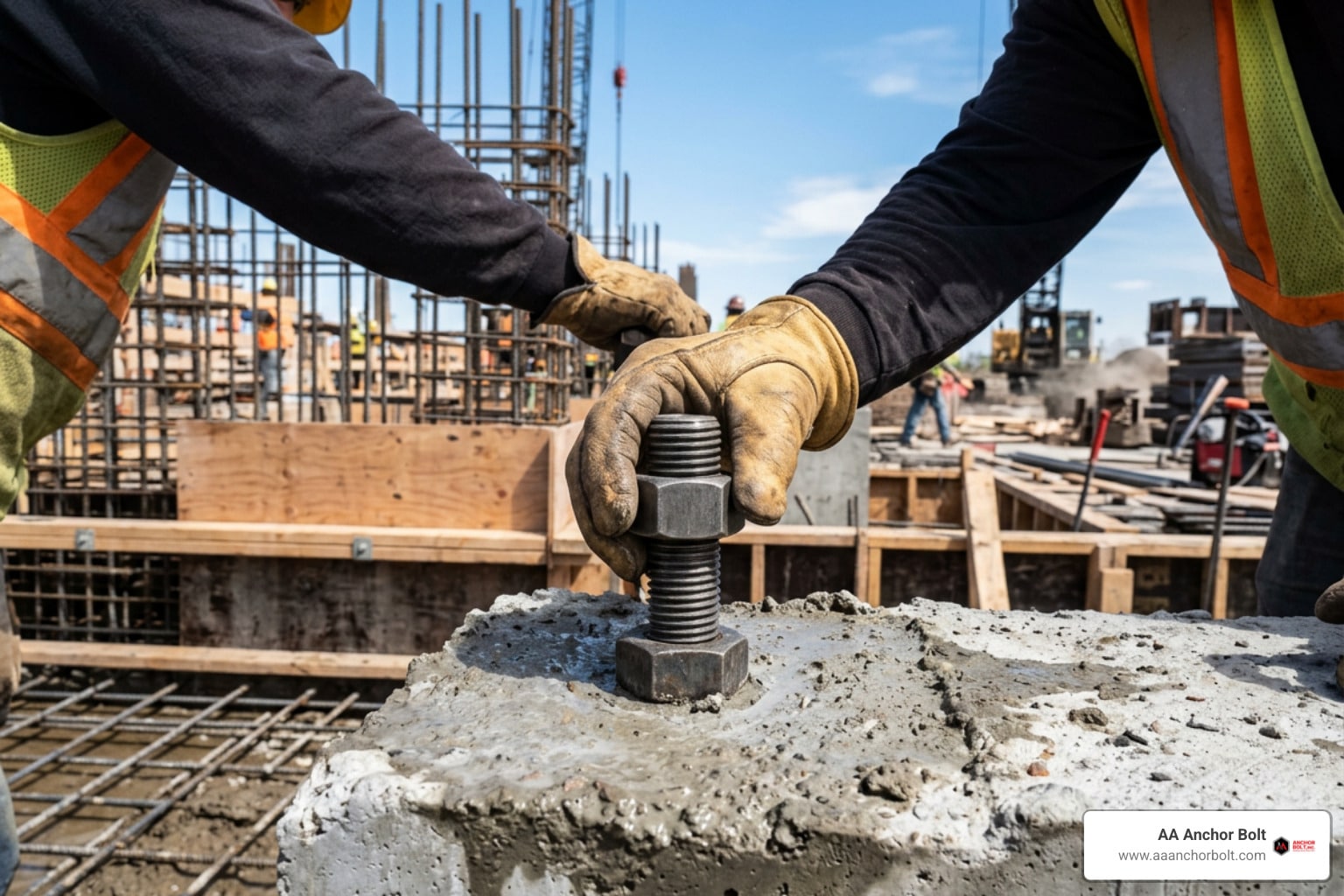
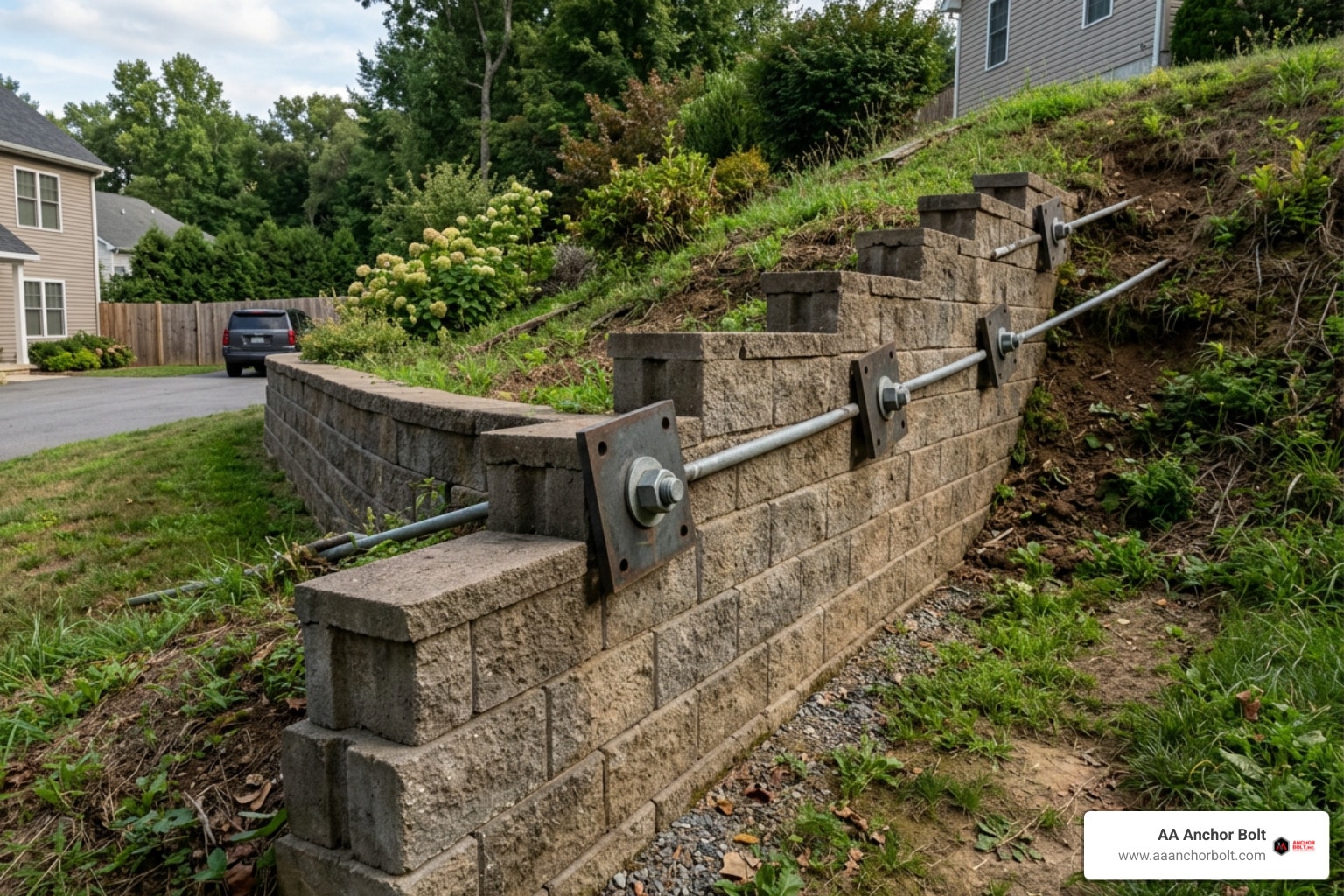
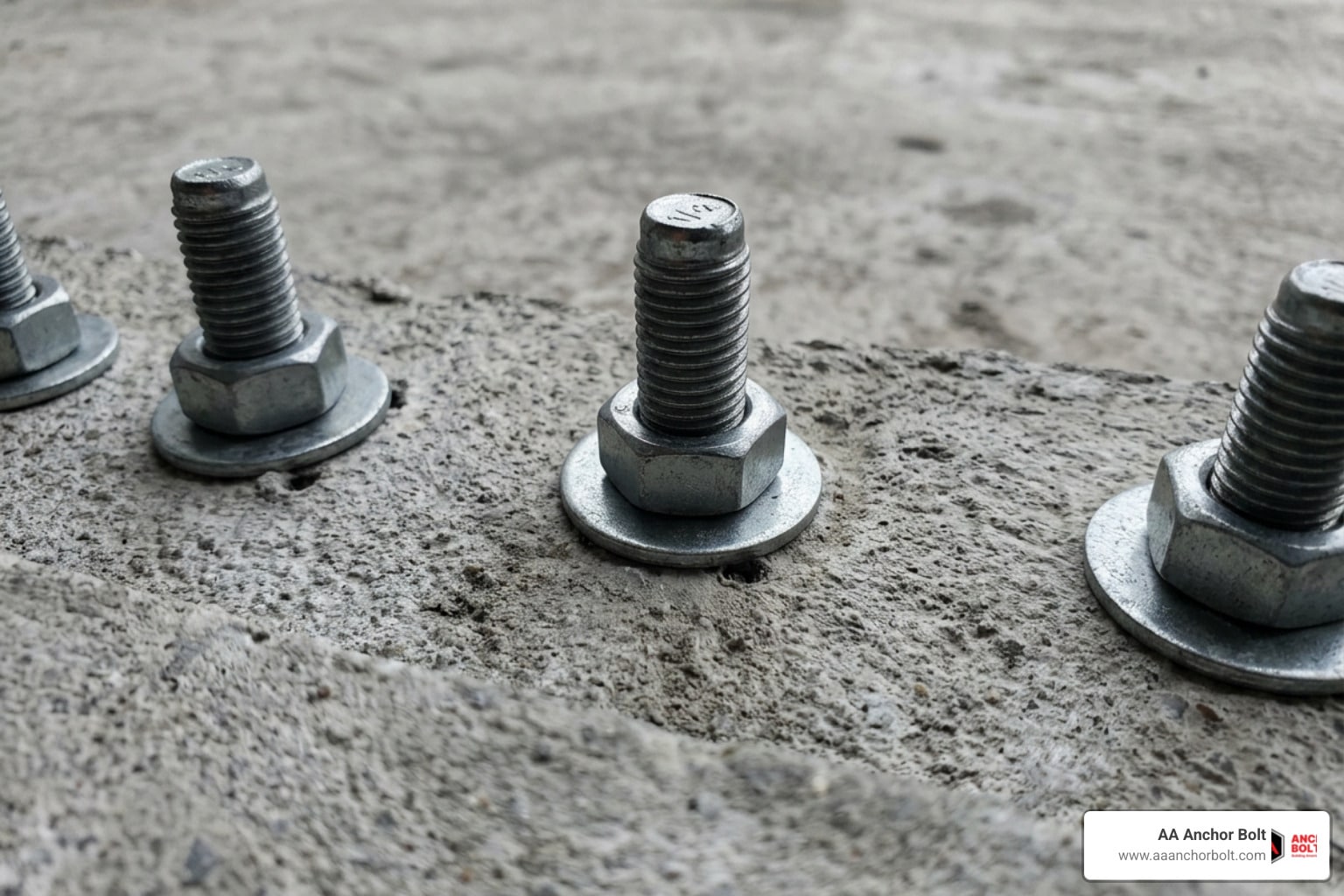
How to Choose and Install Concrete Screw Anchors Fast
Understanding Concrete Screw Anchors and Material Compatibility
To choose and install concrete screw anchors quickly and safely, match the fastener diameter and length to your substrate density (solid concrete, hollow CMU, or brick) and load demands. Fast installation requires three steps: drill an ANSI-spec pilot hole 1/4″ to 1/2″ deeper than embedment depth, thoroughly evacuate all dust using a blow-brush-blow method, and drive the screw at steady speed without over-torquing.
Concrete screw anchors use hardened, serrated threads to tap directly into pilot hole sidewalls, creating a strong mechanical interlock without continuous outward expansion stress. This non-expanding design allows you to install fasteners closer to edges and adjacent anchors without splitting the masonry.
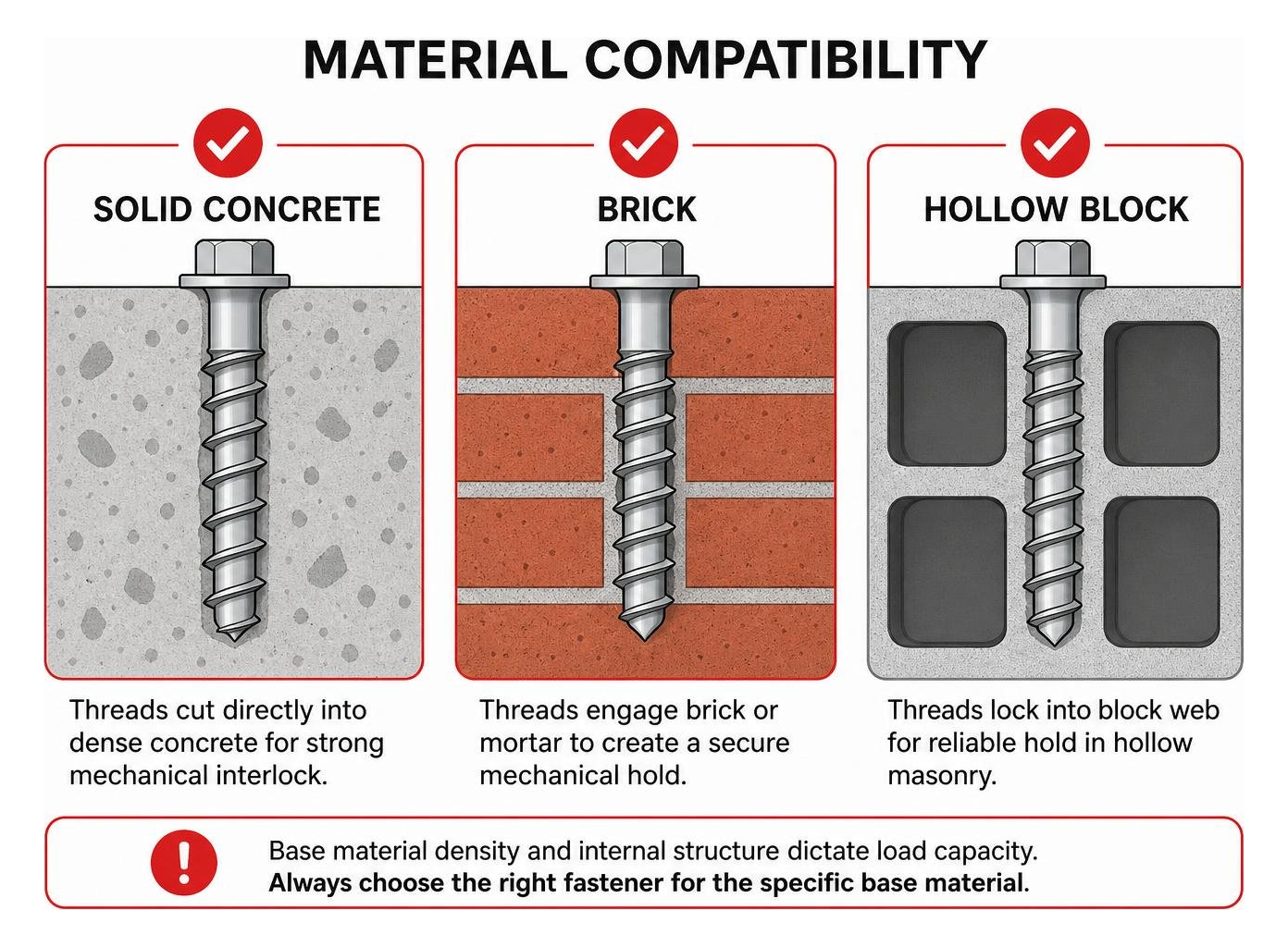
Whether you are anchoring into high-strength poured slabs or older masonry walls, choosing the right fastener for the specific base material is critical. If your project involves hollow masonry units, take the time to lock down your next project with the right concrete block bolts to ensure long-term structural integrity.
Solid Concrete vs Masonry Substrates
Base materials behave differently under mechanical cutting:
- Solid Poured Concrete: The ideal substrate for screw anchors. Standard structural slabs typically test between 3,000 and 4,000 PSI compressive strength. In dense concrete, the hardened threads bite deeply into the cured paste and aggregate, providing maximum resistance to both tension and shear loads.
- Hollow CMU (Concrete Masonry Units): Concrete blocks have thinner face shells, usually between 1 inch and 1-3/8 inches thick. When driving a concrete screw into hollow CMU, thread engagement is limited to the thickness of that outer wall. You must ensure the fastener does not strip out once it breaks through into the hollow core.
- Brick Masonry: Solid clay brick provides solid holding power, but older structural brick can be brittle. Avoid setting screw anchors into mortar joints. Mortar is softer, deteriorates faster over time, and lacks the compressive strength required to maintain thread interlock. Fasten directly into the brick face whenever possible.
Common Applications and Duty Ratings
Concrete screws are engineered primarily for light- to medium-duty applications where rapid installation and clean finishes are paramount. Some of the most reliable jobsite uses include:
- Electrical Installations: Securing conduit clips, junction boxes, cable trays, and strut channels to commercial tilt-up walls or ceilings.
- Architectural Fixtures: Mounting exterior window shutters, decorative trim, metal flashing, and address plaques onto brick or concrete facades.
- Light-Duty Framing: Fastening wood furring strips, metal stud tracks, and bottom sill plates to slab foundations.
- Safety Hardware: Setting light-duty handrails, safety signage, and lightweight protective brackets along concrete stairwells or ramps.
Concrete Anchor Load Capacities and Performance Engineering
To design a safe connection, you must evaluate the direction and magnitude of the structural forces acting on the joint. Fastener loading breaks down into two distinct forces:
- Tension (Pullout): The force trying to pull the anchor straight out along its longitudinal axis.
- Shear: The lateral force acting perpendicular to the fastener shank, trying to slice through the steel.
In solid concrete, load capacity depends heavily on anchor diameter, embedment depth, and concrete compressive strength. In standard 4,000 PSI concrete, standard screw anchors deliver ultimate tension values between 620 and 2,260 pounds and ultimate shear values between 680 and 1,590 pounds, depending on the screw size and embedment.
Structural engineers and safety standards require applying a 4:1 safety factor. This means your calculated safe working load must not exceed 25% of the ultimate load capacity. If an anchor tests at an ultimate tension limit of 2,000 pounds in 4,000 PSI concrete, your maximum working load should never exceed 500 pounds under static conditions.
Typical Load Capacities for Concrete Screw Anchors
The table below outlines typical ultimate tension and shear performance metrics across standard masonry anchor classes in solid 4,000 PSI concrete:
| Anchor Type | Base Material Compatibility | Example Ultimate Tension (lbs) | Example Ultimate Shear (lbs) | Duty Rating Category |
|---|---|---|---|---|
| Concrete Screws | Concrete, CMU Block, Brick | 620 – 2,260 | 680 – 1,590 | Light to Medium |
| Nail-Drive Anchors | Solid Concrete, Brick, Block | 590 – 1,200 | 380 – 1,160 | Light Duty |
| Lag Shields | Solid Concrete, Mortar, Brick | 300 – 2,865 | 970 – 2,000 | Light to Medium |
| Sleeve Anchors | Solid Concrete, CMU, Brick | 1,300 – 8,460 | 1,150 – 10,040 | Medium Duty |
| Drop-In Anchors | Solid Concrete Only | 2,240 – 9,000 | 1,000 – 9,960 | Medium to Heavy |
| Wedge Anchors | Solid Concrete Only | 1,690 – 25,210 | 1,330 – 36,040 | Heavy Duty |
| Large Screw Anchor Bolts | Solid Concrete, Grout-Filled CMU | 2,650 – 7,040 | 2,890 – 11,400 | Heavy Duty |
Note: Data reflects typical test benchmarks. Always apply the 25% safe working load rule for permanent structural installations.
Concrete Screw Anchors vs Other Masonry Fasteners
How do screw anchors stack up against alternative masonry fasteners?
- Concrete Screws vs Wedge Anchors: Wedge anchors deliver massive load resistance (up to 25,000+ lbs ultimate tension in large diameters), making them the industry standard for structural columns and industrial machinery. However, wedge anchors require solid concrete, generate intense expansion pressure near edges, and cannot be cleanly removed. Screw anchors install faster and remove cleanly without leaving protruding studs.
- Concrete Screws vs Sleeve Anchors: Sleeve anchors work well in softer brick or hollow block because the expanding sleeve bridges internal voids. However, concrete screws install significantly faster and create a tighter, more direct mechanical interlock in solid substrates.
- Concrete Screws vs Drop-In Anchors: Drop-in anchors are female threaded inserts set flush into solid concrete using a dedicated setting tool—making them ideal for overhead pipe hangers and threaded rod drops. Screw anchors are single-piece systems driven directly through the fixture into the slab.
- Concrete Screws vs Large-Diameter Concrete Anchor Bolts: Heavy construction often requires massive anchor bolts. When projects demand structural capacity beyond standard light-duty screws, you can consult the concrete fastener guide for heavy-duty anchoring to match bolt diameters with dynamic engineering requirements.
Fast Installation and Best Practices for Reliable Anchoring
The single biggest reason concrete screws fail is improper hole preparation. Because self-tapping threads cut directly into the base material, the pilot hole geometry must be exact.
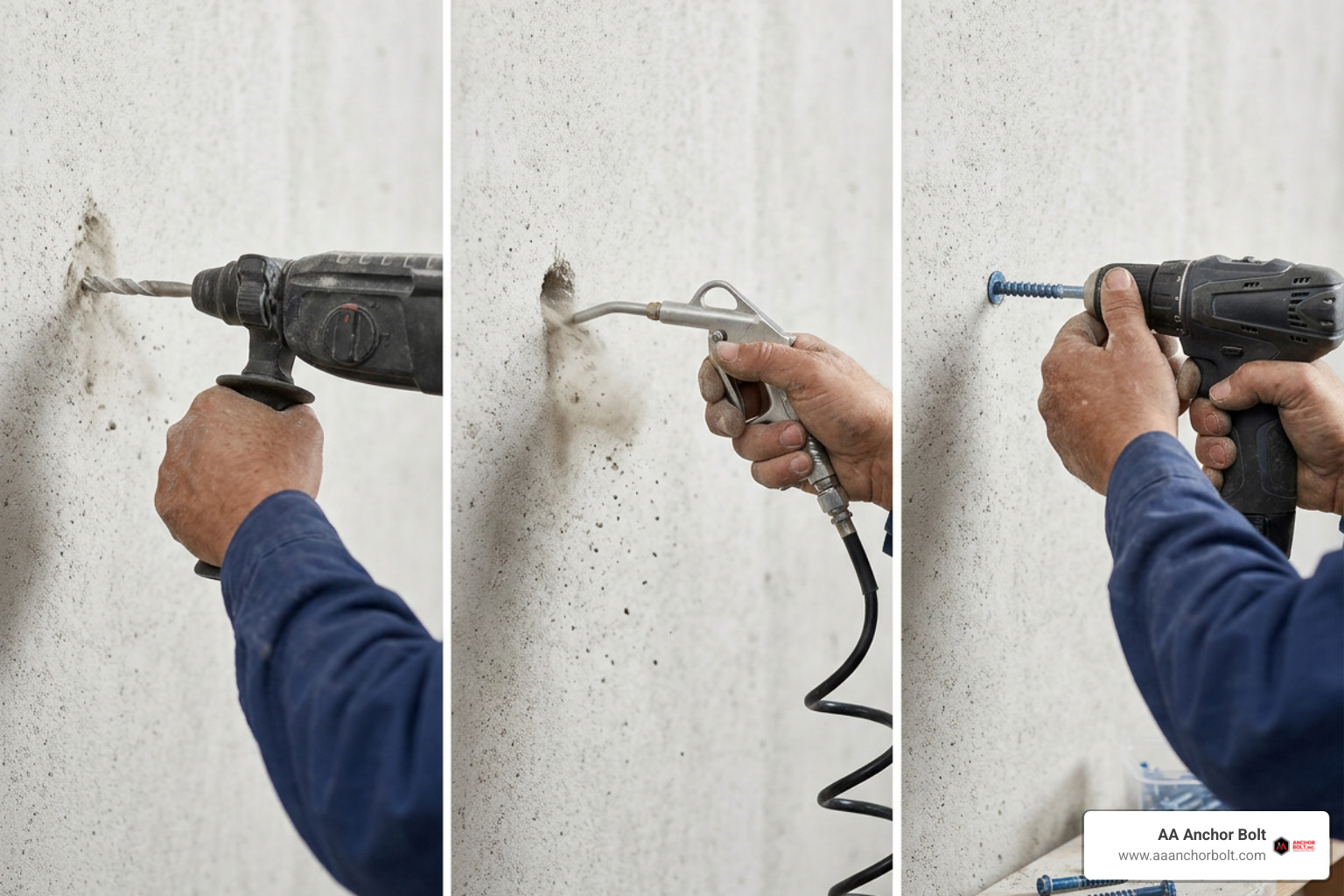
Follow these critical steps on every installation:
- Use an ANSI-Spec Carbide Bit: Concrete screws require an exact pilot hole diameter. Always use a carbide-tipped masonry bit that matches the screw manufacturer’s ANSI specifications. A bit that is worn down will drill an undersized hole, causing the screw to bind and snap. An oversized bit will prevent the threads from engaging deeply enough to carry the design load.
- Drill Past the Embedment Depth: Drill the hole at least 1/4 inch to 1/2 inch deeper than the intended anchor embedment. As the screw cuts into the concrete, it pushes fine dust ahead of its tip. If the hole is drilled to the exact embedment depth, that compressed debris will bottom out the screw before the head seats against the fixture.
- Evacuate the Dust: Thoroughly clean out the drilled hole. Use compressed air, a manual blow-out bulb, or a HEPA vacuum paired with a wire brush. Residual concrete dust packs into the newly cut channels, dramatically increasing torque resistance and leading to head shearing.
- Mind Your Corrosion Protection: For exterior, coastal, or high-moisture environments, standard zinc plating will not prevent rust. Upgrading to specialized coatings or stainless steel ensures the fastener won’t degrade. When extreme outdoor exposure is a concern, learn how to choose and use hot dipped galvanized anchor bolts and corrosion-resistant fasteners to safeguard your structure.
Pilot Hole Preparation and Dust Removal
Taking shortcuts during hole cleaning is the most common cause of stripped threads and broken screw heads. When you drill into concrete, the pulverized aggregate creates fine, abrasive powder. If left inside the hole, this powder packs tightly around the leading threads, turning a smooth driving action into an over-torqued failure.
For structural installations, use the blow-brush-blow technique:
- Blow out the loose debris with compressed air or a hand pump.
- Run a nylon or wire masonry brush down the full depth of the hole to dislodge dust caked to the sidewalls.
- Blow out the hole a second time to leave clean concrete ready for thread tapping.
Proper Fastening Techniques and Head Styles
Selecting the correct head style ensures your installation looks clean and functions as intended:
- Hex Washer Head: Features an integrated flange that distributes clamping force evenly across the surface of the fixture. Ideal for securing metal brackets, electrical strut channels, wood framing, and conduit straps where the head can remain exposed.
- Flat Countersunk Head: Designed with a tapered underside that seats flush with the surface of wood fixtures, sill plates, or pre-countersunk metal brackets.
When driving the screw, use an impact driver or torque-controlled drill. Drive the fastener at a steady, moderate speed until the head sits firmly against the fixture. Avoid over-torquing. Once the head makes contact, stop driving immediately. Over-spinning the fastener will ream out the concrete threads you just cut, destroying the mechanical interlock and leaving you with a spinning anchor that has zero holding capacity.
Frequently Asked Questions About Concrete Fasteners
How do self-tapping concrete screws generate holding power?
Self-tapping concrete screws feature dual-lead or serrated hardened threads that mechanically cut corresponding grooves into the masonry as they are driven into a pilot hole. This creates an interlocking steel-to-concrete connection along the entire embedded length of the shank, distributing load without exerting radial expansion forces against the surrounding concrete.
What is the safe working load calculation for concrete anchors?
The safe working load (SWL) for concrete fasteners is calculated by dividing the manufacturer’s ultimate load capacity by an established safety factor, typically 4:1. This means the safe working load should not exceed 25% of the ultimate tension or shear rating:
$$\text{Safe Working Load} = \frac{\text{Ultimate Load Capacity}}{4} \quad (25\%)$$
For example, an anchor with an ultimate shear rating of 1,600 lbs has a recommended safe working load limit of 400 lbs under static conditions.
Can concrete screws be removed and reused in the same pilot hole?
While concrete screws can be easily backed out and removed—making them ideal for temporary bracing or formwork—we do not recommend reusing the same screw in the same pilot hole for permanent, load-bearing applications. Removing the screw wears down its hardened cutting threads, and re-inserting it can strip the concrete channels previously cut into the hole walls, significantly reducing holding power.
Conclusion
Getting concrete anchoring right comes down to matching your base material, calculating both tension and shear demands, and executing clean pilot hole preparation. Concrete screw anchors provide unmatched installation speed, minimal edge-distance limitations, and clean holding power for a wide range of light- and medium-duty projects.
When your commercial framing or infrastructure project calls for heavy-duty structural anchoring that standard masonry screws cannot support, hold on tight with these heavy-duty 8-inch concrete screw anchors to keep your build secure. At AA Anchor Bolt, we manufacture custom anchor bolts and specialty fasteners right here in Michigan, maintaining nearly a million pounds of domestic steel inventory to deliver the rapid turnaround your jobsite demands.